
The morning is free and the problem has been getting in the way for days. The plan forming in your head is a simple one: find a door, walk through it, sit down and wait your turn. It is how a pharmacy works, and for a sprained ankle it is how parts of the NHS work, so it is natural to look for the same thing from a private doctor.
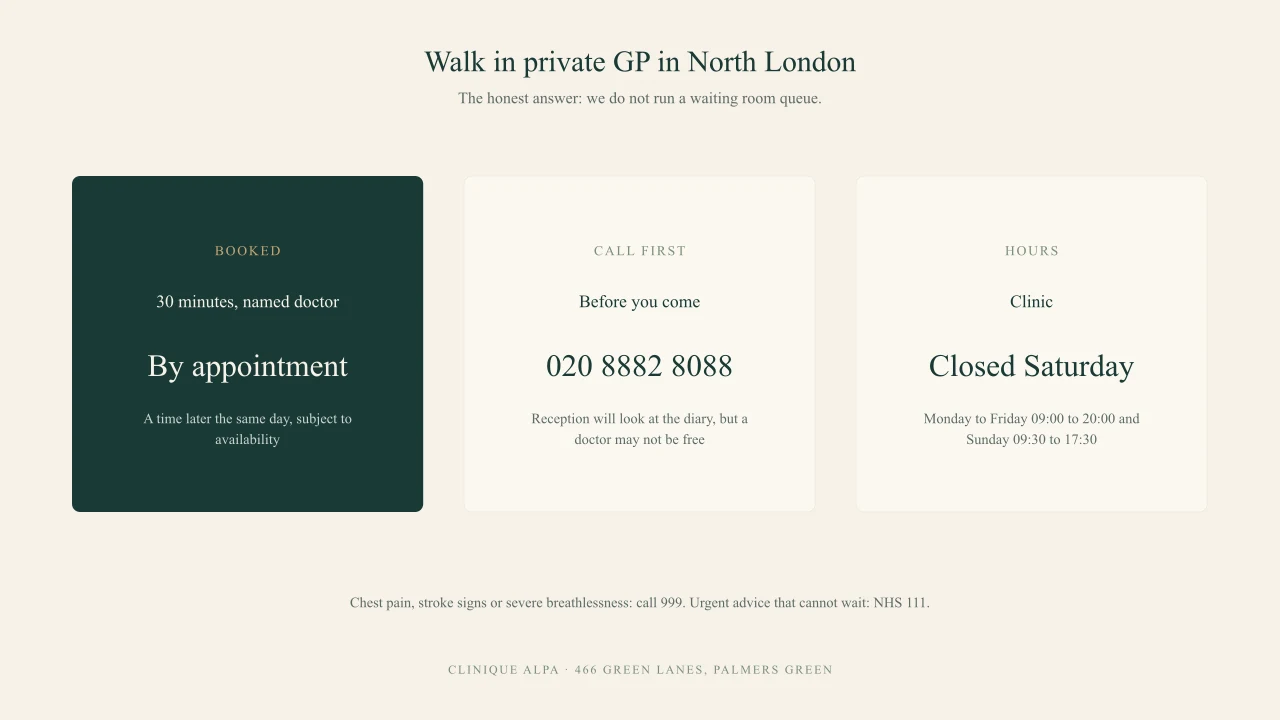
If you are searching for a walk in private GP near Palmers Green, the honest answer about Clinique Alpa is that we do not run a waiting room queue. Every consultation here is a booked 30 minutes with a named doctor. What I can offer in its place is often close to what you were hoping for: a time later the same day, subject to availability, settled in a call that takes 2 minutes.
Chest pain, signs of a stroke, severe breathlessness, heavy bleeding, a severe allergic reaction or symptoms of sepsis need 999 or A&E immediately. For urgent advice that cannot wait, call NHS 111.
Is there a walk in private GP in North London?
I can only speak for this clinic. At 466 Green Lanes we see patients by appointment. The diary is live, so the booking page shows exactly which times are open, and when the day is full it shows the next free time and not a promise we cannot keep.
The reason is practical. A consultation here lasts 30 minutes. If a doctor is giving one person the whole of that time, there is nobody free for the person who has just come through the door, and a queue would mean either cutting the first person short or leaving the second one waiting with no idea for how long. I would sooner tell you a time and keep to it.
So if you arrive without a booking, reception will look at the diary with you, but I cannot promise a doctor will be free. Calling first on 020 8882 8088 saves you the trip. The clinic is open Monday to Friday 09:00 to 20:00 and Sunday 09:30 to 17:30, and is closed on Saturday.
What does a booked appointment give you that a queue does not?
Time, mostly. That time is the point.
The problems people hope to walk in with are familiar ones. A cough, a sore throat, sinus or urinary symptoms that will not wait quietly. A rash, a bite or a patch of skin that has flared. A child who is off colour. Stress or low mood that has reached the stage of needing a proper conversation. A set of results nobody has explained. Each of these can be dealt with quickly, and each can also turn out to be the visible part of something else.
What I look at in clinic starts with your account, in your own words. I try not to interrupt for the first few minutes, because the order in which someone tells a story carries information. Then I fill in the shape: when it started, whether it is better or worse than 2 days ago, what you have tried, what you take regularly and what you are worried it might be.
The examination follows the question. Temperature, pulse and blood pressure almost always. A chest listened to, an ear or a throat looked into, an abdomen felt, a rash seen under good light. When an intimate or physical examination is needed, a chaperone is available.
While the obvious thing is being addressed, I am quietly checking for the less obvious one. This is where a fast, in and out visit tends to fall short. The third urine infection in a year deserves a different conversation from the first. Tiredness that came with the cough may have been there for months before it. A sleep problem is sometimes a worry about money or work that nobody has asked about. A booked half hour leaves room for that second layer to come up without being chased.
The appointment ends with a plan. What I think is going on, what we will do, what to watch for and when to look again. I give a number of days where I can. If a test would help, I explain what it is for and what the result would change. If a specialist opinion is needed, a referral letter is written where clinically appropriate after assessment and is included in the consultation fee. With your consent, a summary goes to your NHS GP.
Sometimes the honest answer after 30 minutes is that I do not know yet. That is acceptable as long as there is a plan for finding out and a date to review it.
From Dr Mitesh Parmar
Walking in feels simple, but I would rather know what the problem is first. Some things suit a face to face examination, some a video call, and some need a hospital. A short message beforehand lets me tell you which. Chest pain, severe breathlessness or heavy bleeding needs 999, not a queue.
When is an NHS walk in service the better choice?
Quite often, and it is worth saying plainly. NHS urgent treatment centres exist for problems that are urgent but not life threatening, and you do not need to be registered with a GP to use one. NHS 111 can tell you where the nearest one is, whether it suits your problem and, in some cases, book you an arrival time. The NHS explains when to use an urgent treatment centre on its own site.
I would point you there, and not here, for:
- An injury that may need an X ray, such as a suspected broken bone.
- A sprain or strain that you cannot put weight on.
- A cut that is likely to need closing.
- Something that needs dealing with on a Saturday, when our clinic is closed.
A pharmacist is also a sound first stop for many minor illnesses and can tell you if a doctor is needed.
When should you not wait for any appointment?
The emergency signs at the top of this page need 999. So does a sudden severe headache unlike any before, a seizure, or a child who is unusually drowsy, floppy or hard to wake. Do not book for these and do not walk anywhere.
Below that line, ring sooner and say so on the phone if:
- A fever has not settled after a few days.
- Pain is getting steadily worse.
- You are passing blood, or have found a new lump.
- An older relative has become suddenly muddled.
- You have not been coping for some weeks.
How do you get seen quickly at Clinique Alpa?
Call, or open the diary online and choose a time. You do not need to be registered with the clinic. A clinic consultation is 30 minutes for £100 and is paid for when you book.
If no examination is needed, a video consultation is £79.99 for 30 minutes and saves the travel. If the person who is unwell cannot come in, a home visit lasts 60 minutes and is from £250 on a weekday. That rises to from £325 at weekends and bank holidays and from £450 for an evening start, with travel priced by postcode.
If you are still deciding whether your problem needs to be seen on the day at all, my guide to same day doctor appointments goes through that question on its own. And if the diary is full, ask what the next time is. A wait of a day is often safe, provided you know what would change that.
Drafted with AI assistance, clinically reviewed by Dr Mitesh Parmar, MBBS MRCGP, Principal GP and Clinical Director at Clinique Alpa, 466 Green Lanes, Palmers Green, London N13 5PA. This article is general information, not personal medical advice. In an emergency call 999. For NHS advice call 111 or visit nhs.uk.