
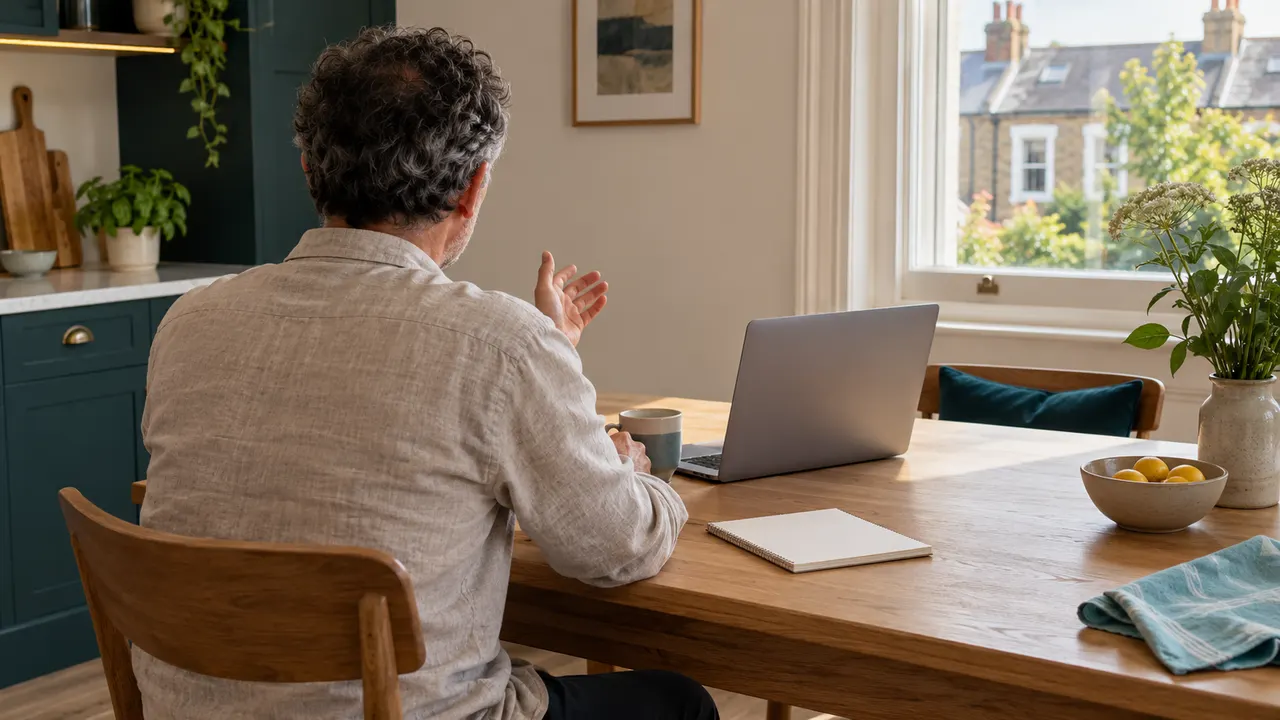
The laptop is propped on two cookery books at the kitchen table, and the list on the pad beside it has been rewritten twice. The problem has been there for a few weeks. It is not an emergency, and losing a morning to a waiting room for what is mostly a conversation feels out of proportion. Most people in that position are not asking whether video medicine works in general; they want to know whether it will work for this.
That is the real question behind booking a video GP consultation. What can a doctor do for you through a screen in 30 minutes, and how will you know when a screen is the wrong place to be seen? Both halves deserve a straight answer, and the second matters as much as the first.
Chest pain, signs of a stroke, severe breathlessness, heavy bleeding, a severe allergic reaction or symptoms of sepsis need 999 or A&E immediately. For urgent advice that cannot wait, call NHS 111.
What does a video GP consultation cover in 30 minutes?
Most of medicine is still the history. Long before anyone examines a patient, the account itself has usually narrowed things down: when it started, what changed, what makes it worse, what has already been tried, and what the person is privately worried it might be. A camera does not get in the way of any of that, and 30 minutes gives it room to come out properly.
On a video call the doctor starts where I would start in clinic, with your account in your own words, without hurrying you towards the point. Then come the questions that fill in the shape. Has it changed over the weeks, or stayed the same? Is it worse at night, or first thing? Have weight, appetite or sleep shifted? What else is going on at home or at work? Those last questions are not small talk. The pattern matters more than the single symptom, and the pattern usually lives in the details people leave out because they assume nobody wants to hear them.
Then the background. Your current medicines and doses, anything you are allergic to, past operations and diagnoses, and any results or hospital paperwork you already hold. Having these written down in front of you saves a surprising amount of the time.
A camera shows more than people expect. How someone breathes while they talk. Their colour. Whether speech flows or takes effort. How a person moves when they stand up to fetch something from another room. Mood shows in the face and the voice well before it is put into words, and a doctor who is paying attention will notice it. Some visible changes on the skin can be looked at too, in good daylight, held close to the lens.
What a screen cannot do is just as plain. Nobody can listen to your chest, feel your abdomen, look inside your ears or feel a lump through a laptop. Blood pressure, a urine test and a temperature need equipment in the room, unless you have reliable equipment of your own at home. If the answer depends on any of those, the honest plan is an examination, and the doctor will say so plainly rather than guess.
The piece most people miss is the second question. When this comes up in consultation, the real concern often surfaces in the last few minutes, introduced as "while I have you". A sleep pattern that has slipped away. A worry about an elderly parent. Low mood sitting quietly underneath a physical complaint. A 30 minute appointment leaves time to hear it properly, instead of sending you away to book another day.
The consultation should end with a plan you could repeat back to someone at home. What the doctor thinks is going on, what to do now, what would change the picture, and when to be seen again. I like a concrete window: if this has not settled in 2 weeks, book an examination; if it changes in a particular way before then, call sooner. With your consent, a summary goes to your NHS GP, because private care here sits alongside the NHS, not in place of it.
When is a video call the wrong way to be seen?
Some problems belong in a room with a doctor, and a few belong in an ambulance. Book an examination, or get help straight away, if any of these apply:
- Chest pain, a sudden severe headache, signs of a stroke or breathlessness at rest. That is 999, not a booking.
- A new lump, abdominal pain that is getting worse, or ear pain with a fever. These need hands and instruments.
- Symptoms changing quickly over a few hours. NHS 111 can advise while you arrange the right appointment.
- A child who is unwell. Video consultations at Clinique Alpa are for adults.
- No private space to talk. A consultation where you cannot speak freely will not give you what you came for.
What should you have ready before the call?
A little preparation makes the 30 minutes go further. Find a quiet room where you will not be overheard, and check your connection beforehand. Have photo identification to hand. Write down your medicines and allergies, and keep any recent results or clinic paperwork beside you. If you own a blood pressure monitor or a thermometer, take a reading shortly before the call and note the time you took it.
Then write your questions in order of importance, with the one you are most worried about at the top. People often leave that one until the end, and it is usually the one that matters.
How do video consultations work at Clinique Alpa?
Video consultations are currently with my colleague Dr Alpa J. Morawala, Clinical Director at Clinique Alpa and a Specialty Surgeon. You choose a time, pay when you book, and the link arrives in your confirmation email. The fee is £79.99 for 30 minutes. The service is for problems that do not need an examination, and that boundary is deliberate.
If the call shows that you do need to be examined, the next step is simple. A clinic appointment at 466 Green Lanes is £100 for 30 minutes with a named doctor. If getting to Palmers Green is the difficulty, a home visit lasts 60 minutes and is from £250 on a weekday, from £325 at weekends and bank holidays, and from £450 for an evening start, with travel priced by postcode.
If you are still weighing the options against each other, I have set out how to choose between clinic, video and a home visit separately. If the reason for the call is worry or low mood, there is a piece on when video works for anxiety and low mood as well.
Written by Dr Mitesh Parmar, MBBS MRCGP, Principal GP and Clinical Director at Clinique Alpa, 466 Green Lanes, Palmers Green, London N13 5PA. This article is general information, not personal medical advice. In an emergency call 999. For NHS advice call 111 or visit nhs.uk.