
The bloating has become a companion. It builds through the day, there is a dull ache low in the tummy, and the bowels have stopped behaving predictably. One day they are normal, the next there are more trips than usual. Someone has mentioned a stool test, and the real question is whether it will tell you anything.
A stool test for bloating can be very useful, in the right person, for answering one narrow question: is there anything in the bowel that looks inflammatory, or is there hidden blood? It cannot answer everything, and knowing which questions it does not answer saves a lot of anxiety.
Chest pain, signs of a stroke, severe breathlessness, heavy bleeding, a severe allergic reaction or symptoms of sepsis need 999 or A&E immediately. For urgent advice that cannot wait, call NHS 111.
What does a stool test for bloating look for?
The clinic's test list includes a faecal immunochemical test, which looks for hidden blood, a faecal calprotectin test, which looks for a marker of inflammation in the bowel, and a test for parasites. They answer different questions, so which one is chosen depends on the story.
The NHS describes the faecal immunochemical test as checking a sample for hidden blood, which can be an early sign of bowel cancer, and notes that blood does not always mean cancer: anal fissures and polyps are common, less serious causes. Calprotectin is not described on the NHS pages I checked, so I explain it as I use it in practice: a raised level suggests inflammation in the bowel wall, which points towards inflammatory bowel disease rather than irritable bowel syndrome.
Does a stool test detect IBS?
No. The NHS says plainly that there is no test for IBS. A diagnosis is made from the symptoms, and tests are used to check for other causes. A blood test looks for conditions such as coeliac disease, and a stool sample checks for infection and for inflammatory bowel disease. A normal stool test is therefore helpful but not a diagnosis: it makes inflammation less likely and leaves the picture open for irritable bowel, which is a diagnosis of pattern.
Can a stool test detect stomach cancer?
Not as such. A hidden blood test looks for blood from the lower bowel and is not a test for the stomach. A negative result does not rule out cancer anywhere, and the NHS says to see your GP if you develop symptoms. That is why the conversation matters more than the kit.
What I look at in clinic
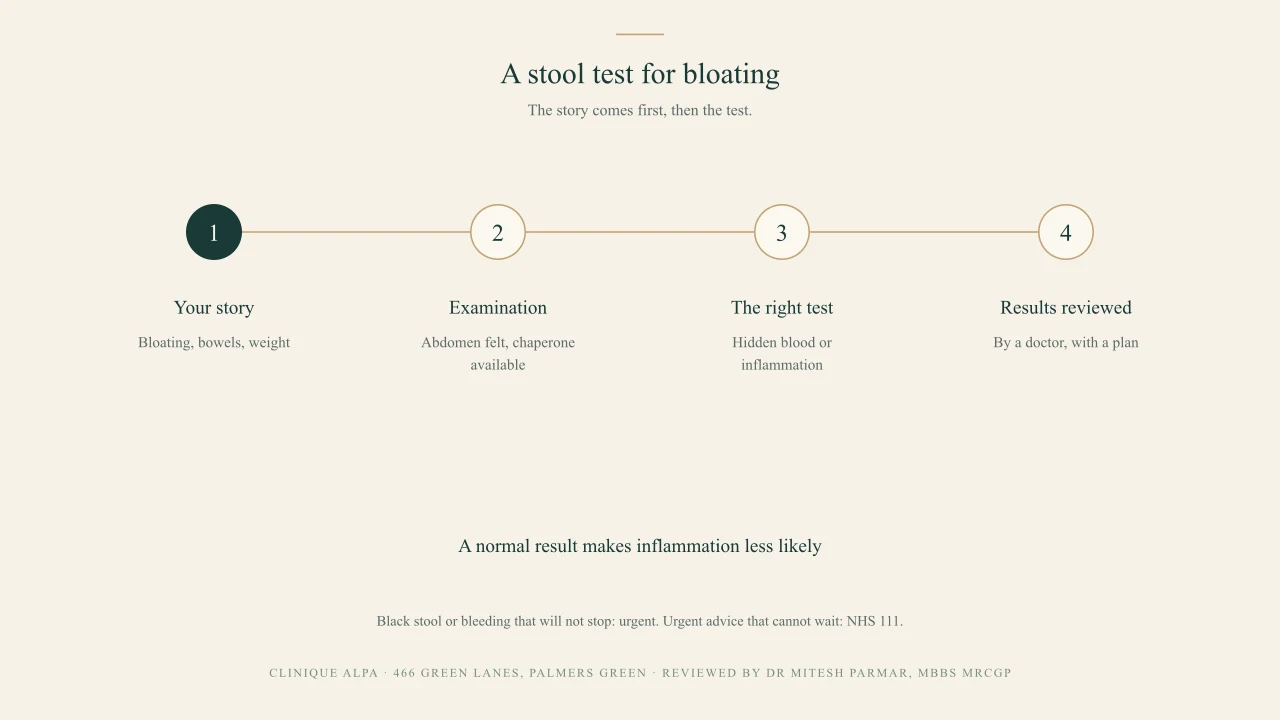
Before any test I want the story. When the bloating started and whether it comes and goes, and how it relates to food, to the time of day and to the bowels. What the stool looks like. Whether there is blood, mucus or pain on passing. Whether the person has lost weight without trying, or feels more tired than usual. The NHS lists unusual changes in bowel habit, blood in the stool, needing to go more often than normal, tummy pain or a lump, bloating, unexplained weight loss and tiredness among the symptoms of bowel cancer, which is why I ask about each one, though they are far more often caused by something else.
I ask about family history of bowel disease and bowel cancer, because that changes how readily I test. I ask about diet, medicines, recent infections and travel, and I ask about the women's health side of the tummy where it applies, because lower abdominal bloating and cramping are not always from the bowel.
The examination is of the abdomen: where it is tender, whether there is swelling, any mass, and how it sounds. Tenderness low on one side tells me something different from tenderness in the middle. A chaperone is available whenever an intimate examination is needed.
Then the decision. If the story fits a functional bowel, with no alarm features, I may suggest a stool inflammation test and a blood test for coeliac disease first, and treat the rest as irritable bowel if both are clear. If there are alarm features, I may go further and faster, and refer for a specialist assessment, written where clinically appropriate after assessment and included in the consultation fee. If the picture has already been looked at elsewhere and the tests were done a while ago, I say whether repeating them would help.
From Dr Mitesh Parmar
The stool test I find most useful screens for gut inflammation, and it helps decide who needs a scope. I also ask about weight loss, blood, night symptoms and family history. A normal result is helpful but not final. Blood in the stool or unexplained weight loss needs early attention, not waiting.
Where do stool tests fit alongside other tests?
Blood tests often come first or alongside: a blood count for anaemia, markers of inflammation and a coeliac screen. The stool tests add the bowel itself. The NHS describes the faecal immunochemical test collected at home and posted for testing; the same principle applies, with a doctor interpreting the result against your symptoms. For the prices of the stool tests in the clinic's list, see blood test prices.
A positive result is a reason to go on, not a diagnosis. For the faecal immunochemical test, the NHS says a positive result usually leads to a colonoscopy. For calprotectin, a raised result usually leads to a specialist referral. A result in the middle may call for a repeat.
When to come in sooner
Call 999 or go to A&E for severe tummy pain, bleeding from the bottom that will not stop, a lot of blood or large clots, or vomiting blood. Do not drive yourself. Call NHS 111 or get an urgent assessment if your stool is black or dark red or you have bloody diarrhoea. See a doctor soon, without waiting for a stool test, if:
- there is blood or mucus in your stool
- diarrhoea lasts more than 7 days
- bloating or tummy pain does not go away or keeps coming back
- you lose weight without trying
- your bowel habit has changed and stayed changed
How do we approach this at Clinique Alpa?
A face to face consultation at 466 Green Lanes is 30 minutes with a named doctor and costs £100. The tests are agreed with you first, results are reviewed by a doctor, and with your consent a summary goes to your NHS GP. If you want to read around the subject first, see bloating and IBS and inflammatory bowel disease in the health library.
Common questions
Can I use a stool sample for bloating on its own?
It is rarely enough on its own. The result is read alongside your symptoms, examination and usually a blood test.
Does a stool test for stomach problems rule everything out?
No. A normal result makes inflammation or hidden bleeding less likely, but it does not rule out other causes, so ongoing symptoms still need review.
Does a stool test detect IBS?
No. The NHS says there is no test for IBS, and tests are used to rule out other conditions.
Drafted with AI assistance, clinically reviewed by Dr Mitesh Parmar, MBBS MRCGP, Principal GP and Clinical Director at Clinique Alpa, 466 Green Lanes, Palmers Green, London N13 5PA. This article is general information, not personal medical advice. In an emergency call 999. For NHS advice call 111 or visit nhs.uk.