
Chest pain on breathing is a pain people test. They take a deliberate deep breath, press a finger on the spot, twist to one side and breathe in again, hoping to find the movement that settles it. By the time they ring, they have usually run the experiment several times and are no closer to knowing what it means.
The question behind the call is simple: is this a strained muscle, an infection, or something that needs a heart tracing, blood tests or a scan? Pain that is sharp, on one side and worse with a breath is a different problem from pain that presses or squeezes, and sorting out which one you have is the first job.
Chest pain, signs of a stroke, severe breathlessness, heavy bleeding, a severe allergic reaction or symptoms of sepsis need 999 or A&E immediately. For urgent advice that cannot wait, call NHS 111.
What causes chest pain on breathing?
The NHS lists several common causes of chest pain that is worse on breathing in. A chest infection, pneumonia or pleurisy can all do it, and you may also cough up yellow or green mucus or have a high temperature. A strained chest muscle after injury or exercise is another, and it eases with rest. Inflammation around the heart, called pericarditis, causes sudden sharp pain that is worse on deep breaths or lying down.
Pleurisy is inflammation of the lining of the lungs. Its main symptom is sharp pain when you breathe in, which can also be worse with coughing, sneezing or moving, and can spread to the shoulders and back. The NHS also names pulmonary embolism, a blood clot in the lung, and tuberculosis as more serious causes. Those are the reasons a doctor does not stop at the muscle explanation, even when it is the likeliest one.
Why does chest pain on breathing deeply need a proper look?
Because the pain does not tell you its own cause. Pain that changes when you press on the chest wall, twist or stretch points towards a muscle or rib, but it does not rule out the lung or the heart. Pain that began alongside a cough, a blocked nose or a fever points towards infection, but a clot can also cause pain on breathing in.
When this comes up in consultation, a common pattern is pain that started during an ordinary chest or sinus infection, often after a few days of unwell feeling, and that people have already tried to explain away. They are often right. What I do is check, because the sensible plan depends on the findings and not on the label.
What I look at in clinic
I begin with the pain itself. Where it sits, whether it started suddenly or built up, what changes it, whether it moves to the back, shoulder or arm, and what else is going on: cough, mucus, fever, wheeze, blood in the sputum, calf pain or swelling, a recent long trip, a recent operation or injury, smoking, and any history of clots in you or your close family. The NHS lists sitting still on a trip of 4 hours or more by plane, train or car as one risk for a clot, so I ask.
Then the examination. Temperature, pulse, blood pressure and oxygen level, which the clinic can measure on site with pulse oximetry. I listen to the front and back of the chest, press along the ribs and breastbone to see whether the pain is reproduced, and check the calves for tenderness or swelling. I look at how you breathe and speak, since the effort of a sentence tells me a good deal.
Whether you need an ECG, blood tests or a scan depends on what I find. An ECG is quick, and I would arrange one if the pain could be coming from the heart, for example if it is central, if it feels like pressure, or if I cannot explain it by the chest wall or lung. Blood tests help when infection or inflammation is likely, and some blood tests help assess the risk of a clot. A chest X ray is the usual test when a chest infection is suspected or the findings are unclear.
If I think a clot in the lung is a real possibility, the right place is hospital the same day, not a waiting list, because the scans that settle the question are hospital tests. I would rather make that call and be wrong than leave it. If the picture is an infection or a strained muscle, we agree a plan, with a clear point at which you should come back.
From Dr Mitesh Parmar
I ask when it started, whether it changes with movement and breathing, and about recent long flights, leg swelling or surgery. Pain that changes with position often has a different cause than pain on exertion. I check oxygen level and heart tracing where I can. Breathlessness, or pain spreading to the arm or jaw, means 999.
Chest pain on breathing symptoms: when to come in sooner
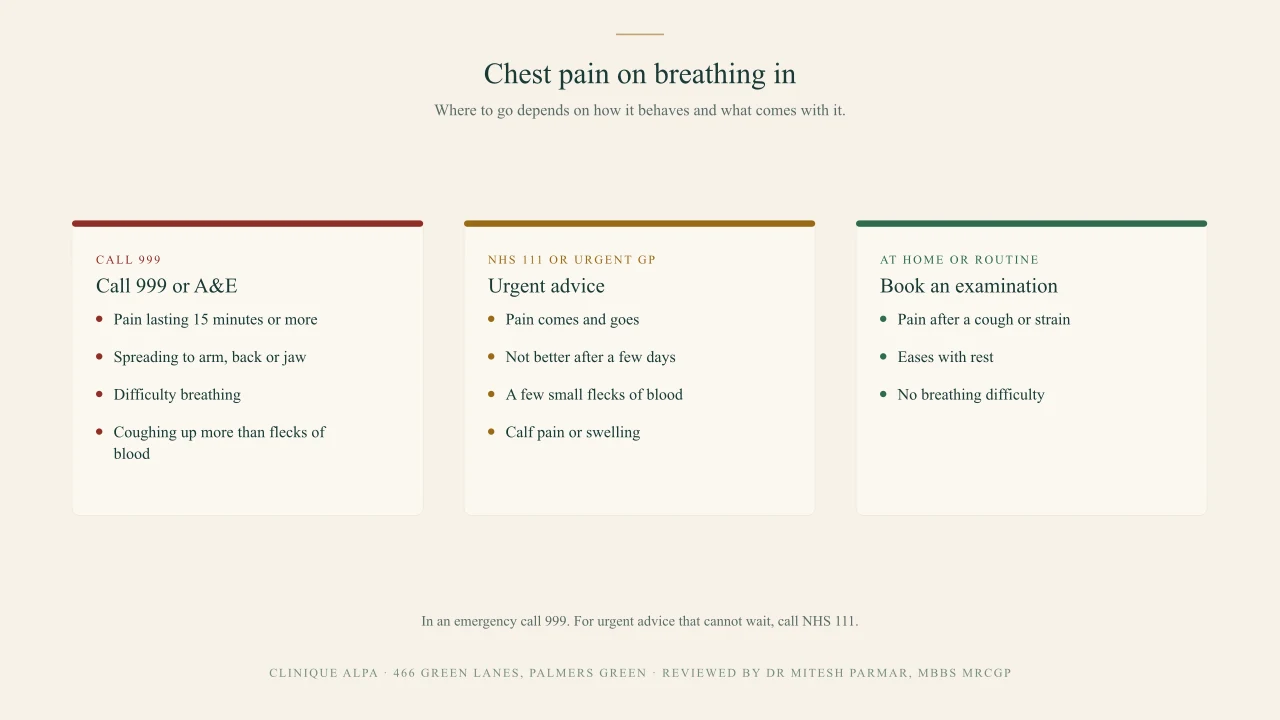
Call 999 or go to A&E if you have sudden chest pain lasting 15 minutes or more, or spreading to the arms, back, neck or jaw, if you have difficulty breathing, if you cough up more than a few spots or streaks of blood, or if you have a very fast heartbeat or collapse. The NHS asks you not to drive yourself, so ask someone to take you or call an ambulance.
Get an urgent appointment, or call NHS 111, if the chest pain comes and goes or only happens when you breathe or cough, if it has not improved after a few days, if you cough up a few small flecks of blood, or if you are regularly short of breath. If calf pain or swelling is part of the picture, treat it as urgent too.
How do we approach this at Clinique Alpa?
A face to face consultation at 466 Green Lanes is 30 minutes with a named doctor and costs £100. That is time to take a proper history, examine you, check your oxygen level and decide which tests to arrange. ECGs and blood tests are carried out on site, as described on the investigations page, and scans are arranged through partner services when they are needed. With your consent, a summary goes to your NHS GP.
This is part 1 of 3 on chest pain. Part 2 covers pain that comes on with effort, and part 3 covers pain that persists after normal tests in an emergency department. If anxiety is the worry, read about chest pain and anxiety, and the clinic keeps a chest pain guide.
Common questions
Can chest pain on breathing deeply be a muscle problem?
Yes, it often is, particularly after exercise or injury, and it usually eases with rest. A doctor still checks the chest and, where the findings do not fit, the heart and lungs.
Do I need an ECG for chest pain on breathing?
Not always. An ECG is arranged when the heart could be the source, or when the cause is not clear after examination.
Does chest pain on breathing mean a blood clot?
Rarely, but it is one of the causes the NHS lists, so a doctor asks about calf symptoms, recent long trips and coughing up blood. A suspected clot needs hospital tests.
More in this series: chest pain
Drafted with AI assistance, clinically reviewed by Dr Mitesh Parmar, MBBS MRCGP, Principal GP and Clinical Director at Clinique Alpa, 466 Green Lanes, Palmers Green, London N13 5PA. This article is general information, not personal medical advice. In an emergency call 999. For NHS advice call 111 or visit nhs.uk.