
People type chest pain normal ECG into a search box when they have been told they are fine and do not feel fine. The emergency department was thorough, the tracing and the blood tests came back clear, and they were sent home with advice to see their own doctor. A few days later the pain has not read the report.
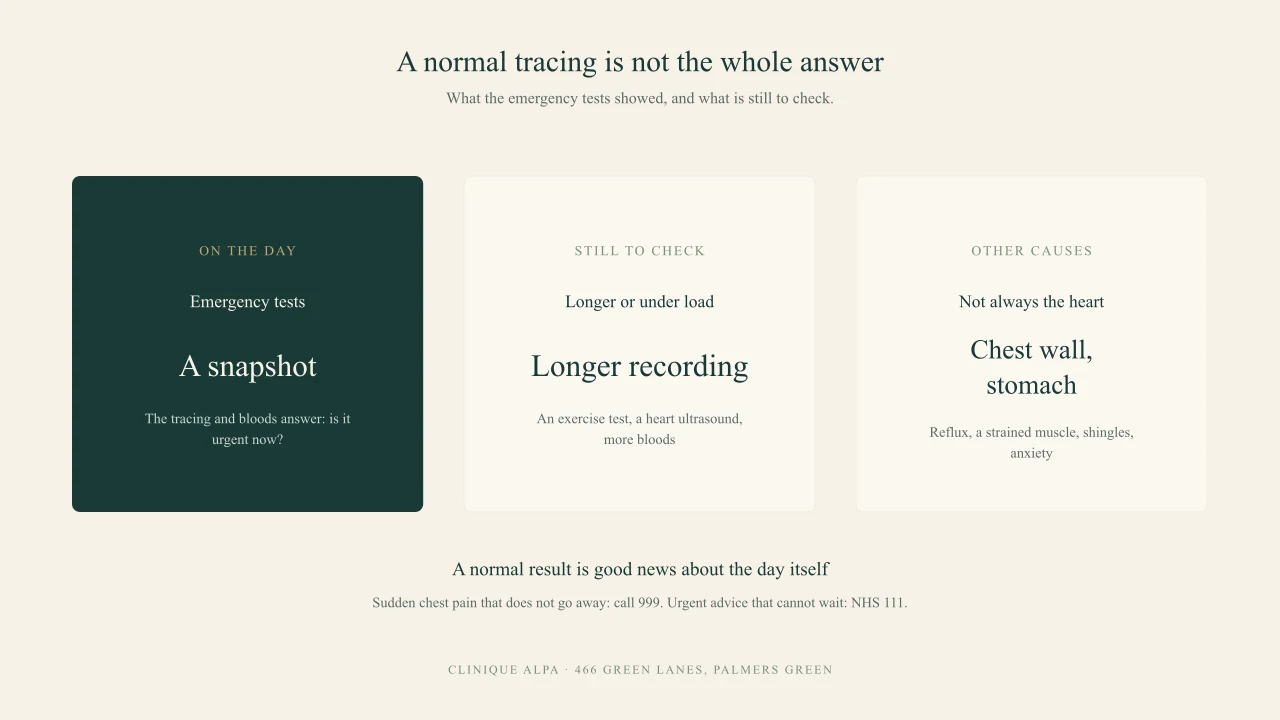
That is a reasonable position, and it deserves a straight answer. Normal tests on the day are good news about the day. They do not always explain what is happening, and for some people they are the start of the work up, not the end.
Chest pain, signs of a stroke, severe breathlessness, heavy bleeding, a severe allergic reaction or symptoms of sepsis need 999 or A&E immediately. For urgent advice that cannot wait, call NHS 111.
Why can chest pain still need a work up after a normal ECG?
An ECG records the heart for a few minutes. The NHS describes it as a test of the heart's rate and rhythm, used to assess a possible heart attack, coronary heart disease and irregular heartbeats. If the pain comes and goes, the tracing may simply have been taken in a quiet moment. It shows what the heart was doing then, not what it does on the stairs, in the cold, or at three in the morning.
Blood tests in an emergency department answer a specific question: has there been damage to the heart muscle that needs urgent treatment? A troponin is a blood test for exactly that. Its answer depends on the timing of the test in relation to the pain, which is why an emergency team may repeat it. A clear result is a good reason not to worry about an acute heart attack. It does not say anything about the other causes of chest pain, or about narrowing of the arteries that only shows up on effort.
A chest X ray looks at the lungs, the outline of the heart and the bones. It is a useful test, but it does not show the arteries or the heart's pumping action. So an entirely normal emergency visit can still leave a cardiac question open, particularly if there are risk factors such as high cholesterol, high blood pressure, smoking, diabetes or a family history of heart problems.
What I look at in clinic
I read the emergency department paperwork first, if you have it, and the results with it. It tells me what has already been done, which saves repeating tests, and it tells me what the team was thinking. Then I take the history again from the start, in my own order, because pain changes in the retelling and often the second telling has the detail that matters.
When this comes up in consultation, a common pattern is pain that began during a busy or sleepless stretch, that is felt across the upper chest, that comes at rest as well as with activity, and that is accompanied by tiredness or light headedness. People are rarely sure whether it is the heart. I ask what makes it better and worse, whether it is linked to eating, lying flat, a particular movement, or lifting, and whether anything else has changed, including mood and sleep.
I examine the chest wall by pressing along the ribs and breastbone, listen to the heart and lungs, measure pulse, blood pressure and oxygen level, and look for anaemia and swelling. I repeat the ECG, because a second tracing taken while you are symptomatic is worth having. I consider whether reflux, a strained muscle, shingles, pericarditis or anxiety could be the explanation, since all of them appear on the NHS list of causes.
The next layer is the cardiac work up, matched to your story. A longer rhythm recording, which the NHS says is usually worn for 24 to 48 hours and sometimes up to 7 days, catches episodes that a short ECG misses. An echocardiogram, a heart ultrasound, shows the size and pumping of the heart and its valves. An exercise ECG, which takes about 40 to 60 minutes, shows how the heart behaves under load. Blood tests look for anaemia, cholesterol, blood sugar and thyroid problems that contribute to symptoms. Which of these you need depends on the pattern, not on a fixed package.
Sometimes the work up is entirely normal, and the pain turns out to come from the chest wall, the stomach or stress. That is a real answer, and it is a better one than a guess made on the day the pain began.
From Dr Mitesh Parmar
I start by asking exactly what the pain feels like, what brings it on and what eases it, because the pattern often says more than the tracing. A normal test does not cover every cause. If the pain returns at rest, spreads to the arm or jaw, or comes with sweating, call 999 without waiting.
When to come in sooner
A normal result does not remove the emergency advice. Call 999 if you have sudden chest pain that does not go away, pain spreading to the arm, neck, jaw, stomach or back, or chest pain with sweating, feeling sick, light headedness or breathlessness. Do not drive yourself.
Call NHS 111, or get an urgent appointment, if the chest pain comes and goes, if it is getting worse or more frequent, or if you are worried even though the pain goes away quickly. Palpitations or fainting alongside chest pain also need urgent attention.
How do we approach this at Clinique Alpa?
A face to face consultation at 466 Green Lanes is 30 minutes with a named doctor and costs £100. ECGs and blood tests are available on site, as set out on the investigations page, and echocardiograms and longer rhythm recordings are arranged through other services when the story points that way. A referral is written where clinically appropriate after assessment and is included in the consultation fee. With your consent, a summary goes to your NHS GP.
This is part 3 of 3 on chest pain. Part 1 covers sharp pain on breathing in, part 2 covers pain on effort, and I have also written about chest pain with very high blood pressure. The clinic keeps a chest pain guide too.
Common questions
Can chest pain happen with a normal ECG and normal troponin?
Yes. Those tests answer whether there is an acute heart attack, and a clear result is reassuring on that point. They do not explain every cause of chest pain.
Why do doctors suggest an echo after a normal ECG?
An echocardiogram shows the heart's structure and pumping, which an ECG does not. It helps when the story suggests a valve, muscle or rhythm cause.
What blood tests are done for chest pain with a normal ECG?
Usually a blood count, cholesterol, blood sugar, kidney and thyroid function. They find contributors such as anaemia and show your wider heart risk.
More in this series: chest pain
Drafted with AI assistance, clinically reviewed by Dr Mitesh Parmar, MBBS MRCGP, Principal GP and Clinical Director at Clinique Alpa, 466 Green Lanes, Palmers Green, London N13 5PA. This article is general information, not personal medical advice. In an emergency call 999. For NHS advice call 111 or visit nhs.uk.