
The spots on the jaw or back have been sore for a while, and then one of them changes. It becomes hot, swollen and tender to the touch, and the skin around it looks angry. Somewhere between ordinary acne and something that needs a doctor sits infected acne, and most people are not sure which side of the line they are on.
This page is about that line, and about what happens next if a longer course of treatment is advised, because the monitoring is the part nobody explains.
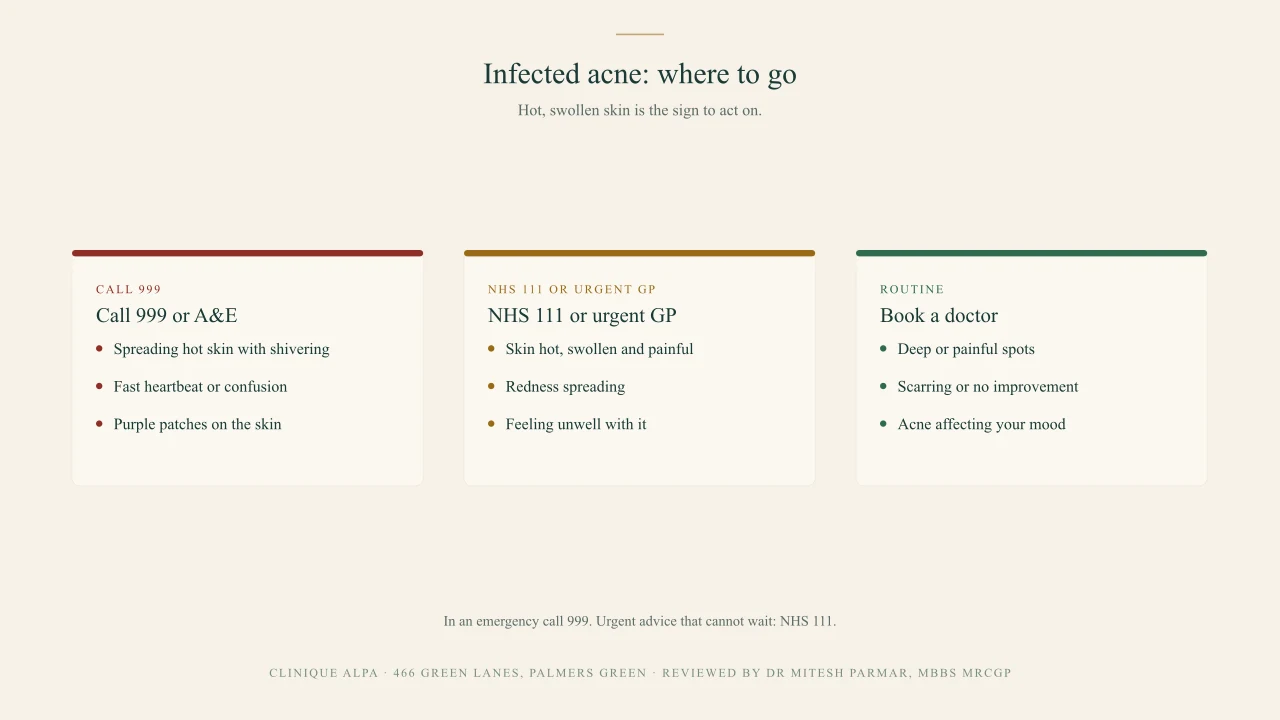
Chest pain, signs of a stroke, severe breathlessness, heavy bleeding, a severe allergic reaction or symptoms of sepsis need 999 or A&E immediately. For urgent advice that cannot wait, call NHS 111.
What does infected acne look like?
The NHS describes the signs of a skin infection as hot, swollen and red skin, and notes that redness is harder to see on brown and black skin. On darker skin I look for heat, swelling and pain instead, and I feel the area as well as look at it. Deep, painful spots, large lumps under the skin and scarring are also reasons the NHS gives for seeing a GP.
Infected acne on the face is not a different disease from acne elsewhere. It is acne where the inflammation has gone deeper or bacteria have got into broken skin, often after a spot has been picked or squeezed. The NHS advises against picking for exactly that reason. An infected acne cyst is the same story at a larger scale: a deep, tender lump with no head that will not simply drain.
When should infected acne be seen by a doctor?
Sooner than most people expect. Ask for a GP appointment if you have tried treating acne yourself and it is not improving, if the spots are deep or painful, if they are leaving scars, or if your skin looks infected. The NHS also lists acne affecting your mental health as a reason, and I agree with it. Acne that makes someone avoid mirrors, photographs or people deserves treatment in its own right.
If the skin becomes painful, hot and swollen over a wider area, treat it as possible cellulitis. The NHS advice is to ask for an urgent GP appointment or contact NHS 111, because early treatment with antibiotics stops it becoming more serious. Call 999 or go to A&E if that comes with a very high temperature, feeling hot, cold or shivery, a fast heartbeat or fast breathing, purple patches on the skin, dizziness, confusion, or cold, clammy, pale skin.
What does a doctor look at with infected acne?
What I look at in clinic starts with the skin, but the temperature comes close behind. An infected spot can come with a fever you have not noticed. I check how many areas are involved, whether there are deep nodules, whether any have a collection of pus, and whether the skin between them is red or warm.
Then I ask about the history, because infected acne rarely arrives alone. How long the acne has been present. What has already been tried, from pharmacy products to earlier courses of treatment, and whether those helped. Whether anything makes it worse: heat, sweating, a new product, shaving, helmets and tight clothing. For women I ask about periods, because the NHS notes that acne can be linked to hormones and that the combined pill is one option for hormone related acne. I also ask about mood. People rarely volunteer it, and it changes how urgently I want to help.
I look for other infections nearby. A sore that has been picked can become a boil or an abscess, and that is a different decision. A collection of pus may need to be drained rather than treated with a course alone, and if I think so I say so plainly.
When this comes up in consultation, a common pattern is that someone has already started a first course elsewhere, the skin has improved, and then the plan stalls. A long course of antibiotic tablets is a treatment with a beginning, a middle and a review, not a pack that is simply handed over. Before it starts I note your other conditions, your medicines and any allergies. Depending on the picture I may arrange blood tests, such as a blood count, kidney and liver function and a marker of inflammation, and, where hormones may be involved, a hormone profile. The point of a baseline is simple. If something changes later, there is a starting line to compare it with.
From Dr Mitesh Parmar
A single hot, swollen spot or spreading redness is what I look for, and I check for fever. Squeezing is what people most often do and most often regret, because it can push infection deeper. Redness spreading quickly, a fever, or swelling near the eye or nose needs urgent review, with NHS 111 or A&E if you feel unwell.
What monitoring do long antibiotic courses for infected acne need?
The NHS page does not set out a monitoring schedule, so I will describe what I do rather than quote a rule. The first aim is to confirm the infection is settling, and I want to see the skin again, because a photograph cannot show heat or depth. The second is to ask about side effects at each review: stomach upset, a new rash, sensitivity of the skin to sunshine, thrush, and anything that has changed since the last time. The third is to decide whether the treatment is still doing its job. If the skin has stopped improving, the answer is not always more of the same.
Blood tests, where I use them, are repeated when there is a reason, not by habit. I tell you what the reason is. I also tell you what we are aiming for: the infection settled first, then a maintenance plan that keeps spots down, using creams and other treatments that suit your skin.
If acne is severe, scarring, or not responding, the NHS notes that a GP may refer you to a dermatologist. I think about this early rather than late, because scars do not undo themselves.
What can you do while you wait for the appointment?
The NHS self care advice is plain and sensible:
- Wash your skin twice a day with a gentle cleanser and take off make up before bed.
- Use products labelled non comedogenic, which are less likely to block pores.
- Try an over the counter treatment containing salicylic acid or benzoyl peroxide, and ask a pharmacist.
- If you have acne on your body, wear loose, breathable clothing, especially when sweating or exercising.
- Do not pick, squeeze or scrub.
Common questions
What is the right treatment for infected acne?
It depends on how deep and widespread it is, which is why it needs to be examined. Treatment may be creams, antibiotic tablets, or other options after an assessment.
Should I try infected acne removal at home?
No. Squeezing a deep infected spot pushes bacteria further in and raises the chance of scarring. Cover it, keep it clean, and have it looked at.
When does infected acne need an urgent appointment?
When the skin is hot, swollen and painful over a wider area, or you feel unwell with it. The NHS advises an urgent GP appointment or NHS 111 for those signs.
How does Clinique Alpa approach infected acne?
A clinic consultation at 466 Green Lanes is 30 minutes with a doctor and costs £100. I look at the skin properly, explain what I think is going on, and agree a review date. If you would like to read more first, the acne guide covers the condition itself, and the NHS page on acne sets out the self care steps. If I need blood tests, they are priced separately and listed on the blood test prices page. With your consent, a summary goes to your NHS GP.
Drafted with AI assistance, clinically reviewed by Dr Mitesh Parmar, MBBS MRCGP, Principal GP and Clinical Director at Clinique Alpa, 466 Green Lanes, Palmers Green, London N13 5PA. This article is general information, not personal medical advice. In an emergency call 999. For NHS advice call 111 or visit nhs.uk.