
The plaster comes off that evening and the waiting starts. By the second day you have checked your phone more often than you would admit. By the fourth there is still nothing, and the silence begins to feel like an answer of its own. It is not one.
How long do blood test results take is a fair question with an honest answer: it depends on the test, on the laboratory and on who reads the result before it reaches you. The NHS says results can take a few days and usually arrive within a few weeks. Here is what sits behind that range, and where your own test is likely to fall.
Chest pain, signs of a stroke, severe breathlessness, heavy bleeding, a severe allergic reaction or symptoms of sepsis need 999 or A&E immediately. For urgent advice that cannot wait, call NHS 111.
How long do blood test results take for common tests?
It helps to follow the sample. The blood is taken, labelled and collected by a courier. At the laboratory it is logged, spun and analysed. A scientist authorises the result, which then travels back to whoever requested the test. A doctor reads it, and only then is it shared with you. The machine is the quick part for routine work. The time goes at either end.
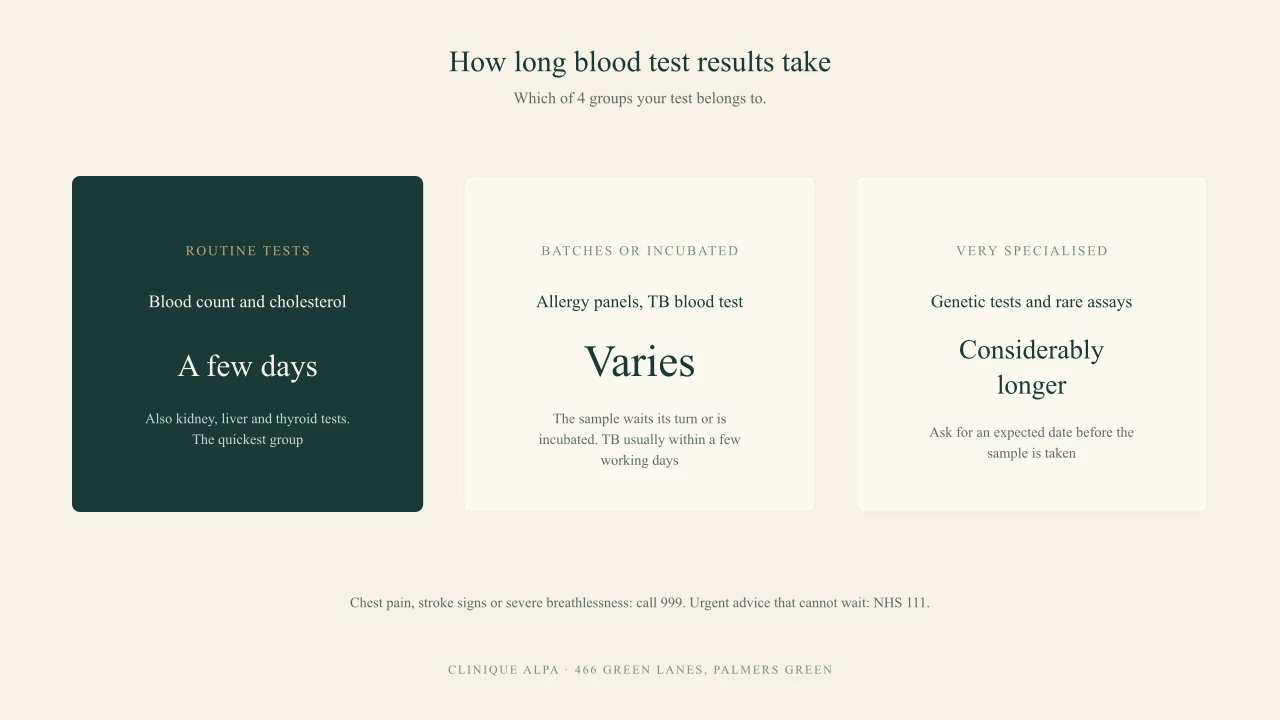
What I look at in clinic, when someone asks how long, is which of 4 groups the test belongs to.
- Routine tests run in high volume. A full blood count, kidney and liver tests, cholesterol, HbA1c and thyroid tests go through automated analysers all day. The NHS says of a cholesterol test taken from the arm that you should get the result in a few days, and says the same of the blood test used to diagnose type 2 diabetes. This is the quickest group.
- Tests run in batches. Some vitamins, hormones, allergy panels and antibody tests are requested less often, so a laboratory may run them on set days, or send them on to a specialist laboratory. The test itself is no slower. The sample simply waits its turn.
- Tests where something has to happen first. Some samples must be incubated or grown before anything can be read, and that takes as long as it takes. The TB blood test is one example: the sample is incubated in the laboratory, and at our clinic the result usually comes back within a few working days.
- Very specialised tests. Genetic tests and rare assays can take considerably longer. Ask for an expected date before the sample is taken.
A finger prick test read on the spot is the exception to all of this. The NHS notes that a finger prick cholesterol test gives a reading in a few minutes. It is quick because it measures less.
Why do some blood test results take longer than expected?
Usually for dull reasons. A sample taken late in the week meets a weekend. A bank holiday adds a day. A batch test just missed its run.
Sometimes the laboratory does extra work. If a first result is unexpected, the laboratory may run it again to confirm it, or add a second test that helps make sense of the first. That is good practice, and it costs a day or so.
Occasionally a sample cannot be analysed at all. It may have clotted in the tube, there may not have been enough blood, or the cells may have been damaged on the way. You are then asked to come back for another. That is a nuisance, not a diagnosis.
The last step is the one I would not want shortened. A result is not finished when the machine prints it. It is finished when a doctor has read it against the reason the test was done, your history and your earlier results. A number just outside its range can be nothing in one person and the important finding in another, and it takes someone who knows the story to tell which. If you would like to understand the report itself, I have covered that in blood test results explained.
From Dr Mitesh Parmar
Before I tell anyone to wait, I ask which test was taken and who ordered it. Some results come back quickly, while others go to a specialist laboratory. If a result is abnormal, I would rather you heard promptly than assumed silence means all is well. Ask for the date a result is expected.
Does no news mean good news?
Often, and it is still not a system I would rely on. Results that need quick action are normally telephoned through by the laboratory to the clinician who requested them, so a quiet first few days usually means your sample is sitting in an ordinary queue.
But the NHS is plain that some surgeries only contact you if they need to discuss a result, and that if you have heard nothing after a few weeks you should contact the surgery or specialist who arranged the test. A result can be filed without anyone telling you. A message can go to an old number.
So before you leave the room, ask 3 things: when the result is expected, how it will reach you and who will explain it. Put the date in your phone. If the date passes, ring. That is not being a nuisance. It is the system working as intended.
Many people can now see their results in the NHS App, sometimes before anyone has commented on them. A flag with no explanation at 11 at night is a hard thing to sit with. A flag shows where to look, not what is wrong, and the NHS advice if you are unsure what a result means is to contact your GP surgery.
When should you chase a result or be seen sooner?
- The date you were given has passed and you have heard nothing.
- Your symptoms have changed or worsened while you wait. A pending test is not a reason to sit on a new symptom. Be seen, and say that a result is outstanding.
- A doctor, a clinic, NHS 111 or a laboratory telephones you about a result. Act on what you are told that day.
- You have been told a result is seriously abnormal and you feel faint, confused or breathless, or have chest pain. That is 999 or A&E.
- The result is needed by a fixed date, for an operation or a trip. Say so before the test, not after.
How are results handled at Clinique Alpa?
Timing varies by test and by the laboratory, and some tests return sooner than others. We confirm the expected turnaround for your chosen profile before your visit, so you know the date you are waiting for. Samples are taken at 466 Green Lanes in Palmers Green, and the profiles are set out on our blood test prices page. The listed prices include taking your blood.
Every result is reviewed by a doctor. When you arrange the test, ask how your results will be shared and whether you need a separate follow up appointment. Any consultation fee is confirmed before you book. If you would like to go through a report line by line, a clinic consultation is 30 minutes and costs £100. I describe what that covers in a blood test results consultation. Bring older results if you have them, because a trend tells me more than a single reading.
If the timing matters to you, tell us when you call. We would rather say honestly that a test cannot be back by Friday than let you find out on Friday.
With your consent, a summary goes to your NHS GP, so the result sits in the record that will still be there in 10 years.
Drafted with AI assistance, clinically reviewed by Dr Mitesh Parmar, MBBS MRCGP, Principal GP and Clinical Director at Clinique Alpa, 466 Green Lanes, Palmers Green, London N13 5PA. This article is general information, not personal medical advice. In an emergency call 999. For NHS advice call 111 or visit nhs.uk.