
A cold goes to the chest, and then one ear starts to throb as well. It is hard to say which is worse, the cough that breaks up the night or the dull pressure on the side of the head. You wonder whether one caused the other, and whether a single visit can deal with both.
Earache and chesty cough usually belong to the same illness, but not always. The question is whether this is one infection or two, and how the answer changes when there are other conditions in the background.
Chest pain, signs of a stroke, severe breathlessness, heavy bleeding, a severe allergic reaction or symptoms of sepsis need 999 or A&E immediately. For urgent advice that cannot wait, call NHS 111.
Why do earache and chesty cough come together?
The NHS says middle ear infections usually follow a virus such as a cold or flu, and that chest infections often follow a cold or flu too. The same virus that inflames the back of the nose and throat can travel to the ear and to the airways. So the two often arrive in the same week, and neither needs to have caused the other.
That matters for treatment. Antibiotics only treat bacterial infections, and they do not work on viral ones, as the NHS explains for the chest. If both problems are viral, what helps most is rest, fluids, pain relief and time. If one of them has become a bacterial infection, the choice changes, and so does the urgency.
When this comes up in consultation, people often arrive after a cold that would not shift, with a sore throat, a blocked nose and an ear that has begun to ache. Some have long term conditions and are worried that an ordinary infection will turn into something worse. Both worries are reasonable.
Children follow the same pattern, and the advice differs a little. The NHS says a pharmacist can help if a child between 1 and 17 may have an ear infection, a GP should see a child under 12 months, and NHS 111 can advise about a child under 5. A cough with earache in a young child that is not improving, or a child who is off their food and drinking poorly, deserves a proper look rather than another night of watching.
It also helps to know that the order of symptoms is a clue. A cough that begins after the ear is sore often has a different source from earache that appears at the end of a long chest illness. The aim is to find out which infection, if either, is bacterial, because that is what decides whether antibiotics will help.
What do I look at in clinic?
I start with what came first and what is worst now. A sore throat before the ear is a different story from a cough that came after. I ask about the colour and amount of mucus, wheeze, breathlessness, chest pain, a high temperature, aching muscles and tiredness. I ask how much is being eaten and drunk.
I listen to the chest at the front and the back, and I count the breathing rate. I check the oxygen level with a pulse oximeter, which we have at the clinic. I take the temperature and the pulse. Then I look at the throat and into both ears, because ear infections are often on both sides when a cold is the cause. I look at the eardrum, the canal and the glands in the neck.
The background changes the plan. The NHS lists the people at higher risk of complications from a chest infection: those who are pregnant, people over 65, people with a weakened immune system such as diabetes or chemotherapy, and people with a long term heart, lung or kidney condition. The NHS also advises urgent advice for an ear infection in people with diabetes, a heart, lung, kidney or nerve condition, or a weakened immune system. So I go through the full list of conditions and every medicine, because the choice of treatment depends on kidney function, other medicines, allergies and how well the long term conditions are controlled.
If antibiotics are needed, I explain why, what to expect and how to take them. The NHS says to take the full course even if you feel better sooner. If they are not needed, I say that plainly as well, and I explain what recovery should look like. For a chest infection the NHS says symptoms usually improve within about 7 to 10 days, while the cough and mucus can last up to 3 weeks. For an ear infection most clear within 3 days, though symptoms can last up to a week.
I write the plan down, with a day to check again. If I am not sure whether the chest is involved more than the ear, I would rather examine you again than guess.
From Dr Mitesh Parmar
Ear, throat and chest get examined at the same visit, because one illness often explains both. Ear pain with a stiff neck, swelling behind the ear, or a child who is very unwell is different, and needs urgent care through NHS 111 or A&E.
When should I come in sooner?
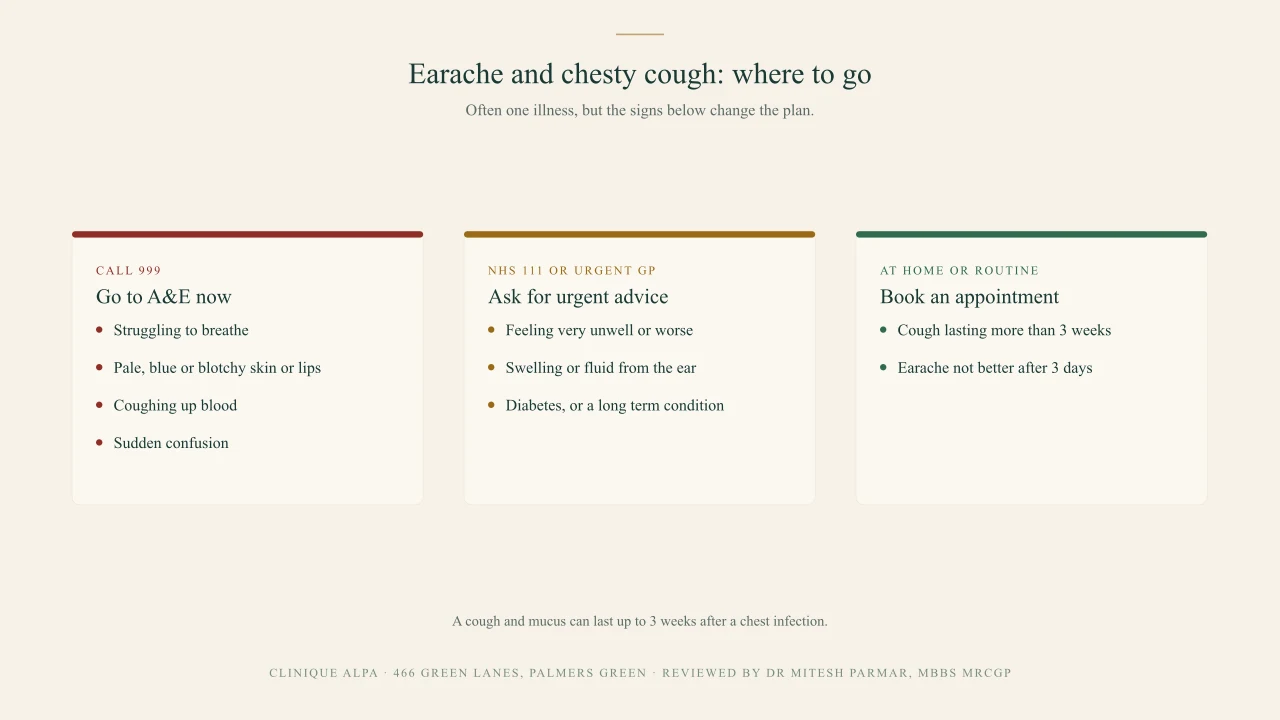
- Struggling to breathe, skin, lips or tongue that look pale, blue or blotchy, coughing up blood, or sudden confusion: call 999 or go to A&E, and do not drive yourself.
- Feeling very unwell, symptoms getting worse, or chest pain that comes and goes or happens when you breathe or cough: ask for an urgent appointment or call NHS 111.
- Earache with swelling around the ear, fluid coming from it, new hearing loss, being sick or feeling dizzy: ask for an urgent appointment or call NHS 111.
- A cough that has lasted more than 3 weeks.
- Any of these with diabetes, a heart, lung or kidney condition, or a weakened immune system.
The NHS pages on chest infection and ear infections set out the same signs. I have written about when treatment for a chest infection helps, and about a chest infection with diabetes.
How do we approach this at Clinique Alpa?
A clinic consultation is 30 minutes with a doctor at 466 Green Lanes for £100. Both ears and the chest are examined, oxygen level is checked, and the plan is agreed with you. With your consent, a summary goes to your NHS GP.
Common questions
Can a chest infection affect your ears?
The same cold or flu virus can affect the ears and the chest. One does not always cause the other, but they often arrive together.
Can an ear infection cause a chest infection?
Not directly. They commonly share a cause, usually a recent cold or flu.
Why do I have earache, phlegm and a cough together?
Because the same illness is often inflaming the nose, throat, ears and airways. A doctor can examine both and say whether either is likely to be bacterial.
Drafted with AI assistance, clinically reviewed by Dr Mitesh Parmar, MBBS MRCGP, Principal GP and Clinical Director at Clinique Alpa, 466 Green Lanes, Palmers Green, London N13 5PA. This article is general information, not personal medical advice. In an emergency call 999. For NHS advice call 111 or visit nhs.uk.