
The course of antibiotics is finished, the box has gone in the bin, and the ear still aches. Perhaps the pain is duller, perhaps it has moved towards the jaw or the throat, but it has not gone. Another few days of waiting feels wrong, and another visit feels like starting again from the beginning.
The question behind an ear infection not clearing is almost never whether more treatment is needed. It is whether the first treatment suited the infection, and what the next step should be.
Chest pain, signs of a stroke, severe breathlessness, heavy bleeding, a severe allergic reaction or symptoms of sepsis need 999 or A&E immediately. For urgent advice that cannot wait, call NHS 111.
Why is an ear infection not clearing after treatment?
The NHS explains that the word ear infection covers different problems. An outer ear infection comes from irritation of the ear canal, from water, eczema or earplugs, or from a fungal or bacterial infection. A middle ear infection usually follows a virus such as a cold. An inner ear infection can be viral or bacterial. The treatments differ, so the wrong match is a common reason for a slow recovery.
There are other reasons. Antibiotics do not work on viruses, so a viral infection will not respond to them, however well the course was taken. Ear drops may not work if they are not used correctly, and a swollen canal can stop them reaching the skin that needs them. Cotton buds and fingers irritate the canal and keep the problem going. Water in the ear, from swimming or washing hair, does the same. And sometimes the ear is not the source at all. Pain can be felt in the ear when it comes from the throat, the jaw or the teeth.
Most ear infections clear within 3 days, and symptoms can last up to a week, according to the NHS. If earache has not improved after 3 days, the NHS advises seeing a GP. If it keeps coming back, the same applies.
Some people notice a pattern: an infection, a course of treatment, a short break and then the same ear again. When that happens the useful question changes from how to clear this one to why it keeps returning. The answer might be a habit with cotton buds, water getting in, eczema in the canal, or a blocked passage between the ear and the back of the nose. I would rather find it than treat the same ear a third time.
What do I look at in clinic?
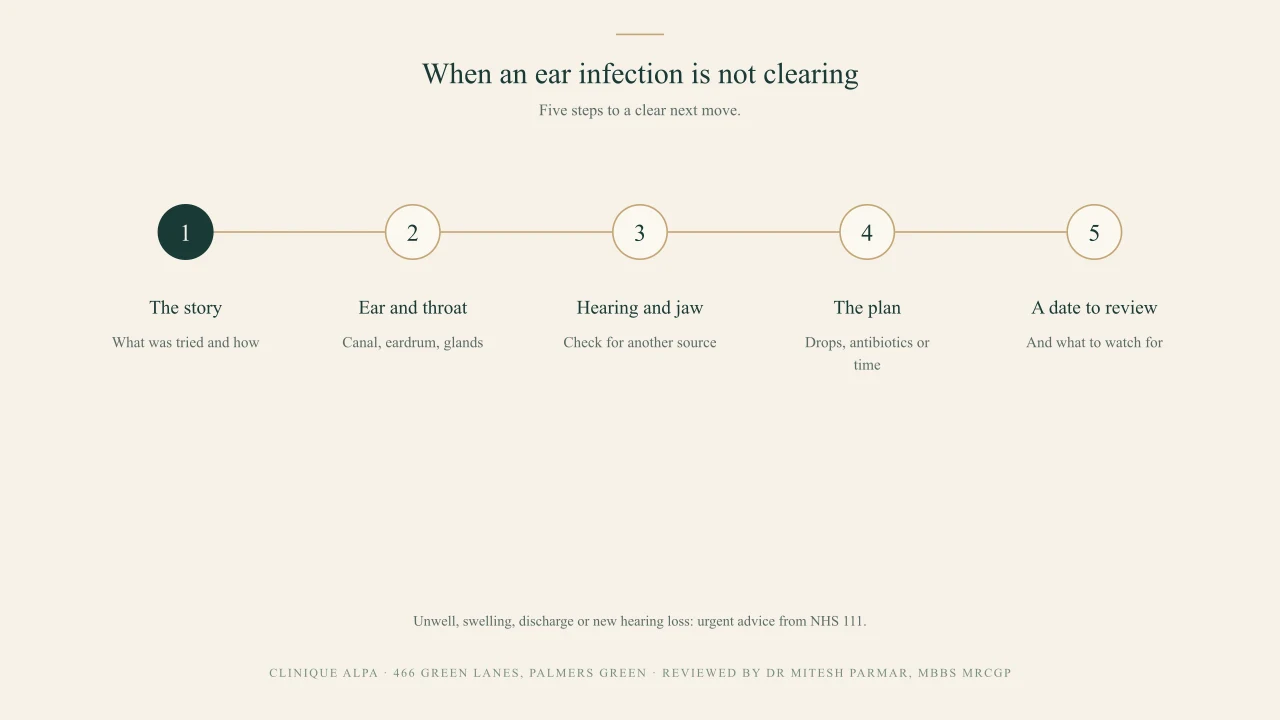
I start with the story in order. What the first symptoms were, which part of the ear hurts, what treatment was started, how it was taken, and what has changed since. I ask how the drops were put in, because it is easy to get this wrong and nobody is shown. I ask about discharge, hearing, dizziness, a high temperature, sweats and feeling unwell, because those change how quickly I want to act.
I ask about background too. Diabetes, heart, lung or kidney conditions and a weakened immune system matter here. The NHS lists them among the reasons to get urgent advice with an ear infection, so I take a lower threshold for acting.
Then the examination. I look at the skin of the ear and around it, feel the glands in the neck, and look into the canal. Is it swollen, narrowed, red, damp or blocked? Can I see the eardrum, and does it look inflamed or dull? Then the throat and the jaw, to see whether the pain is coming from there. I check hearing at the bedside. If the canal is too swollen to see past, that is itself useful information.
The plan follows from what I find. It might be a different type of drop, a change in how they are used, a different antibiotic or none at all, because a viral infection needs time and good pain relief rather than another course. If the canal is blocked with debris and cannot be cleaned safely, we do not do microsuction here, but I can refer you to an external provider. If infections keep returning, I arrange a specialist ear review where clinically appropriate. I give a date to check again, and I say what would make me want to see you sooner.
I also ask what has been tried at home. The NHS advises painkillers, wiping away discharge with cotton wool, keeping water and shampoo out of the ear, and not swimming. It also advises against decongestants and antihistamines, because there is no evidence that they help.
From Dr Mitesh Parmar
The eardrum gets a proper look with an auriscope, and so do the throat, jaw and neck, because ear pain often comes from elsewhere. If the drum looks normal, more treatment is rarely the answer. Fluid behind the drum can linger for weeks. Severe pain, swelling behind the ear or a stiff neck means A&E.
When should I come in sooner?
- Feeling generally unwell, a very high temperature, or hot, cold and shivery feelings.
- Swelling around the ear, or fluid coming from it.
- A change in hearing, or new hearing loss.
- Being sick, feeling dizzy, or a severe sore throat.
- Diabetes, a heart, lung, kidney or nerve condition, or a weakened immune system.
The NHS advises an urgent GP appointment or NHS 111 for any of these. For a child under 5, call NHS 111 for advice. In an emergency, call 999. You can read the NHS page on ear infections, and our ear and hearing guide covers the wider picture.
How do we approach this at Clinique Alpa?
A video consultation with Dr Alpa J. Morawala is £79.99 for 30 minutes. It suits going through the story, reviewing what has been tried and agreeing a plan. It cannot replace looking into the ear, so when an examination is needed we arrange a clinic consultation at 466 Green Lanes, which is £100 for 30 minutes. If getting here is the difficulty, a home visit lasts 60 minutes and is from £250 on a weekday. With your consent, a summary goes to your NHS GP.
Common questions
Why is my ear infection not clearing up with drops?
Drops may not work if they are not used correctly, or if swelling stops them reaching the skin. The type of infection also matters, as some need antifungal or steroid drops.
Why is my ear infection not clearing after antibiotics?
The infection may be viral, which antibiotics do not treat, or it may be a different problem from the one first treated. A doctor needs to look in the ear.
How long should I wait before seeing a doctor?
Most ear infections clear within 3 days. The NHS advises seeing a GP if earache has not improved after 3 days.
Drafted with AI assistance, clinically reviewed by Dr Mitesh Parmar, MBBS MRCGP, Principal GP and Clinical Director at Clinique Alpa, 466 Green Lanes, Palmers Green, London N13 5PA. This article is general information, not personal medical advice. In an emergency call 999. For NHS advice call 111 or visit nhs.uk.