
By the time most people book for this, the breathlessness has stopped being a few bad days. Stairs have become something to plan, a walk has a pause built into it, and the problem has outlasted a cold, a long stretch of waiting and at least one hopeful assumption that it would pass. Breathlessness for weeks is a symptom I want to understand rather than watch.
The question underneath is usually practical: which test comes next, and will it find anything? The usual first steps are an X ray of the chest and some blood tests. Here is what they are for, what comes before them and what happens afterwards.
Chest pain, signs of a stroke, severe breathlessness, heavy bleeding, a severe allergic reaction or symptoms of sepsis need 999 or A&E immediately. For urgent advice that cannot wait, call NHS 111.
Is breathlessness for weeks something to worry about?
Often it has an ordinary explanation, and it still needs checking. The point of weeks, rather than days, is that a passing virus has had time to clear and has not. Something else is keeping it going, and finding that something is the work of the appointment.
The NHS lists asthma, chest infection, panic attacks, being overweight and smoking among the common causes of shortness of breath, and heart failure, lung scarring, COPD and lung cancer among the more serious ones. I do not read that list as a reason to frighten anyone. It is the list I need to be able to rule in or out, with the history and the examination first and the tests second.
What causes prolonged shortness of breath?
Three broad groups, and most people sit in one of them. The first is the lungs and airways: an infection that has not fully cleared, asthma that has crept up, an airway irritated for a long time. The second is the heart and circulation: a heart that is not pumping as well as it should, fluid collecting in the legs or lungs, a rhythm problem. The third is the blood and the body around it: low iron, thyroid problems, weight, loss of fitness after an illness, and anxiety.
These overlap more than people expect, which is why one test rarely answers the question alone. Low iron, for example, can look exactly like a lung problem, and I have written about it separately in iron deficiency and breathlessness.
What I look at in clinic
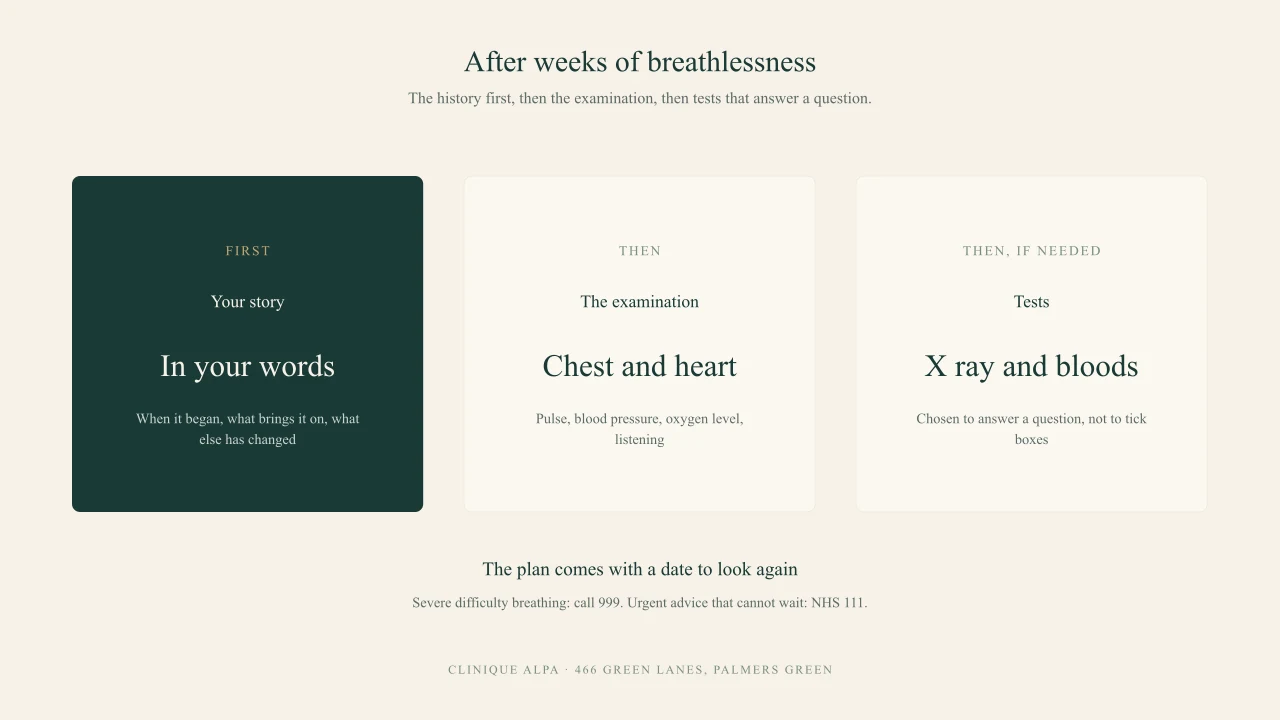
When this comes up in consultation, people often arrive having already waited, sometimes tried a course of treatment elsewhere, and still without an explanation. So I start with the story and let it run for a few minutes without interrupting.
I want to know how it began. Some people can link it to a cold that never quite finished. Others cannot link it to anything at all, and that is useful in its own way. Then what brings it on: stairs, a slope, carrying shopping, lying flat, the early hours. Breathlessness that eases when you sit up points me one way; breathlessness with a wheeze or a cough points me another.
Then everything around it. A cough, and whether anything comes up. Wheeze. Swollen ankles. A change in weight, in either direction. Palpitations, tiredness, a pain in one calf. Smoking now or in the past, dust or fumes in a working life, family history, and every medicine and inhaler in the cupboard, because some medicines cause cough or breathlessness themselves.
The examination is aimed at those questions. Pulse and blood pressure. Oxygen level, which we can check at the clinic with a pulse oximeter. Listening to the chest and heart, looking at the ankles, the colour of the skin and the inside of the eyelids, and watching how you breathe as you speak a full sentence.
Then the tests, chosen to answer a question rather than to tick boxes. An X ray of the chest looks at the lungs and the outline of the heart, and it is a sensible early test when breathlessness has gone on for weeks, because it can show infection, fluid or scarring that listening alone can miss. Blood tests look at whether you are anaemic, how your iron stores, thyroid and kidneys are working, and whether there are signs of inflammation. A tracing of the heart rhythm helps when the pulse is irregular or fast. Where a test is not done at the clinic, I explain where it is arranged and I write the request.
Sometimes the most sensible step is a short, defined trial of treatment for the most likely cause, with a date to look again. The NHS is clear that antibiotics only help bacterial infection, and a chest infection that is viral usually clears by itself, so I use them when the picture fits and say why. If I do not know yet, I say so, and we agree when to look again.
From Dr Mitesh Parmar
I listen to the chest, but I also check pulse, oxygen level and ankles. Then I ask when it happens: on flat ground, lying down or at night. Blood tests, a heart trace or a scan may follow. Sudden breathlessness, chest pain or blue lips needs 999, not an appointment.
How do you know if breathlessness is serious?
Call 999 or go to A&E for severe difficulty breathing, such as gasping or being unable to get words out; a chest that feels tight or heavy; pain spreading to the arms, back, neck or jaw; lips or skin turning pale, blue or grey; or sudden confusion.
Call NHS 111 if breathing is harder than usual, you are coughing up blood, you have pain or swelling in one leg, or your heart is racing or pounding.
See a doctor without waiting for a routine slot if:
- breathlessness is getting worse with normal activities, or when you lie down
- your ankles are swollen as well
- a cough has gone on for 3 weeks or more
- you have lost weight without trying, or you are running a fever that keeps returning
How do we approach this at Clinique Alpa?
A face to face consultation at 466 Green Lanes is 30 minutes with a named doctor and costs £100. That time is what makes the story, the examination and a clear plan possible in one visit. A video consultation does not suit this problem, because the chest needs listening to. If getting to the clinic is the difficulty, a doctor can visit at home; home visits are from £250 on a weekday.
If a blood test is needed, the clinic's testing service covers the usual panels, and if an X ray or a specialist is needed, a referral letter is written where clinically appropriate after assessment and is included in the consultation fee. With your consent, a summary goes to your NHS GP. If this is the start of a pattern, see also breathlessness and palpitations.
Common questions
Can shortness of breath last for weeks?
Yes, and when it does it deserves an assessment rather than more waiting. The cause may be simple, but it is rarely one that resolves just by being ignored.
Is breathlessness for 2 weeks worth getting checked?
If it is limiting what you can do, getting worse or not settling, yes. Sooner is better if any of the warning signs above are present.
What happens after the X ray and the bloods?
The results are explained alongside what I found on examination, not in isolation. Then we agree on treatment, further tests if needed, and a date to review.
More in this series: breathlessness
Drafted with AI assistance, clinically reviewed by Dr Mitesh Parmar, MBBS MRCGP, Principal GP and Clinical Director at Clinique Alpa, 466 Green Lanes, Palmers Green, London N13 5PA. This article is general information, not personal medical advice. In an emergency call 999. For NHS advice call 111 or visit nhs.uk.