
A pounding heart and a breath that will not go all the way down are alarming, and they are very often felt at night, when the house is quiet and there is nothing else to think about. Add poor sleep and a stretch of pressure, and it is natural to wonder whether this is the heart, the lungs, or stress.
Breathlessness and palpitations together are one of the most common reasons people book to see a doctor, and the honest answer is that it can be stress, and that a doctor should still check for the things that look the same.
Chest pain, signs of a stroke, severe breathlessness, heavy bleeding, a severe allergic reaction or symptoms of sepsis need 999 or A&E immediately. For urgent advice that cannot wait, call NHS 111.
If anxiety or low mood ever leaves you at risk of harming yourself, call 999 or go to A&E. For urgent mental health help, call NHS 111 and choose the mental health option, or call Samaritans free on 116 123, any hour.
What are breathlessness and palpitations a sign of?
Most of the time, not a dangerous heart problem, and sometimes a very real one. The NHS lists stress and anxiety as common triggers of heart palpitations, along with caffeine, alcohol, nicotine and lack of sleep. It also lists iron deficiency anaemia, an overactive thyroid, some medicines, heart rhythm problems and heart valve disease. Panic attacks are a common cause of shortness of breath too.
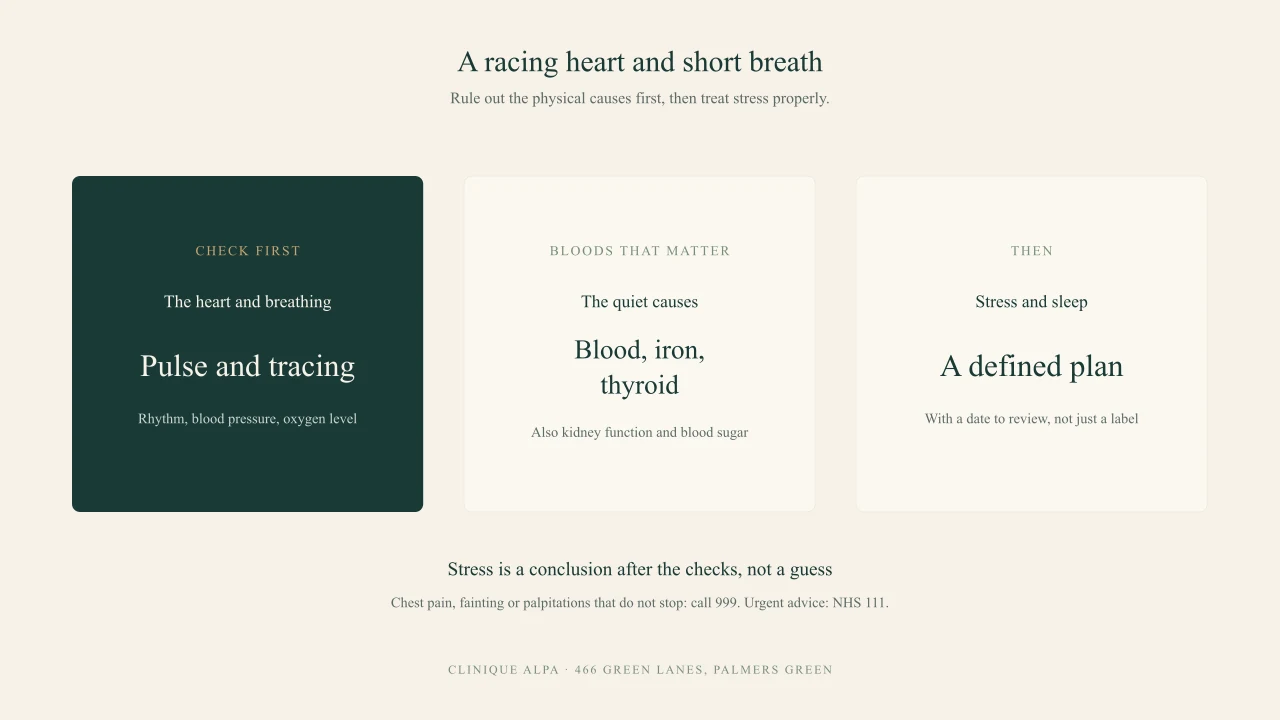
So the useful question is not whether it is stress, but what has been ruled out, so that stress can be the explanation with a clear conscience A diagnosis of anxiety made without looking at anything else is a guess. A diagnosis made after a pulse, a heart tracing and sensible blood tests is a conclusion.
What are the symptoms that point towards anxiety?
Anxiety has a physical side that surprises many people. The NHS lists difficulty sleeping, a noticeable or unusual heartbeat, feeling worn out more quickly, tense muscles, stomach upsets and dizziness among the physical symptoms of generalised anxiety.
A pattern that makes anxiety more likely: symptoms that come in waves rather than steadily, that arrive in particular situations or with a rush of fear, that are worse when attention turns to them and ease with distraction, and that sit alongside poor sleep, a busy mind and tension in the neck and shoulders. A pattern that makes me look harder for something physical: symptoms that come on with exertion and ease at rest, that are steadily progressive, that arrive with chest pain, fainting or a family history of heart problems, or that are present with no worry at all.
What if you are breathless and have palpitations on exertion?
Symptoms that come on with effort deserve more attention than symptoms that come in the middle of the night. The heart, the blood count and the lungs all behave differently under load, and anxiety is the diagnosis I make last in that situation, not first. It is still possible, and exercise can set off a panic response in people who have become afraid of their own heartbeat, but I do not assume it.
What I look at in clinic
A doctor starts by listening to how the symptoms behave: what they feel like, how long each episode lasts, what sets them off, what stops them, how sleep, caffeine, alcohol and pressure at home or work have changed. Questions about low mood, worry and panic are part of an ordinary assessment, not a judgement.
Then the examination: pulse rate and rhythm, blood pressure, oxygen level, listening to the heart and lungs, looking for signs of anaemia, a swollen neck or a tremor that would suggest the thyroid. A tracing of the heart rhythm is the standard test for palpitations, as the NHS notes, and a longer recording can be arranged through a heart specialist when episodes are brief and unpredictable.
The blood tests that still matter when stress is the likely explanation are a full blood count, iron stores, thyroid function, kidney function and blood sugar, with vitamin B12 where there is tiredness or tingling. These are the quiet causes of an anxious feeling, and finding one changes the plan completely. Most of the time they are normal, and a normal result is reassuring in a way that a doctor's word alone is not. My own special interest is in psychological medicine, so the second half of the appointment matters as much as the first: how the body is reacting to pressure, and what is helping and what is not.
If anxiety is the explanation, the plan is practical. Understanding the cycle in which a fast heartbeat causes fear, and fear causes breathing faster, is itself treatment for many people. Cutting back on caffeine, alcohol and nicotine, protecting sleep, and slow steady breathing are sensible early steps. Adults can refer themselves directly to NHS talking therapies, and treatment options can be discussed with you at the appointment. I would rather offer a defined plan with a review date than a label.
From Dr Mitesh Parmar
I want to know whether the palpitations come with effort, whether anyone has fainted, and what the pulse is doing during an episode. A heart tracing and blood tests often settle a lot. Chest pain, fainting or breathlessness that is getting worse is not something to ride out: call 999.
When to come in sooner
Call 999 or go to A&E if palpitations do not go away, or come with chest pain, breathlessness or faintness, or if there is severe difficulty breathing, a tight or heavy chest, or pain spreading to the arm, back, neck or jaw. The NHS asks you not to drive yourself.
Get an urgent appointment, or call NHS 111, if:
- palpitations keep coming back or happen more often
- episodes last longer than a few minutes
- you already have a heart condition, or there is a family history of heart problems
- you are breathless lying down or at everyday activity
How do we approach this at Clinique Alpa?
A face to face consultation at 466 Green Lanes is 30 minutes with a named doctor and costs £100. That time allows the examination, a plan for the right blood tests, and a proper conversation about sleep and pressure. A video consultation can suit follow up once the physical causes have been checked, with Dr Alpa J. Morawala, for £79.99.
Results are explained in plain words, and a referral letter is written where clinically appropriate after assessment, included in the consultation fee. The clinic's testing service arranges the bloods, and with your consent a summary goes to your NHS GP. If breathlessness has lasted a long time, read breathlessness that lasts several weeks, and if you are tired as well, iron deficiency and breathlessness.
Common questions
Can anxiety cause breathlessness and palpitations at the same time?
Yes, they commonly appear together, because the body's alarm response speeds up both breathing and the heart. It should still be diagnosed after a physical check rather than assumed.
Do I need blood tests if I think it is stress?
Usually yes, as a small set of tests. They exclude anaemia, thyroid problems and blood sugar changes, which can feel identical.
Why do these symptoms come at night?
With no distractions, the body is easier to notice, and poor sleep makes the alarm response more sensitive. A pattern of waking with a racing heart is worth describing to a doctor.
More in this series: breathlessness
Drafted with AI assistance, clinically reviewed by Dr Mitesh Parmar, MBBS MRCGP, Principal GP and Clinical Director at Clinique Alpa, 466 Green Lanes, Palmers Green, London N13 5PA. This article is general information, not personal medical advice. In an emergency call 999. For NHS advice call 111 or visit nhs.uk.