
It is an unwelcome surprise, and rarely one that people raise first. A laugh, a cough or a run for the bus, and urine escapes. Or a sudden urgency in the bowel that does not leave time to get to the toilet. For many people the weeks after having a baby are full of other priorities, so the leakage is quietly managed with pads and planning, and nobody mentions it at the postnatal check.
Incontinence after childbirth is common, and it is a treatable problem. The question this page answers is a practical one: when is it reasonable to manage this yourself, when does it need a doctor, and when does it merit a referral to a urogynaecologist, the specialist who looks after bladder and pelvic floor problems in women?
Chest pain, signs of a stroke, severe breathlessness, heavy bleeding, a severe allergic reaction or symptoms of sepsis need 999 or A&E immediately. For urgent advice that cannot wait, call NHS 111.
Why does incontinence after childbirth happen?
The NHS explains that pregnancy and vaginal birth can weaken the muscles that control the flow of urine. The pelvic floor and the sphincter muscles that close the bladder outlet can be stretched or damaged. The same applies to the bowel: the NHS lists childbirth, ageing and hormonal changes among the causes of bowel incontinence, because they can weaken the muscles around the bottom.
It helps to know which kind of leakage you have, because the treatment differs. The NHS describes the main types of urinary incontinence:
- Stress: urine leaks when the bladder is under pressure, such as when you cough or laugh.
- Urge: a sudden strong need to pass urine, followed by leakage.
- Mixed: a combination of the two.
- Overflow: the bladder does not empty fully, so it leaks frequently.
Bowel leakage may be of wind, liquid stool or solid stool, and may come with a sudden urge or with no warning at all. These details matter to the assessment.
Is incontinence after pregnancy something to wait out?
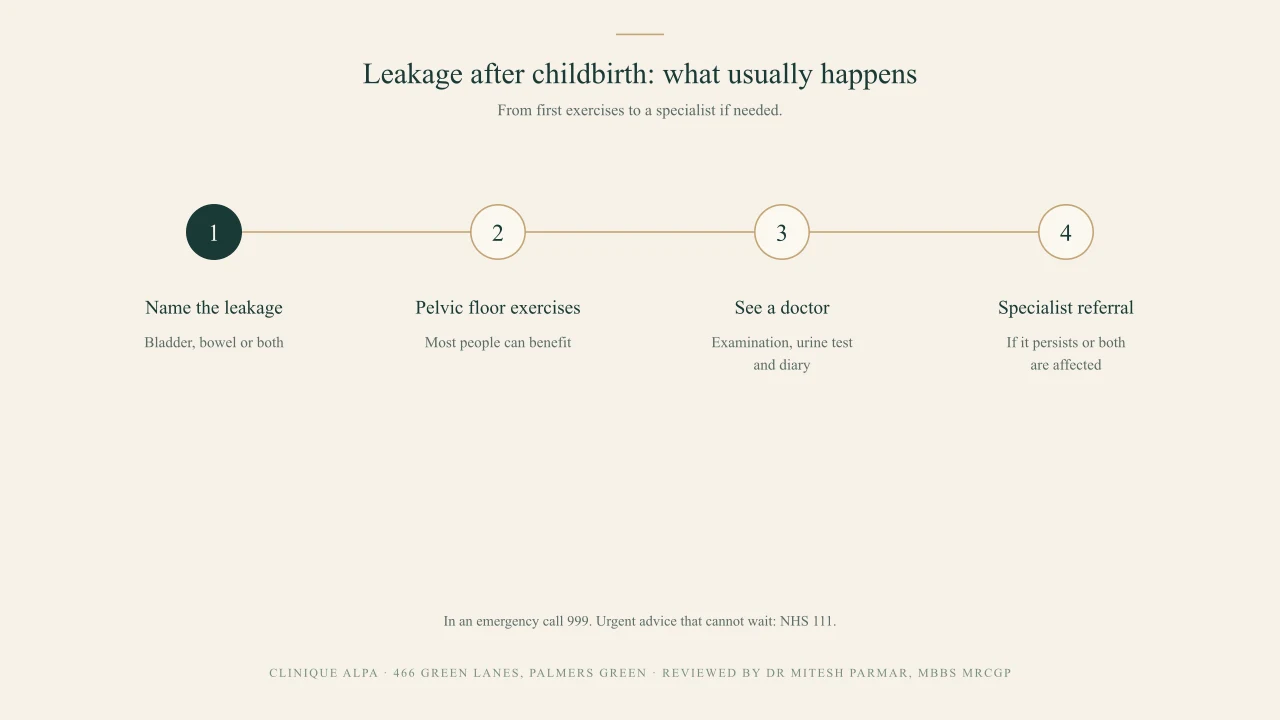
Some improvement is common as the body recovers, and pelvic floor exercises are the first thing the NHS recommends, because most people can benefit from them. The advice is also to see a GP for any type of urinary incontinence, however embarrassing it may feel. If leakage is still there after a few months of regular exercises, or if it is severe from the start, waiting is rarely the right plan. Early treatment is simpler than treatment that comes after years of coping.
What does a doctor look at with incontinence after childbirth?
What I look at in clinic starts with the type of leakage and how much it matters to the person. When does it happen, how often, how much, and what has changed since the birth? I ask about the bowel as well as the bladder, since many people have both and do not volunteer the second. I ask about drinks, caffeine, constipation, and any medicines that might make a bladder more irritable.
I ask how it affects daily life: whether you plan outings around toilets, avoid exercise, or are anxious about intimacy. The NHS suggests a diary of what you drink and when you pass urine, and I find it more useful than almost any test. Two or three days of honest entries often shows the pattern.
The examination looks at the tummy, checks blood pressure, and, with consent and a chaperone available, examines the pelvic floor and looks for any prolapse or sign of damage. A urine test excludes infection, which can mimic or worsen bladder symptoms. Blood tests are used when something in the history suggests them. For the bowel, the NHS says a GP may examine, ask for a stool sample, and refer for blood tests, a colonoscopy or an ultrasound scan where needed. The first aim is to find out whether this is a problem the pelvic floor can fix, or one that needs more.
From Dr Mitesh Parmar
Leaking after a baby is common and usually improves, so please do not put up with it quietly. I ask about the delivery and whether the leak is wind, liquid or stool. Pelvic floor work is the first step. Bowel leakage that is new or getting worse deserves an early examination.
What is the treatment for incontinence after childbirth?
For the bladder, the NHS lists non surgical measures as the usual first step: pelvic floor exercises, bladder training to lengthen the time between needing to go and going, cutting down on caffeine and alcohol, weight loss where relevant, and pads, with medicine if symptoms continue. For the bowel, it lists reviewing diet and medicines, medicines to slow or soften motions, pads and skin protection, then a specialist incontinence service offering pelvic floor biofeedback and bowel retraining if this does not help.
Surgery, such as a sling procedure for stress leakage or repair of the muscle for the bowel, is considered when other measures fail. I mention it because people are often more afraid of the word than the idea. It is a later option, chosen after a full assessment, and it is the specialist who offers it.
When does leakage merit a urogynaecology referral?
The NHS says a GP may refer you to a specialist for further tests, and refers on to a specialist incontinence service if GP treatment does not help. In my own practice I think about referral when:
- Leakage is still troublesome after a sensible trial of pelvic floor exercises and first line measures.
- Both bladder and bowel are affected.
- Symptoms are getting worse, or are severe from the start.
- You are considering another pregnancy and want a plan first.
Referral is not a failure of first line treatment. It is a way of shortening the route to the right test. A clear summary of what has been tried helps the specialist to start where you left off.
When should you come in sooner?
The NHS says to get an urgent GP appointment or call NHS 111 if poo is black or dark red, or if there is bloody diarrhoea. Call 999 for severe symptoms with chest pain, difficulty breathing or heavy bleeding. Come in sooner than planned if you are leaking more, have blood in the urine or stool, or feel low about it. For background on related symptoms, see our guide to bladder symptoms.
Common questions
What is the treatment for incontinence after childbirth?
Pelvic floor exercises, bladder training and lifestyle changes come first, with medicines and specialist referral if they do not help. Surgery is considered only when other measures fail.
Is surgery ever needed for incontinence after childbirth?
Sometimes. The NHS describes sling procedures for stress leakage and muscle repair for bowel problems as options when other treatments have not worked. It is a decision for you and a specialist.
Does incontinence after pregnancy or delivery go away by itself?
It sometimes improves, but not always. See a GP if it persists or bothers you.
How do we help at Clinique Alpa?
Call 020 8882 8088 or book online. A 30 minute clinic consultation at 466 Green Lanes is £100. A chaperone is available whenever an examination is needed. I assess, arrange the first tests, advise on a plan and, where clinically appropriate after assessment, refer you to a urogynaecologist. With your consent, a summary goes to your NHS GP. The wider overactive bladder page covers urgency and frequency in more detail.
Drafted with AI assistance, clinically reviewed by Dr Mitesh Parmar, MBBS MRCGP, Principal GP and Clinical Director at Clinique Alpa, 466 Green Lanes, Palmers Green, London N13 5PA. This article is general information, not personal medical advice. In an emergency call 999. For NHS advice call 111 or visit nhs.uk.