
Back pain makes ordinary things hard, and work is often where it shows first. Sitting, standing, lifting, driving or bending can all set it off. The question that follows is practical and a little awkward: how much time off is reasonable, and will anyone believe the pain?
A back pain fit note is how a doctor answers that question in writing for an employer. This article explains when time off is reasonable, how the work itself changes the answer, and what I check before signing anything.
Chest pain, signs of a stroke, severe breathlessness, heavy bleeding, a severe allergic reaction or symptoms of sepsis need 999 or A&E immediately. For urgent advice that cannot wait, call NHS 111.
Can I get a fit note for back pain?
Yes, where it is clinically appropriate after an assessment. GOV.UK explains how the system works. If you are off for 7 days or less, you can self certify and your employer cannot insist on a fit note, though they can ask you to confirm you were ill when you return. If you are off for more than 7 days in a row, a fit note is needed, and weekends and bank holidays count towards the total.
A fit note says either not fit for work, or may be fit for work. If it says may be fit, the employer should discuss changes that could help you return. That second option matters a great deal for back pain, because the right answer is often to keep working in a modified way rather than to stop altogether.
Is time off the right answer for back pain?
Often not for long. The NHS advises that you stay active and try to continue with your daily activities, and not stay in bed for long periods. It says back pain usually improves within a few weeks, but can sometimes last longer or keep coming back. So a short break can be reasonable when the pain is severe, but long rest tends to slow recovery, not speed it.
That is why a good fit note is rarely just a date range. When this comes up in consultation, people often expect the choice to be between full work and no work. In practice the useful answer is usually somewhere between: shorter periods in one position, a break from heavy lifting, a change in the working pattern for a couple of weeks, and a review.
What do I look at in clinic?
First, the pain itself. Where it is, whether it spreads into a leg, what brings it on, what eases it, and how it behaves at night. I ask how it started and whether it has happened before. I also ask what has already been tried, because that tells me what is likely to help.
Then the safety questions, which I ask every time. Any numbness or weakness in the legs, any change in bladder or bowel control, any numbness around the genitals or back passage, any fever or feeling generally unwell, any weight loss without trying, and any recent injury. The NHS lists these as reasons to call 999 or go to A&E, or to get urgent advice. They are uncommon, but they are the reason I never sign a fit note without asking.
I examine the back. How you stand and walk, how the spine moves, whether particular movements bring the pain on, and where it is tender. I test strength, reflexes and sensation in the legs, and I check that the pain does not go with other signs that point elsewhere. Most back pain is what doctors call non specific: painful, real and mechanical, without a dangerous cause. Saying so clearly is reassuring, and it shapes what I advise.
Then the work. This is where a fit note is made or lost. I ask what the job involves hour by hour. How much is sitting and how much standing. Whether there is lifting, driving or repetitive bending. Whether the workstation, the chair, the screen height or the vehicle seat can be adjusted. Whether breaks are possible. Whether the employer knows about the problem and has been asked for changes. The same back can be fine in one setting and miserable in another, and the fit note should reflect that.
I also ask about the rest of life, because low mood, poor sleep and worry about work all make pain harder to bear. If any of those need attention, I deal with them directly, not as an afterthought.
Last, I decide what to write. Sometimes it is not fit for work for a short, defined period. Sometimes it is may be fit, with specific changes, such as a phased return or adjusted tasks, and a review date. Either way the note records what I found and why, and not simply what the person hopes it will say.
From Dr Mitesh Parmar
A fit note is rarely a choice between work and no work. I ask what the job involves, and I often suggest adjusted duties or hours instead of full time off, because staying gently active usually helps recovery. What changes my plan is weakness in a leg, numbness around the groin or trouble passing urine. Those need A&E.
Will my employer accept a private fit note?
That depends on the employer, and I cannot promise acceptance. For how private notes are treated in general, see can a private doctor issue a sick note. For wider reading on the problem itself, see the back and neck pain guide.
When to get help sooner
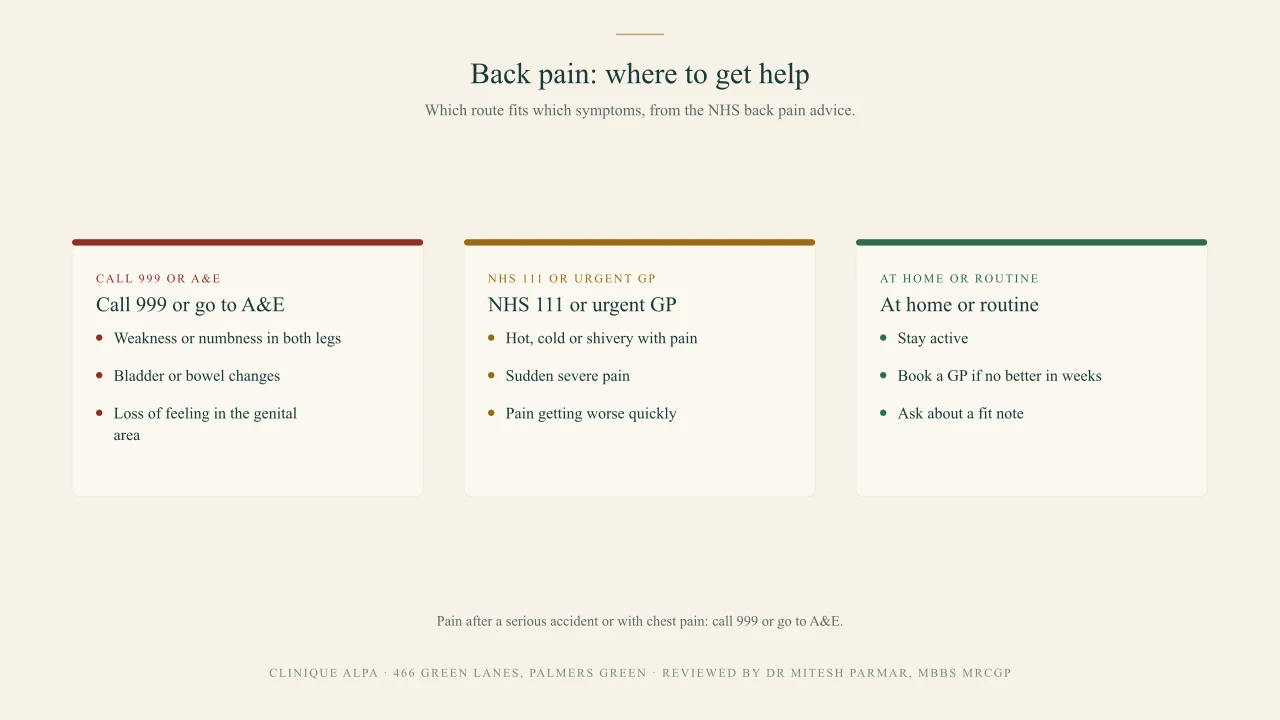
Call 999 or go to A&E if back pain comes with pain, tingling, weakness or numbness in both legs, loss of feeling around the genitals or back passage, changes in bladder or bowel control, chest pain, or if it started after a serious accident. Do not drive yourself. Get an urgent GP appointment or call NHS 111 if you feel hot, cold, shivery or generally unwell, or if pain is sudden, severe or getting worse quickly.
Otherwise, the NHS suggests seeing a GP if pain has not improved after a few weeks of home treatment, if it stops you doing daily activities, if it is worse at night or rest does not help, or if you have lost weight without trying.
Common questions
Can I get a back pain sick note straight away?
A fit note is provided where clinically appropriate after an assessment. For 7 days or less you can usually self certify, and your employer can say what proof they accept.
What is the difference between a lower back pain doctors note and a fit note?
A fit note uses the standard wording of not fit for work, or may be fit for work. A private doctors note is a certificate of what we found on assessment.
Can the note say I need lighter duties?
Yes, where the assessment supports it. The employer decides what is possible.
How do we approach this at Clinique Alpa?
You see a doctor for 30 minutes in the clinic at Palmers Green for £100. Where there is no need for an examination, a video consultation is £79.99, though back pain nearly always needs hands on assessment. With your consent, a summary goes to your NHS GP. This is private healthcare alongside the NHS.
If a longer letter about your work is needed, that is a different document and its fee is confirmed first.
This is an independent clinical opinion. It cannot be written to a required conclusion and does not guarantee the outcome of any claim, application, exemption or hearing.
Drafted with AI assistance, clinically reviewed by Dr Mitesh Parmar, MBBS MRCGP, Principal GP and Clinical Director at Clinique Alpa, 466 Green Lanes, Palmers Green, London N13 5PA. This article is general information, not personal medical advice. In an emergency call 999. For NHS advice call 111 or visit nhs.uk.