
The request is usually short and reasonable: carry on with what has been working. The sleep is better, the nerves are quieter, the pain is bearable. Nobody asking has done anything wrong. They have found something that helps, and after a while it has become part of the routine, like the kettle.
Anxiety and sleep problems feed each other, and the medicines that ease one can quietly settle in for years. This page explains why a doctor reviews long term medicines for anxiety, sleep or pain, why review dates and limits exist, and how changes are planned so that nobody is left without support.
If you are at immediate risk of harming yourself or someone else, call 999 or go to A&E. For urgent mental health help, call NHS 111 and choose the mental health option, or call Samaritans free on 116 123, any hour.
Why do anxiety and sleep problems come together?
They are close neighbours. The NHS lists stress, anxiety and depression among the common causes of insomnia, and it lists difficulty sleeping among the symptoms of generalised anxiety disorder. A mind that is on guard at night does not sleep well, and a body that has not slept is less able to cope with worry the next day. Pain adds a third loop: it is a recognised cause of poor sleep, and poor sleep makes pain feel worse.
That loop is why people can end up on more than one medicine for what is, underneath, one tangled problem. It is also why a review has to look at all of it together, not one medicine at a time.
Why do doctors review sleep and anxiety medicines?
The honest answer is that the NHS position on sleeping medicines is cautious. It describes them as a last resort, generally given only for a few days or weeks at most, when insomnia is very severe and other treatments have not worked. It also warns of serious side effects and the risk of becoming dependent. For long term insomnia, the NHS says cognitive behavioural therapy is often the first option, delivered face to face or online. For anxiety, it describes talking therapies and self help before medicines.
None of that is a judgement on the person asking. It is the reason a medicine that was right at the start needs to be looked at again after months. Needs change. Side effects creep in. Drowsiness affects driving and concentration. The dose that worked can stop working, and then the temptation is to take more. A review is the moment to catch that early, with a clear head, before it becomes a problem.
The same questions apply to any strong medicine taken for a long time, including for pain. Is it still doing the job it was started for? What is it costing in side effects? Is there another way to get the same benefit? Those are fair questions to put to any treatment.
What does a doctor look at in a long term review?
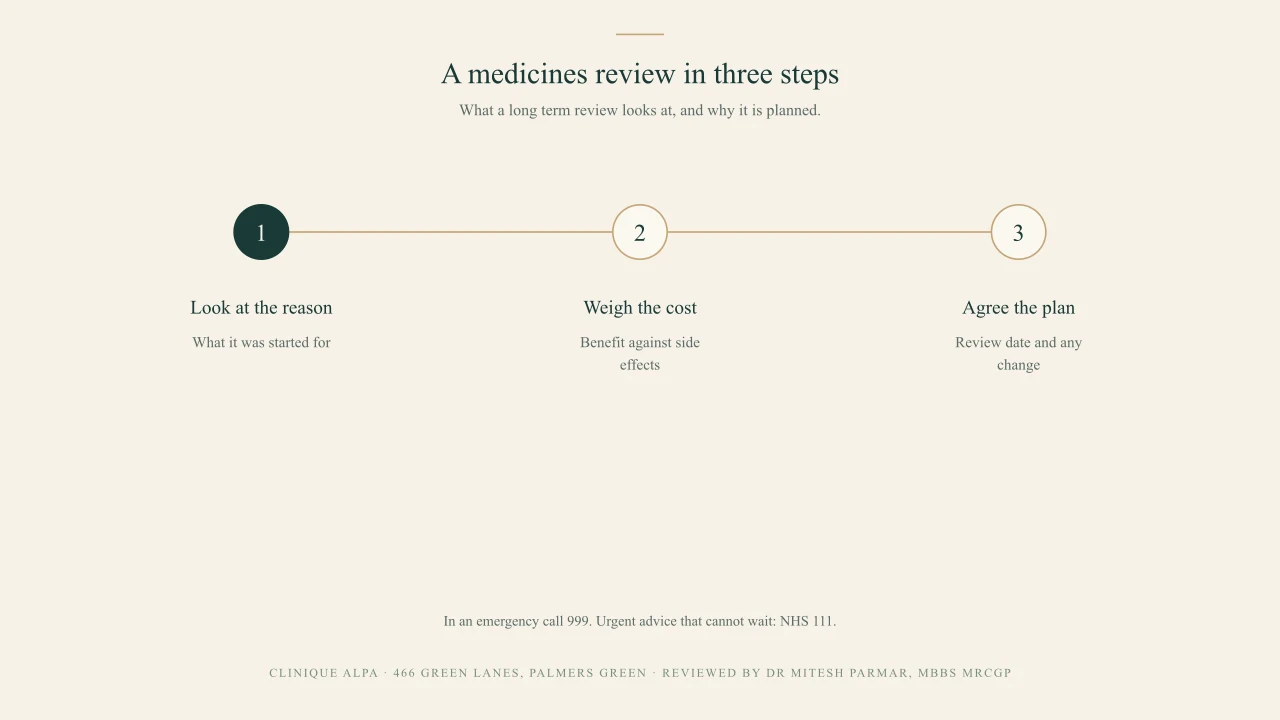
What I look at in clinic begins with the story, not the medicine. When did the problem start, what was happening in life then, and what was tried before? What was the medicine meant to do, and is that still the problem? Sometimes the original reason has gone and the habit has stayed. Sometimes the reason has grown.
Next I look at how it is being used. Is the pattern steady, or has it crept up? Is it taken at set times, or when things feel bad? Has anything run out, been lost or been taken early? I ask these things plainly and without suspicion, because the answers help me more than any rule does.
I ask about sleep in detail: how long it takes to fall asleep, how often you wake, how you feel in the morning, what the evenings look like. I ask about caffeine and alcohol, both of which the NHS lists among the things that disturb sleep. Alcohol also matters alongside any sedating medicine, so I always ask about it.
I ask about mood, worry, pain and what the days look like, because a medicine can hide a problem that then needs its own treatment. Where it is clinically appropriate, I check your general health and arrange monitoring tests. I look at what else you take, including anything bought over the counter.
Then I ask what you want. Some people want to come off a medicine and do not know how. Some are frightened of losing the only thing that helps. Both are reasonable, and the plan has to answer both.
From Dr Mitesh Parmar
At a long term review I ask what sleep is really like without help, how the day goes and whether the original problem has changed. Do not stop a regular treatment suddenly on your own. Withdrawal can feel worse than the original trouble, so any change is planned slowly and together.
Why are review dates and limits set?
Review dates and limits are a safety structure, not a punishment. They exist so that decisions are made with fresh information, so that no one runs out unplanned, and so that the dose and the supply stay matched to the need. A medicine reviewed at a planned point is less likely to drift. When a review date is agreed, I ask that it is kept, because a plan that is missed has to be rebuilt from the start.
It is also honest to say what a doctor cannot do. I cannot promise to continue any medicine before I have assessed you, and I cannot supply anything outside a safe plan. If you are registered with an NHS GP, they hold your longer record. With your consent, a summary goes to them, so that you are not looking after two separate plans.
How are changes made gradually?
A change is agreed with you and planned, with a date to check how it is going. Please do not reduce or stop a long term medicine suddenly on your own, and do not take extra to make up for a shortfall. Speak to a doctor first, and if something has been lost or has run out, tell us the same day.
Alongside any change, I want something in place that works at night. The NHS describes simple sleep habits that make a difference: a regular time to get up, a wind down hour, a dark and quiet bedroom, no caffeine, alcohol or nicotine in the 6 hours before bed, no screens just before sleep, and no daytime naps. For anxiety, the NHS describes calming breathing, regular exercise and meals, and gradually facing the things you avoid. None of it is dramatic. Together it is often what makes a reduction possible.
The NHS also says adults can refer themselves to NHS talking therapies without seeing a GP first, and cognitive behavioural therapy for insomnia can be done online. Both can run alongside a review.
When should you ask for help sooner?
- If you are at immediate risk of harming yourself, call 999. For urgent mental health help, call NHS 111 and choose the mental health option, or Samaritans free on 116 123.
- If you have run out, lost a medicine or taken more than planned, speak to a doctor the same day.
- If sleep has been poor for months, or is making daily life hard.
- If drowsiness is affecting driving or work.
- If you are drinking more to cope.
How do we approach this at Clinique Alpa?
A clinic consultation is 30 minutes at 466 Green Lanes. That is long enough for the whole story, a review of everything you take and an agreed plan with a follow up date. If your problem is long term sleep, our guide to insomnia and sleep problems sets out the self help steps in more detail. If alcohol is part of the picture, see alcohol support.
Common questions
Can anxiety cause sleep problems?
Yes. The NHS lists anxiety and stress among the common causes of insomnia, and the two often reinforce each other.
How long is insomnia considered long term?
The NHS describes insomnia lasting 3 months or more as long term, and under 3 months as short term.
Why does my doctor want to review my medicines?
Because needs and side effects change over time. A planned review keeps treatment safe and matched to what you need now.
Drafted with AI assistance, clinically reviewed by Dr Mitesh Parmar, MBBS MRCGP, Principal GP and Clinical Director at Clinique Alpa, 466 Green Lanes, Palmers Green, London N13 5PA. This article is general information, not personal medical advice. In an emergency call 999. For NHS advice call 111 or visit nhs.uk.