
It started as a small bump on the skin, easily mistaken for a spot. Then it caught on a towel, bled, scabbed over, and bled again a few days later. It never quite heals, and now there is a plaster on it most days. Eventually the question is not whether to go, but why it took so long.
The question is what a bleeding skin lump is, and whether one that keeps bleeding should be seen by a specialist. My answer is yes, it should, and I will explain why that is not the same thing as saying it is cancer.
Chest pain, signs of a stroke, severe breathlessness, heavy bleeding, a severe allergic reaction or symptoms of sepsis need 999 or A&E immediately. For urgent advice that cannot wait, call NHS 111.
What can a bleeding skin lump be?
Many things. Some harmless growths are rich in tiny blood vessels and bleed with the smallest knock. Skin that has been scratched or irritated can build up a soft, raw lump of healing tissue that bleeds easily. A cyst can become inflamed. And some bleeding skin growths are skin cancers. They look similar, which is why they cannot be sorted by eye from a description.
The NHS describes non melanoma skin cancer as a growth or unusual patch on the skin that can be raised and smooth with clear edges, or bumpier, rough and crusty, and may feel itchy or scab over. It advises seeing a GP for a growth or patch that hurts, itches, bleeds, crusts or scabs for more than 4 weeks, or that is getting bigger or has changed colour or texture.
Why does a skin growth keep bleeding?
Because every time it heals, the surface is thin, and the next knock opens it again. That pattern, bleeding, healing and bleeding again, is itself information. A lump that settles and stays settled is a different story from one that keeps returning to the same state. A bleeding skin cyst is another thing again, and usually has a history of a swelling first.
What does a doctor look at in a bleeding skin lump?
What I look at in clinic starts with timing. When did it appear, and how fast did it grow? When did it first bleed, how often since, and what triggers it? Has anything been done to it, such as a dressing or treatment by someone else? Has it changed colour or shape? I ask about sun exposure, previous skin cancers and general health, including any condition that affects healing or bleeding.
Then I look closely at the lump, in good light. I note its size, surface, colour, edges and whether it is raised, flat or on a stalk. I feel whether it is firm, soft, tender or fixed to the tissue beneath. I look at the skin around it and examine the rest of the skin, since a second lesion elsewhere can change the picture. If the area looks inflamed or infected, I deal with that first.
Most of the time I can say what I think it is and what I am unsure about. A growth that bleeds and comes back is one I want a skin specialist to see, whatever I think it is, because the specialist can look closer and decide whether a sample is needed. We do not remove lumps at the clinic. I explain the reasons and arrange the referral. With your consent, a summary goes to your NHS GP.
From Dr Mitesh Parmar
Bleeding is not the thing I am most worried about. I ask how long the lump has been there, whether it has grown, and whether it ever fully healed. A lump that bleeds easily, crusts and returns in the same spot needs looking at properly with a dermatoscope, not another plaster.
It is common for people to put a plaster on a growth like this and stop thinking about it. The trouble is that a plaster hides the very thing a doctor needs to see, which is how the surface looks when it is left alone. If you can, come with the lump uncovered, and bring photographs from earlier, even ones taken for another reason. They show how quickly it has changed.
I also tell people honestly that a lump can be harmless and still need a specialist. A growth that keeps bleeding is a nuisance and a worry, and a specialist can look at it with better equipment and decide whether it needs to be sampled or treated. That is a sensible outcome, not a bad one.
When should you be seen sooner?
- A lump that has bled more than once.
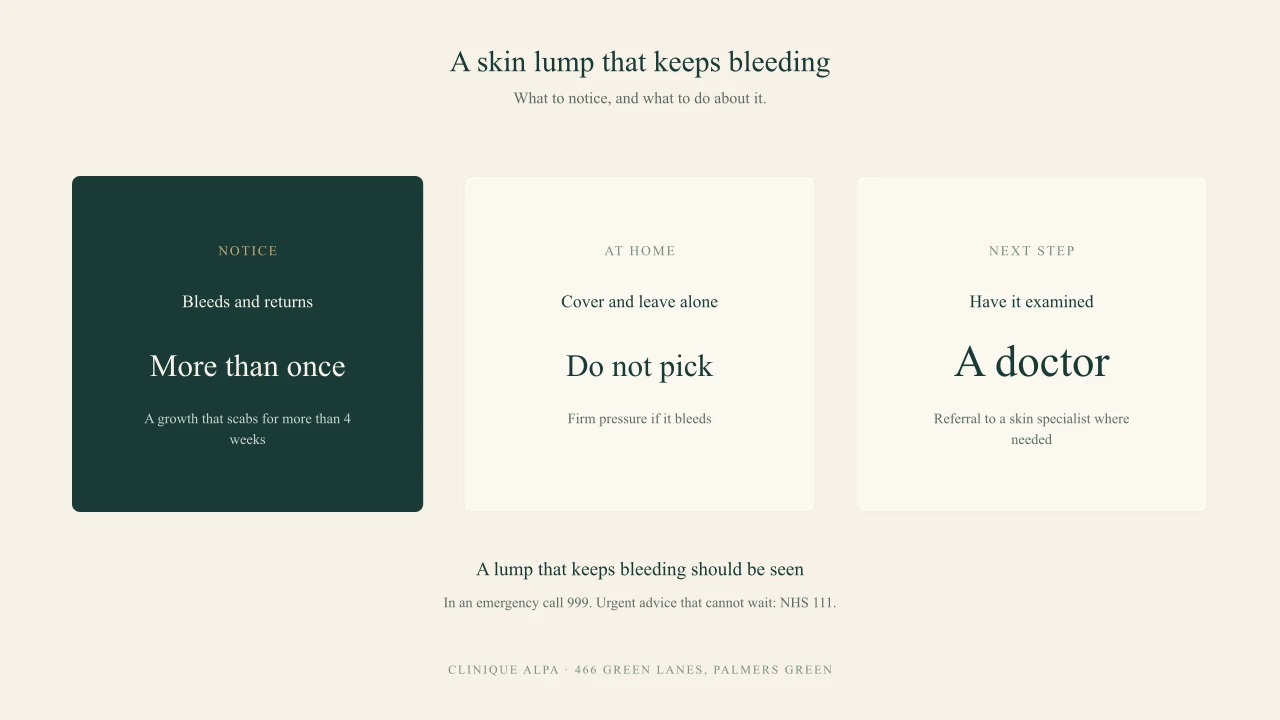
- A growth or patch that hurts, itches, bleeds, crusts or scabs for more than 4 weeks.
- A lump that is getting bigger, or has changed colour or texture.
- A lump that looks red, hot and swollen, or comes with a temperature.
Call 999 or go to A&E for bleeding that does not stop with firm pressure from a clean cloth, or if you feel faint. For a hot, swollen, painful lump ask for an urgent appointment or call NHS 111.
What can you do at home?
Press firmly with a clean cloth if it bleeds, and cover it with a dressing. Avoid picking at the scab or squeezing. Take a photograph with a ruler beside it, so that change can be seen later. Write down the date of each bleed, because the frequency tells a doctor a lot. Keep it out of the sun.
Common questions
What is a bleeding skin lump?
It is any growth that bleeds, from harmless blood vessel growths to skin cancer. A doctor needs to see it to say which.
Is a bleeding skin bump always cancer?
No. Many are harmless, but a bump that keeps bleeding or has not healed in more than 4 weeks should be examined.
Should a bleeding skin growth be squeezed or cut off?
No. Leave it alone, cover it and have it examined.
For a mole that is changing, read a changing mole with a family history. For changes under a nail, see a dark line in a toenail, and for skin changes in diabetes a darkening skin patch in diabetes.
How do we help at Clinique Alpa?
Call 020 8882 8088 or book online and tell us what has been happening. A 30 minute clinic consultation at 466 Green Lanes is £100. A home visit lasts 60 minutes and is from £250 on a weekday, with travel priced by postcode. We assess the lump and arrange referral to a specialist where it is needed.
More in this series: skin changes to get checked
- A changing mole with a family history of skin cancer
- A dark line in a toenail
- Skin lesion in diabetes: a darkening patch
Drafted with AI assistance, clinically reviewed by Dr Mitesh Parmar, MBBS MRCGP, Principal GP and Clinical Director at Clinique Alpa, 466 Green Lanes, Palmers Green, London N13 5PA. This article is general information, not personal medical advice. In an emergency call 999. For NHS advice call 111 or visit nhs.uk.