
The note is written. It is sitting in your inbox as a PDF, signed by a doctor you saw privately yesterday, and your thumb is over the forward button. The worry is not whether you are ill. It is whether someone in HR will write back to say this is not the right kind of note.
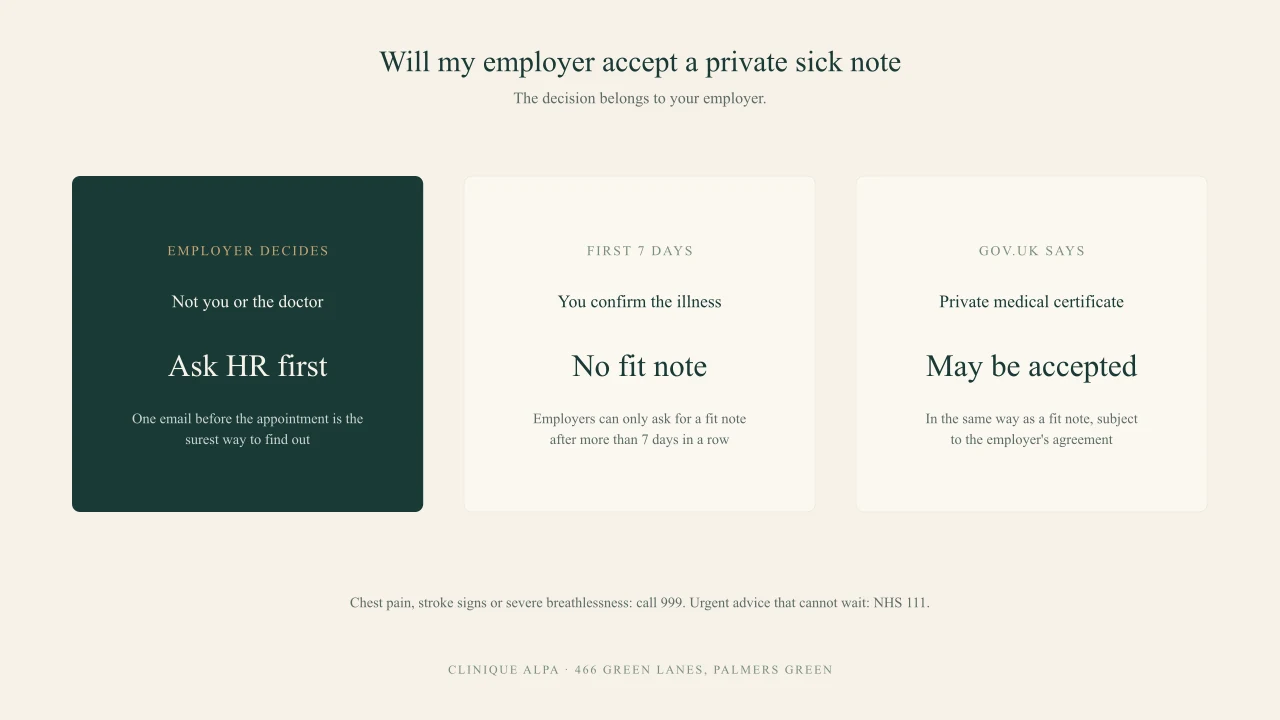
Will my employer accept a private sick note is the question I am asked before almost every one of these appointments. Some do and some do not. The decision belongs to your employer, not to me and not to you, and no doctor can promise it. It is better to understand that before you book than after you have paid.
Chest pain, signs of a stroke, severe breathlessness, heavy bleeding, a severe allergic reaction or symptoms of sepsis need 999 or A&E immediately. For urgent advice that cannot wait, call NHS 111.
Will my employer accept a private sick note under the GOV.UK rules?
The official position is short. The GOV.UK fit note guidance for patients and employees says that healthcare professionals in private practice who are not treating NHS patients may produce other forms of medical evidence, including private medical certificates, and that these may be accepted by an employer in the same way as a fit note, subject to the employer's agreement. The guidance written for employers and line managers tells employers much the same.
So nothing obliges an employer to accept a private certificate, and nothing stops them. When this comes up in consultation, the employers who hesitate are usually following a written absence policy that says a fit note from your GP. One email to HR before the appointment, asking whether a certificate from a private GP is acceptable, is the surest way to find out.
Timing matters too. GOV.UK tells employers they can only ask for a fit note once an employee has been off for more than 7 days in a row, counting non working days. For a shorter absence you confirm the illness yourself when you return. If your employer still wants medical evidence in that first week, the fit note guidance says the cost should be covered by the employer.
What does sick pay depend on?
Two different things get called sick pay. Statutory sick pay is the legal minimum. Its rules are set by government, not by any doctor, and GOV.UK publishes them: who qualifies, the current weekly rate and the number of weeks it can run. Your employer works it out and pays it. One rule is easy to miss when you are unwell. You are expected to tell your employer you are ill by their deadline, or within 7 days if they have not set one.
For proof, the eligibility rules ask for a fit note once you have been off for more than 7 days in a row. If your employer agrees, other evidence can be used in its place. A private certificate sits in that second group: evidence your employer may accept, not evidence it has to accept. No note, NHS or private, decides whether you are paid. Where there is a dispute about statutory sick pay, the fit note guidance points employees to HMRC.
The second kind is contractual sick pay, the fuller pay many employers offer through their own scheme. Its evidence rules are whatever your contract or staff handbook says. That is where wording such as a note from your registered GP tends to live, so read that paragraph before anything else.
What does the note actually state?
What I look at in clinic decides what goes on the page. I take the history, examine what needs examining and ask about the job itself: the hours, the lifting, the driving, the contact with the public. Then I write down an opinion I could defend if your employer rang to ask about it.
The certificate gives your name and date of birth, the date I assessed you and the period my opinion covers, with clear start and end dates. It says whether, in my opinion, you are not fit for work or may be fit for work with changes such as a phased return, altered hours, amended duties or workplace adaptations. It is signed by the GMC registered doctor who assessed you and carries the clinic's details, so an employer can see where it came from.
How much clinical detail appears is something we agree in the room. Many people prefer a plain description to a full diagnosis, and that is usually possible. I will tell you if leaving something out would make the note misleading.
The note does not tell your employer what they must do. GOV.UK is clear that the advice on a fit note is not binding on an employer, though they are recommended to consider it. Where a note says you may be fit for work with changes and no agreement can be reached on them, the guidance on sick leave says you are treated as not fit for work.
There are things I will not write. I do not certify a period of illness I cannot reasonably assess from your history and records. I do not adjust dates to fit a payroll deadline.
One smaller point saves a second appointment. GOV.UK says people do not need to be signed back to work, and the fit note has no option for it. If your employer asks for clearance before you return, that is a separate document, a fit to work letter, which I cover in what a doctor's letter for work should say.
From Dr Mitesh Parmar
A note works best when it is specific about what you cannot do and for how long, not just a diagnosis. I would also check your contract or sickness policy first. Some employers ask for their own form, and it is easier to write the right thing once than to reissue it.
What should you check before you book?
- Whether you need a note yet. Under 8 days of absence, you can usually confirm the illness yourself.
- Your employer's absence policy, and whether it names who the evidence must come from.
- Whether HR will accept a certificate from a private GP. Ask by email so the answer is in writing.
- The exact dates you have been off, and the date the illness began.
What if your employer says no?
Ask what, specifically, they need. Often it is a particular form, or the same information set out in their own order. Bring it, and I will tell you whether I am able to complete it. Sometimes the policy does require an NHS fit note. Once you have been ill for more than 7 days you can ask your NHS GP practice to assess you for one, and GOV.UK says there is no charge for it. With your consent we send a summary of my assessment to your NHS GP, so the examination is on record for them.
If the disagreement is about whether you are well enough for the job at all, an occupational health assessment arranged by the employer is the usual next step. What I cannot do is reword an opinion until it suits one side. If you are off because of stress or low mood, the assessment is a different conversation, and I have written about it in sick notes for mental health.
How does this work at Clinique Alpa?
The assessment is face to face at 466 Green Lanes, Palmers Green, 30 minutes with a GP, and the consultation is £100. Any document fee is separate and depends on the document; current fees are on appointments and fees. Sick notes, certificates and letters are provided where clinically appropriate after assessment. If the assessment does not support what the note is being asked to say, we tell you plainly and explain why. You can book online or call.
Drafted with AI assistance, clinically reviewed by Dr Mitesh Parmar, MBBS MRCGP, Principal GP and Clinical Director at Clinique Alpa, 466 Green Lanes, Palmers Green, London N13 5PA. This article is general information, not personal medical advice. In an emergency call 999. For NHS advice call 111 or visit nhs.uk.