
It usually takes a torch and a mirror, or a phone camera held at an awkward angle. Mouth wide, tongue down, and there at the back of the throat are small pale patches that were not there yesterday. Within a minute the question is no longer whether the throat is sore. It is what the spots are, and whether they mean antibiotics.
White spots on tonsils have several explanations, and the spots alone rarely settle which one. What decides the next step is what the rest of you is doing: how sore the throat is, whether you can eat and drink, and which way the illness is heading.
Chest pain, signs of a stroke, severe breathlessness, heavy bleeding, a severe allergic reaction or symptoms of sepsis need 999 or A&E immediately. For urgent advice that cannot wait, call NHS 111.
When do white spots on tonsils need NHS 111 or 999?
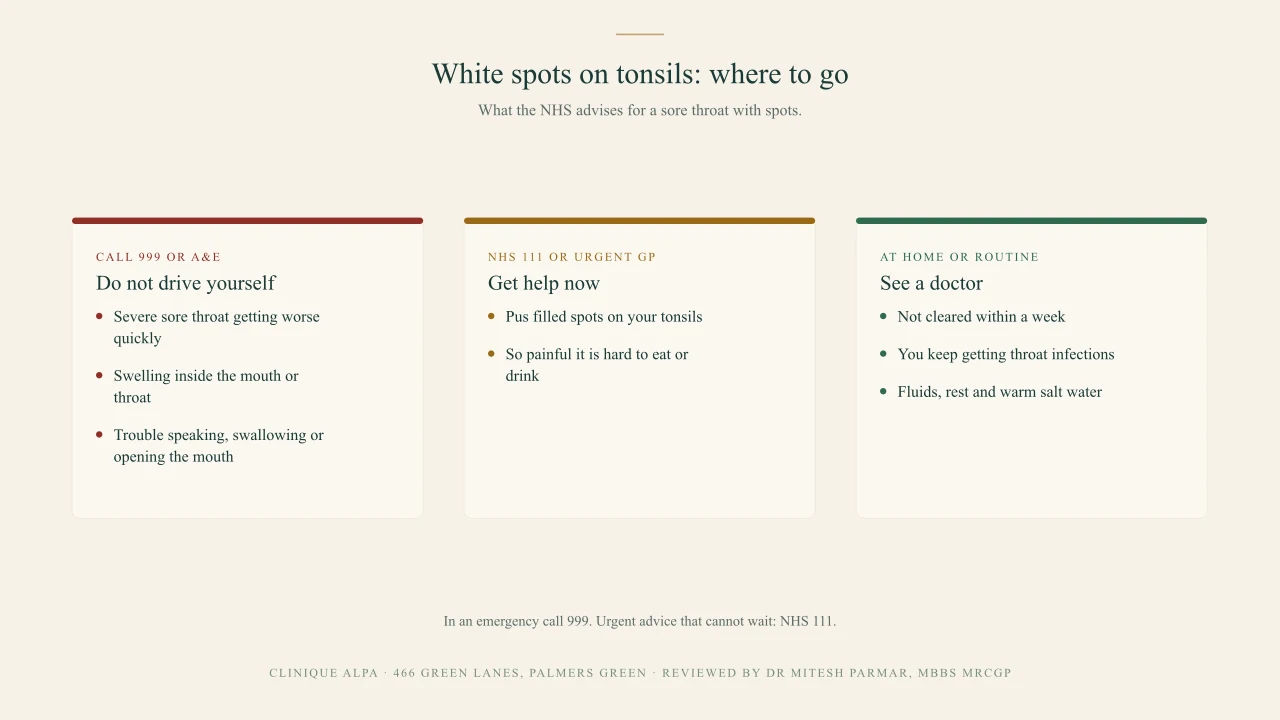
The NHS says to get help from NHS 111 now if you have pus filled spots on your tonsils, or if your sore throat is so painful that it is hard to eat or drink. Call 999 or go to A&E if a severe sore throat is getting worse quickly, or if you have swelling inside the mouth or throat, or difficulty speaking, swallowing, breathing or opening your mouth. Those are signs of quinsy, a collection of pus beside the tonsil. Do not drive yourself.
What causes white spots on tonsils?
The common explanations are these:
- Tonsillitis. The NHS describes red, swollen tonsils and, in more severe cases, pus filled spots or white patches, swollen painful neck glands and bad breath. It is caused by a virus or by bacteria.
- Glandular fever. This viral illness gives a very sore throat, swollen glands, a high temperature and marked tiredness, and the NHS says to see a GP for a severe sore throat that is not getting better.
- Debris in the folds of the tonsils. Small pale or yellowish specks can collect in the crevices of the tonsils. They may cause bad breath or a feeling of something there, and they are a common finding rather than a sign of illness in themselves.
When this comes up in consultation, people often ask me to tell them from the spots whether it is bacterial. I cannot do that reliably by looking alone, and I would be wary of anyone who says they can. That is why the rest of the assessment matters.
What do I look at in clinic with white spots on tonsils?
What I look at in clinic starts with the timeline. When did the sore throat start, and when did you first see the spots? Is it getting worse, staying the same or easing? Did a cold or cough come first, or is it throat only? Have you had a fever, chills, body aches, ear pain or a rash? I ask whether you can eat and drink normally, because that is the first practical test of how bad it is, and whether you have already started treatment from a pharmacy or elsewhere and how it went.
Then I ask about the background that changes decisions: previous throat infections, how often they come, any condition that affects the immune system, allergies to medicines, and what else you take.
Then I look. I check temperature, pulse and oxygen level. I look at the tonsils with a light: their size, whether they are equal, the colour of the surrounding throat, and the character of the spots, whether they are flat patches, small crypts with debris, or collections of pus. I feel the glands in the neck. I look in the ears and listen to the chest if there is a cough. I note how the voice sounds and how wide the mouth opens. A throat that is mildly inflamed, with a person who is eating and drinking and feeling better than yesterday, gets a very different plan from one with swollen, one sided tonsils and a mouth that will hardly open.
A swab may be needed to check for bacteria, as the NHS describes. I use it when the result will change what I do, not as a routine. The NHS says viral tonsillitis clears up on its own, and that antibiotics may be offered for bacterial tonsillitis. I would rather give you a clear reason for treatment, or a clear reason for not treating, than a course by default.
Sometimes the spots persist after a course of treatment has been completed. That is a reason to look again, not a reason for a second course by reflex. I reassess whether the diagnosis was right, whether another cause such as glandular fever is possible, and whether the pattern of repeated infections means a specialist opinion would help. The NHS advises seeing a GP if symptoms have not cleared within a week or if you keep getting throat infections, and I agree with both.
From Dr Mitesh Parmar
White spots can be tonsil stones, a virus or a bacterial throat infection, and I tell them apart by examining the throat, neck glands and temperature. Gargling and scraping at them yourself can make things worse. Difficulty swallowing saliva, drooling or trouble breathing needs 999. A swab is sometimes useful.
White spots on tonsils with no fever: what does it mean?
No fever does not rule out a throat infection, and a fever does not prove a bacterial one. Spots without a temperature are often a viral tonsillitis, a mild infection or harmless debris in the crevices of the tonsils. The thing to watch is the direction of travel over a few days, how painful swallowing is, and whether you are drinking enough. If it is not improving after a week, see a doctor.
White spots on tonsils that are not strep: what then?
Many are not. A swab can show whether bacteria are present, and the NHS describes the swab as the way to check. If the result is negative, that is useful information: it points towards a viral cause or towards another explanation, and it makes antibiotics less likely to help. You can read about the bacterial form in our piece on strep throat, and about ordinary tonsillitis on the tonsillitis page.
What helps at home while you wait?
The NHS suggests gargling with warm salt water, drinking plenty of fluids, eating cool or soft foods, avoiding smoke, resting, and asking a pharmacist about pain relief. Tonsillitis symptoms usually settle within about 3 to 4 days, though they can last longer.
Common questions
Do white spots on tonsils always mean an infection?
No. Pale specks can be harmless debris, but if you also have a sore throat that is getting worse, a doctor should look at them.
Do white spots on tonsils with a sore throat need antibiotics?
Not always. The NHS says viral tonsillitis clears up on its own, and antibiotics may be offered for a bacterial cause, so a doctor decides after examining you.
How do we help with white spots on the tonsils at Clinique Alpa?
Call 020 8882 8088 or book online and tell us how long you have had the spots and how the throat feels. A 30 minute clinic consultation at 466 Green Lanes is £100 with Dr Parmar or another Clinique Alpa doctor, and the fees page lists everything else. This is private care alongside your NHS GP, never a replacement, and with your consent a summary goes to your NHS GP.
Drafted with AI assistance, clinically reviewed by Dr Mitesh Parmar, MBBS MRCGP, Principal GP and Clinical Director at Clinique Alpa, 466 Green Lanes, Palmers Green, London N13 5PA. This article is general information, not personal medical advice. In an emergency call 999. For NHS advice call 111 or visit nhs.uk.