
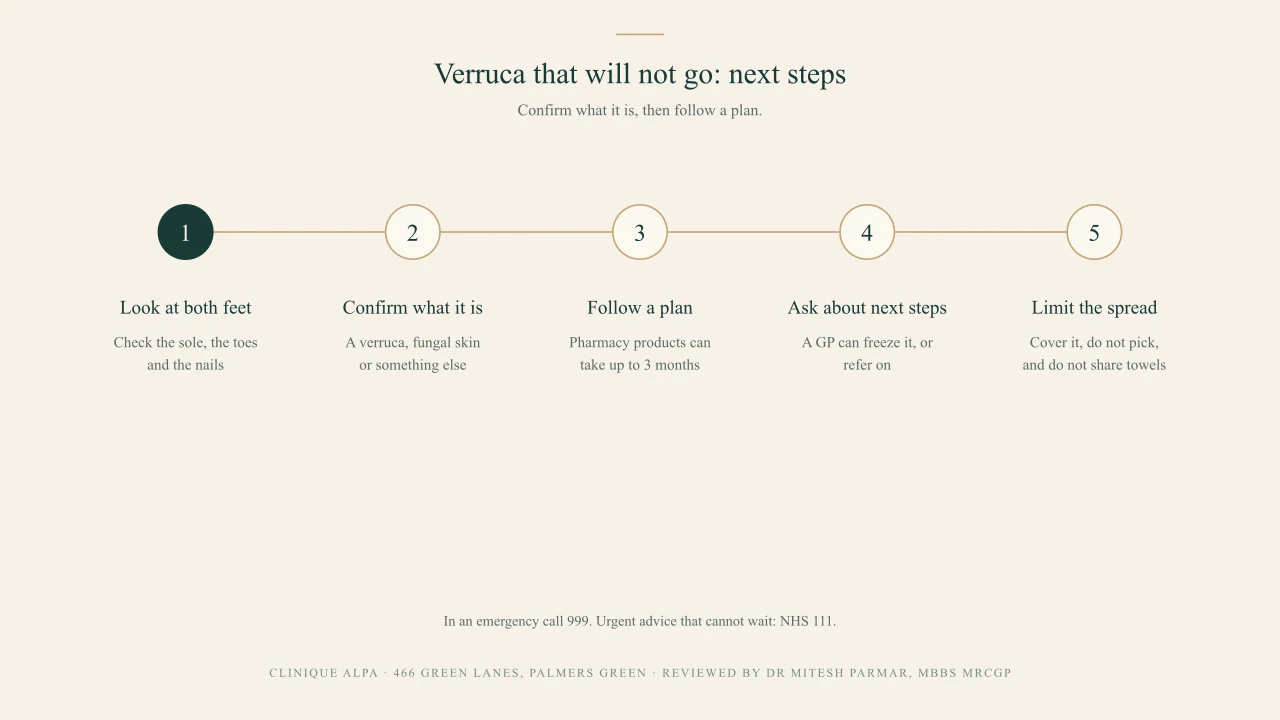
One verruca became two, then a cluster, and now there is a patch on the other foot as well. The treatment from the chemist has been used as directed, perhaps for weeks, and the foot looks no better and sometimes sorer. When a verruca keeps spreading, it is reasonable to start asking whether it is a verruca at all.
That is the question I ask first, and the rest of this page follows from it.
Chest pain, signs of a stroke, severe breathlessness, heavy bleeding, a severe allergic reaction or symptoms of sepsis need 999 or A&E immediately. For urgent advice that cannot wait, call NHS 111.
Why does a verruca keep spreading?
A verruca is a wart on the sole of the foot, and the NHS says warts and verrucas are caused by a virus. It passes through contaminated surfaces and close skin contact, and wet or damaged skin makes spreading more likely. The NHS describes them as harmless and says they often clear on their own, though this can take months or even years, and symptoms can take months to appear after the virus is picked up.
So a verruca that spreads is usually doing what the virus does. The usual helpers are damp skin, small cracks, scratching or picking, bare feet in shared places, and shared towels or socks. The NHS lists these as things to avoid. Treatments that irritate the surrounding skin can make matters worse, because broken skin is easier to infect, which is why a very sore patch after a home product deserves a closer look.
How is a verruca told apart from a fungal look alike?
This is where a doctor earns the fee. Several things on the foot look like verrucas from a photograph and are not. Fungal skin infection can produce thickened, scaly or macerated patches, especially on the sole and between the toes. Corns and callus are also common, and so are other skin lesions that need to be named properly. When lesions are spreading, I do not assume. I look.
What I look at in clinic starts with the surface. A true verruca interrupts the normal lines of the skin of the sole. If I pare a little of the surface away, tiny dark dots may show. It is often tender when squeezed from the sides, which is a different feel from pressure straight down on a corn. Fungal skin tends to have scale with a distinct edge, to itch, to affect the area between the toes, and to involve the whole foot, often in a pattern that is not quite the same on both sides. I look at both feet and the nails, including the toenails, because the NHS notes that athlete's foot, if untreated, can spread to them.
I ask how it started and how fast it has changed. A single lesion that appeared and grew for a long time is one picture. A rash of many lesions appearing across several weeks is another. I ask what has been used, for how long and what the skin did in response, because a patch that got angrier after a product tells me something. I ask about swimming, communal showers, gyms and shared footwear. I ask about the rest of you: eczema, diabetes, and a weakened immune system, all of which change what I advise. The NHS says to see a GP if a wart or verruca keeps returning, if it is very large or painful, if it bleeds or changes appearance, or if you are worried about a skin growth.
When this comes up in consultation, a common finding is that two problems are present at once: a verruca in one place and fungal skin infection in another. Treating only one leaves the foot looking unchanged and the person assuming that nothing works. That is why I look at both feet.
If a photograph is all I have, I can usually say what I think and what I would need to see. I would still like to examine the foot, because a diagnosis made from a picture is a hypothesis.
From Dr Mitesh Parmar
Look at the surface: a verruca usually interrupts the lines of the skin and has tiny dark dots. Corns, calluses and some skin conditions look similar. I look at it closely, sometimes with a dermatoscope. A lesion that bleeds, changes colour or is not typical should be checked, not just treated again.
What is the treatment if a verruca keeps coming back?
The NHS sets out the options. Pharmacy treatments are creams, plasters and sprays, and they can take up to 3 months, may irritate the skin and do not always work. A GP can freeze the wart, sometimes over several sessions. A dermatologist is the route if treatment fails or the wart is on the face, and a podiatrist for a large or painful verruca, who may offer stronger medicines, freezing or surgical removal.
I add two things from my own practice. First, if the diagnosis is uncertain or the lesion is changing, I would rather confirm it before treating. Second, if fungal skin infection is part of the picture, it is treated with its own antifungal plan, and the verruca plan does not replace it.
How do you stop a verruca spreading?
The NHS advice is practical:
- Wash your hands after touching a wart.
- Change your socks daily if you have a verruca.
- Cover it with a plaster when swimming.
- Do not share towels, flannels, socks or shoes.
- Do not walk barefoot in public places with a verruca.
- Do not scratch or pick at it, and do not bite your nails or suck your fingers.
Keeping feet clean and dry helps too, for the same reason it helps with athlete's foot.
When should you come in sooner?
A verruca is rarely urgent. Book a doctor sooner than you planned if a lesion is bleeding, changing in size, shape or colour, or very painful, if you have diabetes or a weakened immune system, or if you are simply worried about it. If a foot or leg becomes hot, red, swollen and painful, ask for an urgent GP appointment or call NHS 111, because that can be a skin infection. Call 999 or go to A&E if that comes with a very high temperature, shivering, a fast heartbeat, confusion, dizziness or purple patches on the skin.
Common questions
Why does my verruca keep coming back?
Because the virus can remain in the skin after the visible lesion has gone, and because damp, damaged skin and shared surfaces make it easy to pick up again. If it keeps returning, the NHS advises seeing a GP.
What should I do if my verruca will not go away?
Have it examined to confirm the diagnosis, then follow a treatment plan. The NHS says pharmacy products can take up to 3 months and do not always work, so ask about the next step if nothing changes.
Does a wart keep spreading if I leave it alone?
It may. They often clear on their own, but not predictably, and the NHS says it can take months or years. Covering it and not picking at it can reduce the spread.
How does Clinique Alpa approach this?
A clinic consultation at 466 Green Lanes is 30 minutes with a doctor and costs £100. I examine the skin, tell you whether I think it is a verruca, a fungal infection or something else, and agree a plan and a date for review. The warts and verrucas guide covers the condition in general, and the skin lesions guide is useful if you are worried about another mark. For the fungal side of the question, see my article on itchy cracked heels and athlete's foot. The NHS page on warts and verrucas lists the prevention steps. With your consent, a summary goes to your NHS GP.
Drafted with AI assistance, clinically reviewed by Dr Mitesh Parmar, MBBS MRCGP, Principal GP and Clinical Director at Clinique Alpa, 466 Green Lanes, Palmers Green, London N13 5PA. This article is general information, not personal medical advice. In an emergency call 999. For NHS advice call 111 or visit nhs.uk.