
The strip came back with a faint trace of blood and a row of negatives everywhere else, and now there is a result in your hand that does not say infection and does not say all clear. Reading urine dipstick results without the context is a common way to end up either alarmed or falsely reassured, and neither is where you want to be.
The question is what a dipstick can and cannot tell you, and what to do when it shows something small and unexplained.
Chest pain, signs of a stroke, severe breathlessness, heavy bleeding, a severe allergic reaction or symptoms of sepsis need 999 or A&E immediately. For urgent advice that cannot wait, call NHS 111.
What do urine dipstick results actually show?
A dipstick is a plastic strip with small pads that change colour when they touch urine. Each pad looks for something different. In plain terms:
- white cells, a sign that the body is reacting to something, often infection
- nitrite, a chemical that some bacteria produce
- blood, in amounts too small to see
- protein, which can leak from the kidneys
- glucose and ketones, which relate to sugar and to how the body is using fuel
- acidity (pH) and concentration, which reflect how much you have been drinking
It is a screening test. It is quick and useful, and it cannot name the germ, show where blood is coming from or tell you how the kidneys are working. The NHS notes that a GP may do a urine test for a urine infection, but that it is not always needed, which is a reminder that the symptoms count as much as the strip.
Is there a urine dipstick results chart I can use myself?
You will find charts and printable sheets online, and I understand the appeal. I do not give one out, for a practical reason: a result means something only alongside the symptoms, the person and the sample. A faint reading on a strip in someone with no symptoms is a different question from the same reading in someone with burning and a temperature. The colour blocks on a chart look more precise than they are, and different brands read slightly differently.
What does a dipstick with trace blood and no infection markers mean?
It means there is a small amount of blood and nothing pointing to infection on that sample. By itself it is not a diagnosis. The causes overlap with the ones the NHS lists for blood in the urine: infection, kidney stones, and the prostate in men. It can also come from outside the urinary tract altogether, as the NHS notes that a period or bleeding between periods can look similar, and a sample taken then can show blood.
Because the NHS says blood in the pee must be checked, even when the amount is small or you are unsure it is blood, a trace on a strip should not simply be filed away. Most of the time it turns out to be something minor. It still needs a sensible sequence of steps so that the occasional serious cause is not missed.
What I look at in clinic
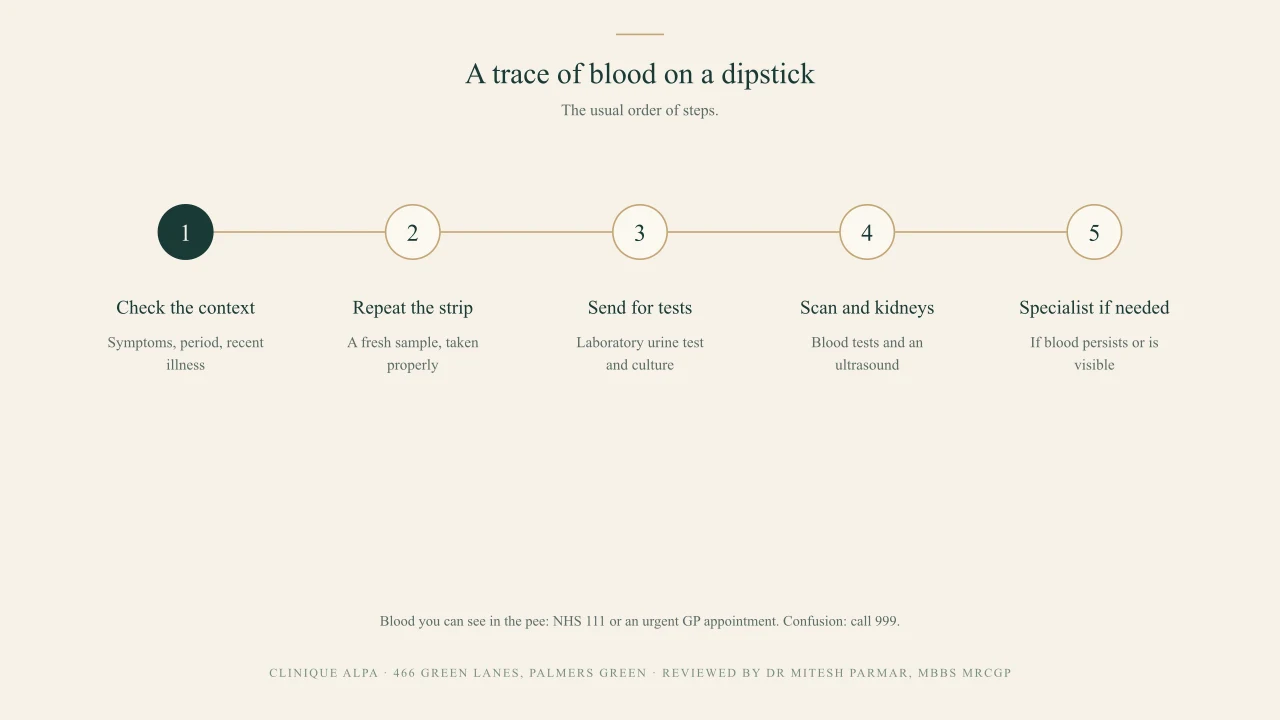
When this comes up in consultation, people often arrive with a result from a pharmacy, a workplace check or an earlier appointment, and they want to know how worried to be. I start with what was happening when the sample was taken. Were there urinary symptoms? Was it during a period? Had there been vigorous exercise, an injury, or a recent infection? Did the person have a high temperature or feel unwell? A sample taken in the middle of a period is one I would not rely on.
I then ask about the wider picture: past urine infections and what they grew, kidney stones, a family history of kidney disease, blood pressure, diabetes, and any medicines that thin the blood or change the colour of urine. I check blood pressure and examine the tummy and flanks. I repeat the dipstick on a fresh sample that I see taken properly, because a single result is a snapshot and repeating it is often the most informative first step.
If blood is still present on the repeat and there is no clear explanation, I arrange further tests: a urine sample sent for laboratory examination and culture, blood tests for kidney function, and an ultrasound of the kidneys and bladder through partner clinics. If there is a persistent finding, blood that can be seen, or risk factors that raise concern, a urology referral is the next step. The NHS describes the same sequence: a urine sample, a blood test, and referral to a specialist for further tests.
Equally important is what I say when everything is reassuring. A negative repeat and a normal scan allow a clear plan: what to watch for, and when to recheck, with a date. If the strip shows no infection and you do have symptoms, I do not dismiss them. A negative dipstick does not rule out infection, so a culture may still be needed. And if the result points to something that needs a different approach, we change course.
From Dr Mitesh Parmar
A dipstick is a screening test, not a diagnosis. Trace blood may come from contamination, exercise, periods, or something needing a closer look. I ask about symptoms and repeat it, sometimes sending a sample to the laboratory. Visible blood, or blood with pain or fever, should be checked sooner.
When to come in sooner
Call 999 or go to A&E if you are confused, drowsy or having difficulty speaking. Do not drive yourself.
Call NHS 111 or ask for an urgent GP appointment if:
- you can see blood in your pee, or think you might
- you have back or side pain under the ribs, or severe pain that comes and goes
- you have a high temperature, shivering or sickness
- burning or frequency has not improved 48 hours after starting treatment
- you have had 2 urine infections in 6 months or 3 in 12
How do we approach this at Clinique Alpa?
A face to face consultation at 466 Green Lanes is 30 minutes with a named doctor and costs £100. Urine analysis is done on site, with blood tests and scans arranged as needed through the investigations service. If the result is part of a wider set of tests, a results consultation can go through it all together. A video consultation does not suit this, because the sample needs testing in person.
This is the last of four articles on urine infections. Start with cystitis or kidney infection, then recurrent urine infection with blood, and urine infections with diabetes. For a straightforward infection, see UTI assessment at a private doctor. A referral is written where clinically appropriate after assessment and is included in the consultation fee. With your consent, a summary goes to your NHS GP.
Common questions
How do I read urine dipstick results for UTI?
White cells and nitrite point towards infection, but symptoms and a culture decide. A strip alone is not enough.
Can dipstick results be wrong?
Yes, in both directions. Timing, how the sample was taken, a period and the brand of strip can all change a reading.
Does trace blood mean something serious?
Usually not, but the NHS advises having any blood in the pee checked, because occasionally it is.
More in this series: urine infections
- Cystitis or kidney infection when back pain joins
- Recurrent urine infection with blood in the urine
- Urine infections when you have diabetes
Drafted with AI assistance, clinically reviewed by Dr Mitesh Parmar, MBBS MRCGP, Principal GP and Clinical Director at Clinique Alpa, 466 Green Lanes, Palmers Green, London N13 5PA. This article is general information, not personal medical advice. In an emergency call 999. For NHS advice call 111 or visit nhs.uk.