
The call to the family usually starts the same way. Mum or Dad was muddled yesterday, but today is different. They do not know the room they are in, they are seeing people who are not there, they have not slept, and nothing you say seems to land. Someone says it is the dementia getting worse. Someone else is not so sure.
That second voice is worth listening to. Dementia is gradual. When confusion arrives over hours or a day or two on top of dementia, there is very often something else going on, and it is often something treatable. This page explains why sudden confusion dementia calls for prompt assessment, and what a doctor looks for.
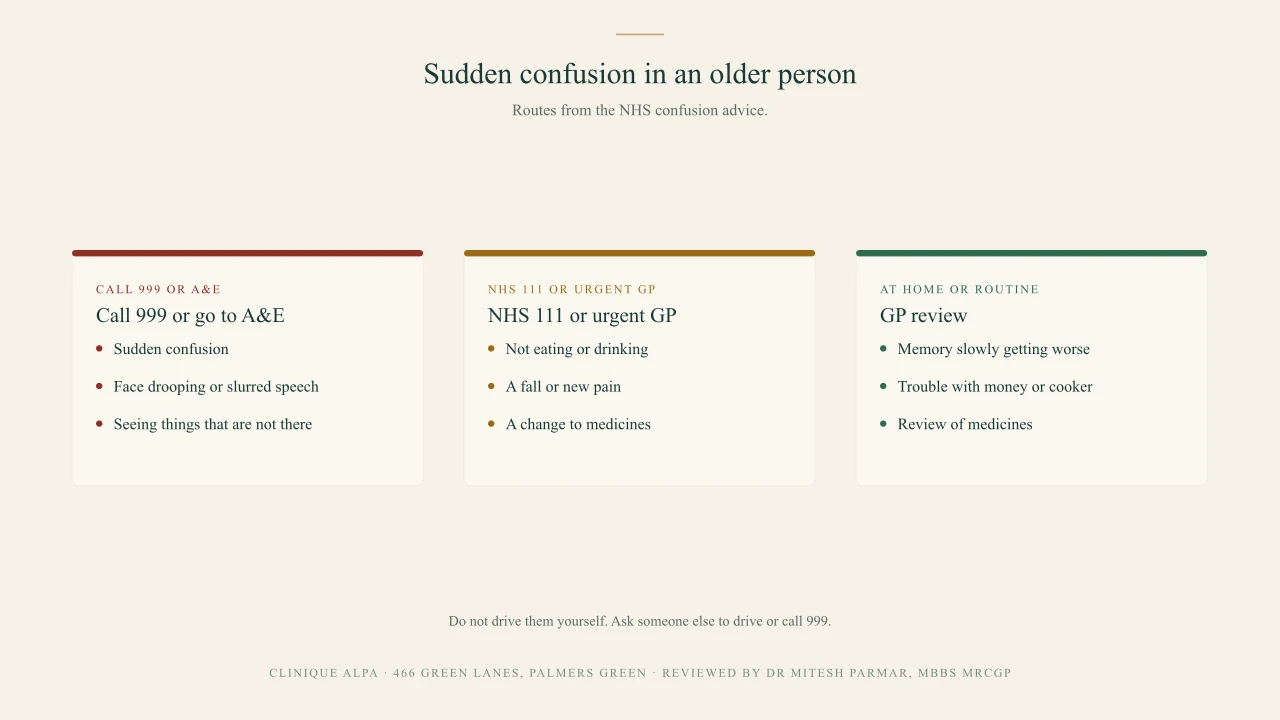
Sudden confusion in an older person needs urgent assessment. The NHS advises going to A&E or calling 999. Do not drive them yourself: ask someone else to drive, or call an ambulance, and bring any medicines they take. Chest pain, signs of a stroke, severe breathlessness, heavy bleeding, a severe allergic reaction or symptoms of sepsis also need 999 or A&E immediately. For urgent advice that cannot wait, call NHS 111.
Can dementia happen suddenly?
Dementia itself usually does not. The NHS describes forgetfulness or confusion that gets worse over time as something to see a GP about, and notes that in older people this can sometimes be a sign of dementia. Sudden confusion is a different thing. The NHS says that if someone suddenly becomes confused, you should go to A&E or call 999. It also advises against trying to diagnose it yourself.
People with dementia are more vulnerable to this, not less. A brain that is already working at the edge of its reserves has little room to cope with an infection, dehydration, pain or a new medicine. The change can look like the dementia taking a step down. Often it is a separate, reversible illness sitting on top.
Why does acute confusion often have a treatable cause?
The NHS lists the common causes of sudden confusion:
- Infections, especially urinary tract infections in older people or people with dementia.
- Stroke or TIA, the mini stroke.
- Low blood sugar in people with diabetes.
- Head injury.
- Certain medicines.
- Alcohol poisoning or withdrawal, and drug use.
- Carbon monoxide poisoning, especially if others in the home are unwell.
- Severe asthma attack, or lung or heart problems.
- Some epileptic seizures.
A common pattern is a few quiet days beforehand. Eating less, drinking less, sleeping badly, a new pain, a fall that was brushed off, or a change to a medicine. By the time the confusion is obvious, several of these have added up. Treating the cause, which may be an infection, dehydration or a medicine, can help the person recover towards how they were before, though recovery takes time and is not certain. That is the reason I would not put it down to the dementia without looking.
What does a doctor look at with sudden confusion?
What I look at in clinic, or at home, starts with the timeline. When did you last see them as they usually are? What changed first? I ask the person who knows them well, because the history from a confused person is unreliable, and the family usually notices the first signs before anyone else. I ask about eating, drinking and sleep, bowels and urine, any new pain, any fall, any new or changed medicine, and any alcohol.
Then I check the basics that are most often missed. Temperature, pulse, blood pressure and oxygen levels. Whether the mouth is dry, the skin dry, the urine dark. Whether there is a chest infection, a painful abdomen, a full bladder, constipation, a sore area from a fall or a pressure area. I look for signs of a stroke: weakness on one side, a drooping face, slurred speech. I check blood sugar where there is any chance it is low. I look at the whole medicine list for anything new, anything doubled up, and anything that causes drowsiness or confusion.
Tests come next where they would change the plan. A urine sample is a common one, but a urine test alone can mislead in older people, since many have bacteria in the urine without it being the cause, and I look at the whole picture before blaming it. Blood tests, a chest examination and sometimes a heart tracing complete the picture. If the findings point to a stroke, a severe infection, a head injury or someone who is too unwell to be managed safely at home, the answer is hospital, and I say so at once.
If the person is calm enough and there is no emergency, treatment depends on the cause, with a clear plan for fluids, food, pain, sleep and who will recheck. I give the family a specific time to look again and the signs that mean call sooner. The NHS also gives advice for the waiting time: stay with the person, explain where they are and reassure them, use simple words and short sentences, and avoid firing lots of questions.
From Dr Mitesh Parmar
A sudden change in someone with dementia is not simply the dementia getting worse. I look for infection, dehydration, constipation, pain and new tablets first, and check temperature, oxygen and blood sugar. Those causes can be treated. Drowsiness, a fall or one sided weakness needs 999.
What if the confusion has been getting worse slowly?
That is the other pattern, and it deserves its own appointment. Slowly worsening forgetfulness, getting lost in familiar places, trouble with money or the cooker, changes in mood or behaviour: these are for a GP review, not 999. I have covered memory and concentration problems in the memory and concentration guide, and an older relative who cannot easily get to a clinic is the reason for a GP home visit for an elderly parent.
Common questions
Is severe confusion in dementia an emergency?
If it has come on suddenly, the NHS advice is A&E or 999. Do not wait to see if it settles.
Is confusion an early sign of dementia?
Gradually worsening memory or confusion can be, and is a reason to see a GP. Sudden onset confusion is a separate problem needing urgent assessment.
What can I do while waiting for help?
Stay with them, use short, calm sentences, and note their medicines so you can hand the list over.
How do we help at Clinique Alpa?
For sudden confusion we will tell you to call 999 or go to A&E before we talk about an appointment. For the review afterwards, a video consultation with Dr Alpa J. Morawala is £79.99 for 30 minutes and suits conversations that do not need an examination. A clinic consultation at 466 Green Lanes is £100. A home visit may suit someone who cannot travel. Book online or call, and see appointments and fees for the rest. With consent, a summary goes to the NHS GP.
Drafted with AI assistance, clinically reviewed by Dr Mitesh Parmar, MBBS MRCGP, Principal GP and Clinical Director at Clinique Alpa, 466 Green Lanes, Palmers Green, London N13 5PA. This article is general information, not personal medical advice. In an emergency call 999. For NHS advice call 111 or visit nhs.uk.