
It began as a cold and it has not finished. The nose is blocked, there is a dull ache across the cheeks and behind the eyes, bending forward makes it worse, and the mucus has turned thick and yellow green. Someone at home says it must be sinusitis and that it needs treatment.
Sometimes it does. More often it needs time and the right kind of help for the nose. Working out which is the main point of the appointment, and it is the question behind most searches for sinusitis symptoms treatment.
Chest pain, signs of a stroke, severe breathlessness, heavy bleeding, a severe allergic reaction or symptoms of sepsis need 999 or A&E immediately. For urgent advice that cannot wait, call NHS 111.
What are sinusitis symptoms, and what usually settles without treatment?
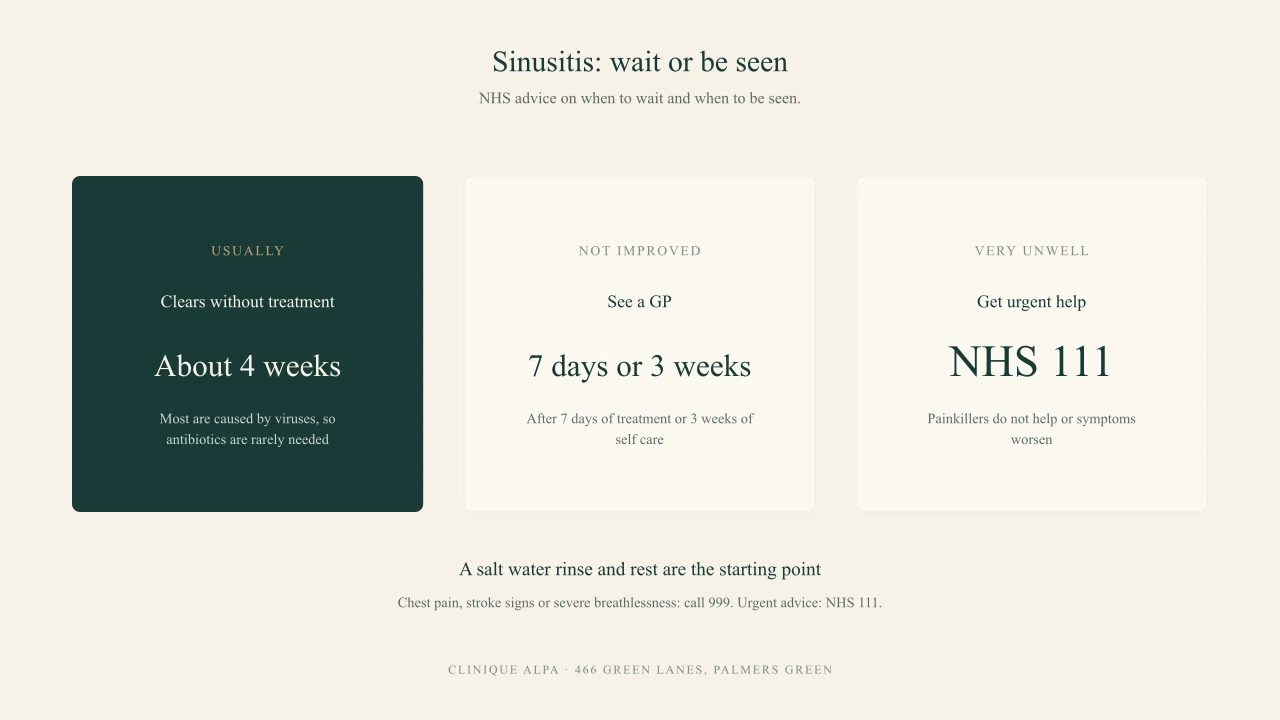
The NHS lists pain, swelling or tenderness around the cheeks, eyes or forehead; a blocked or runny nose with green or yellow mucus; a reduced sense of smell; a high temperature; headache, toothache, bad breath, cough or ear pressure. Sinusitis often follows a cold or flu, and it usually clears up without treatment within about 4 weeks.
The reason colour of mucus is a poor guide is that it changes with ordinary colds too. What matters more is the shape of the illness over time, and how much it is affecting you. Most sinus infections are caused by viruses, so antibiotics are rarely needed, as NHS advice makes clear.
When does a sinus infection need treatment?
When this comes up in consultation, a few features push me towards active treatment rather than waiting. A pattern that has been going on for a long time with no improvement. Pain that is getting worse and is not responding to simple painkillers. A high temperature that persists. A person who is run down by a long illness, or who has a weakened immune system. Or a clear second wave: improving, then worsening again.
A few features push me the other way. Symptoms that are slowly easing. A temperature that has settled. A person eating, drinking and sleeping reasonably. In that situation the plan is usually to look after the nose properly and set a date to look again.
What I look at in clinic
I want the story first. How did it begin, what has changed, and what has been tried? A nasal spray used for one day is a different story from one used for two weeks. I ask whether the blockage is on one side or both, because a persistent one sided problem has a different set of explanations. I ask about facial pain and whether it changes with bending forward, about the sense of smell, about a cough or sore throat from drip at the back of the nose, and about earache or toothache. I ask about hay fever and allergies, smoking, dust or chemicals at work, and previous episodes.
Then the examination. Temperature, pulse and an oxygen level on a finger probe, which we have on site. I press gently over the cheeks and forehead to see where the tenderness is. I look inside the nose for swelling, colour and mucus. I look at the throat, which often shows mucus running down from behind, and I check the ears, because a blocked nose and blocked ears go together. I feel the glands in the neck. If there is a cough, I listen to the chest, because I want to know whether this is staying in the sinuses or reaching the lower airways.
I am also quietly ruling out what is not a sinus problem. Many headaches that people call sinus headaches have another cause, and the plan for them is different. A tooth can cause pain in the cheek. An allergy can produce all the symptoms of a long sinus infection without any infection at all. NHS advice says antihistamines help if allergies are the cause.
The plan is built from this. For most people it is rest, fluids, simple painkillers, a salt water nasal rinse, avoiding smoke and known triggers, and a nasal spray or drops that reduce swelling, which the NHS notes may be needed for several months in some people. Antibiotics are reserved for the few who show signs that point to a bacterial infection, and I explain why. I give a review date, normally within a week or so, and I say what would make me want to see you sooner.
From Dr Mitesh Parmar
Most sinus trouble after a cold eases by itself, so I look at how long it has lasted, and whether it is one sided or worse after a better spell. Salt water rinses and steam help comfort. Swelling around the eye, a severe headache or a stiff neck needs urgent care.
What can you do yourself in the meantime?
The NHS suggests rest, plenty of fluids and simple painkillers if they are suitable for you, and never aspirin for anyone under 16. Avoid allergy triggers, do not smoke and try a salt water nasal rinse. A pharmacist can advise on sinusitis and on treatments for the nose. If you are 12 or older and think you may have sinusitis, NHS advice is to start with a pharmacist.
When should you come in sooner?
Get an urgent appointment or call NHS 111 if you are very unwell, if painkillers do not help or symptoms are getting worse, or if your immune system is weakened, for example by chemotherapy. For a child under 5, call 111. See a GP if you have not improved after 7 days of pharmacy or GP treatment, if you have not improved after 3 weeks of self care, if the symptoms keep coming back, or if the person affected is 11 or younger. If this is the pattern, the sibling article on sinus infections that keep returning explains the next steps. Call 999 for chest pain, severe breathlessness or any sign of a stroke.
How do we approach this at Clinique Alpa?
A clinic consultation with a named doctor is 30 minutes for £100. We take the history, examine the nose, ears, throat and chest, and agree a plan with a date to review. With your consent, a summary goes to your NHS GP. For the symptoms around the throat as well as the nose, the health library has a guide to sinus and throat problems.
Common questions
What is the treatment for sinus infection symptoms?
Most settle on their own within about 4 weeks with rest, fluids, painkillers and a salt water rinse. A doctor can advise whether a nasal spray or antibiotics are needed.
How can I prevent sinusitis?
Avoid known allergy triggers and smoke, and treat hay fever properly. A salt water nasal rinse is suggested by the NHS.
Is sinusitis pain treated differently?
Simple painkillers are the starting point, as advised by the NHS. Pain that is getting worse or does not respond to them needs to be seen urgently.
Sources: NHS: sinusitis.
More in this series: sinus problems
Drafted with AI assistance, clinically reviewed by Dr Mitesh Parmar, MBBS MRCGP, Principal GP and Clinical Director at Clinique Alpa, 466 Green Lanes, Palmers Green, London N13 5PA. This article is general information, not personal medical advice. In an emergency call 999. For NHS advice call 111 or visit nhs.uk.