
It is Saturday evening and the surgery closed yesterday. Someone in the house has been getting worse since lunchtime, not dramatically, but enough that nobody wants to go to bed without a decision. One of you has said hospital. The other has said that feels like too much.
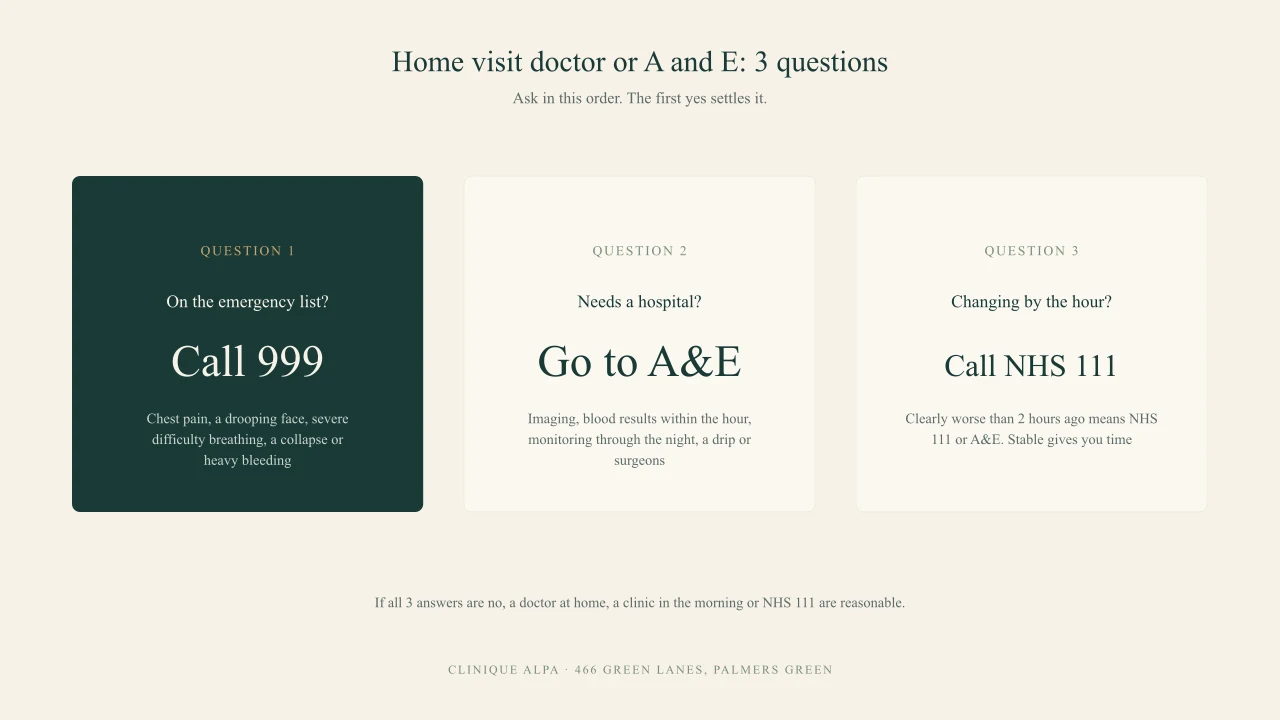
Should I go to A&E or GP is the question, with a doctor who comes to the house as a third option and NHS 111 sitting between them, and it has a more orderly answer than it seems to at that moment. I ask 3 questions, in the same order every time, and the first one that gets a yes settles it.
Chest pain, signs of a stroke, severe breathlessness, heavy bleeding, a severe allergic reaction or symptoms of sepsis need 999 or A&E immediately. For urgent advice that cannot wait, call NHS 111.
Should I go to A&E or GP: what are the 3 questions?
1. Is anything on the emergency list? If so, the decision is made. Call 999. Do not ring a clinic first, including this one.
- Chest pain, pressure or tightness, especially with sweating, sickness or pain spreading to the arm, neck, jaw or back.
- A face drooping on one side, a weak arm, or speech that is slurred or muddled.
- Severe difficulty breathing, or breathing that is worsening quickly.
- A collapse, a loss of consciousness or a seizure that does not stop.
- Heavy bleeding, or swelling of the lips, tongue or throat.
- New confusion or drowsiness with skin that looks blue, grey, pale or blotchy.
2. Does this person need something only a hospital has? A doctor at home brings a history, an examination and judgement. A hospital has imaging, blood results within the hour, monitoring through the night, fluids through a drip and surgeons. If the problem is likely to need any of those, A&E is the right place, however calm things look. That covers:
- A fall or injury with a limb that will not take weight or looks the wrong shape.
- A head injury followed by vomiting, drowsiness or confusion.
- Severe abdominal pain that is constant and getting worse.
- Vomiting blood, or passing black or bloody stools.
- A sudden, severe headache unlike any before.
- A deep wound that needs closing.
3. Is it changing by the hour, or holding steady? Speed matters more than severity. Something that is clearly worse than it was 2 hours ago needs assessing now, which means NHS 111 or A&E. Something that is unpleasant but stable gives you time to choose.
If all 3 answers are no, you are in the territory where a doctor at home, a clinic appointment in the morning or advice from NHS 111 are all reasonable.
What is NHS 111 for?
It is for exactly the moment when you cannot place the problem. NHS 111 is free and answers at any hour. They assess the situation and direct you to the right place, which may be an urgent treatment centre, an out of hours service, a pharmacist or A&E.
If you are hovering between questions 2 and 3, ring them. I would rather you spoke to NHS 111 and then decided you did not need us than booked a visit for something that should have gone straight to hospital.
What can a home visit add at night or the weekend?
An examination, and a decision made by a doctor who has an hour. That is the whole of it, and for the right problem it is a great deal.
When this comes up in consultation, the problems that suit a visit have a pattern. The person is unwell enough that waiting 2 days feels wrong, and well enough that nothing on the lists above applies. A fever with urinary symptoms in someone who is otherwise holding up. A chest infection where breathing is comfortable at rest. Vomiting and diarrhoea in an adult who is still passing urine. A back that has locked, with normal strength in the legs and no change in the bladder or bowels. A frail parent who is "not right" and whom nobody wants to move across London to sit in a waiting area overnight.
What I look at when I arrive is the same as in clinic: the story in order, then pulse, blood pressure, temperature and oxygen level, then the examination the story points to. What I am really doing is answering question 2 with my hands and eyes rather than over a telephone. Most of the time the answer is that this can be managed at home, with a plan for the next 24 hours and clear instructions on what would change it. Sometimes the answer is hospital, and then the person goes with a reason, a set of observations and a referral rather than a guess.
It is worth saying plainly what a visit is not. It is not an ambulance, and it is never quicker than one. A doctor has to be free and has to drive to you, so it will not always be possible at short notice. And if you ring us and the description sounds like an emergency, we say so and direct you to 999 or A&E rather than book you in.
From Dr Mitesh Parmar
I ask three things first. Is breathing easy, is the person alert, and is the pain getting worse? Chest pain, struggling for breath, collapse, severe bleeding or sudden weakness means 999. If you are unsure, NHS 111 can help you decide, and I would rather you were checked than waited through the night.
Is waiting until morning ever the right answer?
Often, yes. If the problem is uncomfortable but stable, the person is drinking, passing urine and making sense, and none of the lists above apply, a night's sleep and a morning appointment is sound medicine.
The clinic is open on Sunday from 09:30 to 17:30 and Monday to Friday from 09:00 to 20:00, and a 30 minute consultation is £100. It is closed on Saturday, although home visits still run.
If you do decide to wait, decide in advance what would end the waiting. Write it down if it helps: a temperature that will not settle, breathing that becomes harder, pain that moves or sharpens, a person who becomes muddled or difficult to rouse. If any of those arrive at 2 in the morning, you already know the next step, and it is 999 or NHS 111.
What does a home visit cost at these times?
A 60 minute home visit is from £325 at weekends and on bank holidays and from £450 for an evening start, with travel priced by postcode and shown before you book. A weekday visit is from £250. Where clinically appropriate after assessment, tests are arranged and a referral letter is included in the fee. With your consent, a summary goes to your NHS GP.
You can book online or call 020 8882 8088. Suitability is assessed first. Very late visits are arranged by telephone only and at the doctor's discretion, so call and we will tell you plainly whether one is possible.
I have written in more detail about what an evening home visit involves, and our emergency advice page sets out the 999 and NHS 111 signs for adults and children in full.
Drafted with AI assistance, clinically reviewed by Dr Mitesh Parmar, MBBS MRCGP, Principal GP and Clinical Director at Clinique Alpa, 466 Green Lanes, Palmers Green, London N13 5PA. This article is general information, not personal medical advice. In an emergency call 999. For NHS advice call 111 or visit nhs.uk.