
The call to the insurer has been going for 20 minutes when the adviser says the sentence that stops things: before anything can be authorised, they need a referral from a GP. You have the policy number, the symptom and a specialist a colleague recommended. What you do not have is the piece of paper, and you are not sure whose job it is to write it.
People search for private GP health insurance at exactly this point. The real question has 3 parts. Will a private GP's referral do, what does it need to say, and what will the insurer still leave you to pay. I can answer the first 2 from the consulting room. The third belongs to your policy, and I will show you what to ask.
Chest pain, signs of a stroke, severe breathlessness, heavy bleeding, a severe allergic reaction or symptoms of sepsis need 999 or A&E immediately. For urgent advice that cannot wait, call NHS 111.
How does a private GP health insurance referral work?
Most policies are built around specialist care, and the insurer wants a GP to confirm that a specialist is the right next step. NHS advice says the same thing from the other direction: if you want to see a private specialist, you are still advised to get a referral from a GP. That can be your NHS GP. It can also be a private GP who has assessed you. Which one your insurer accepts is their decision, and some policies have their own rules about it, so ask before you book anything.
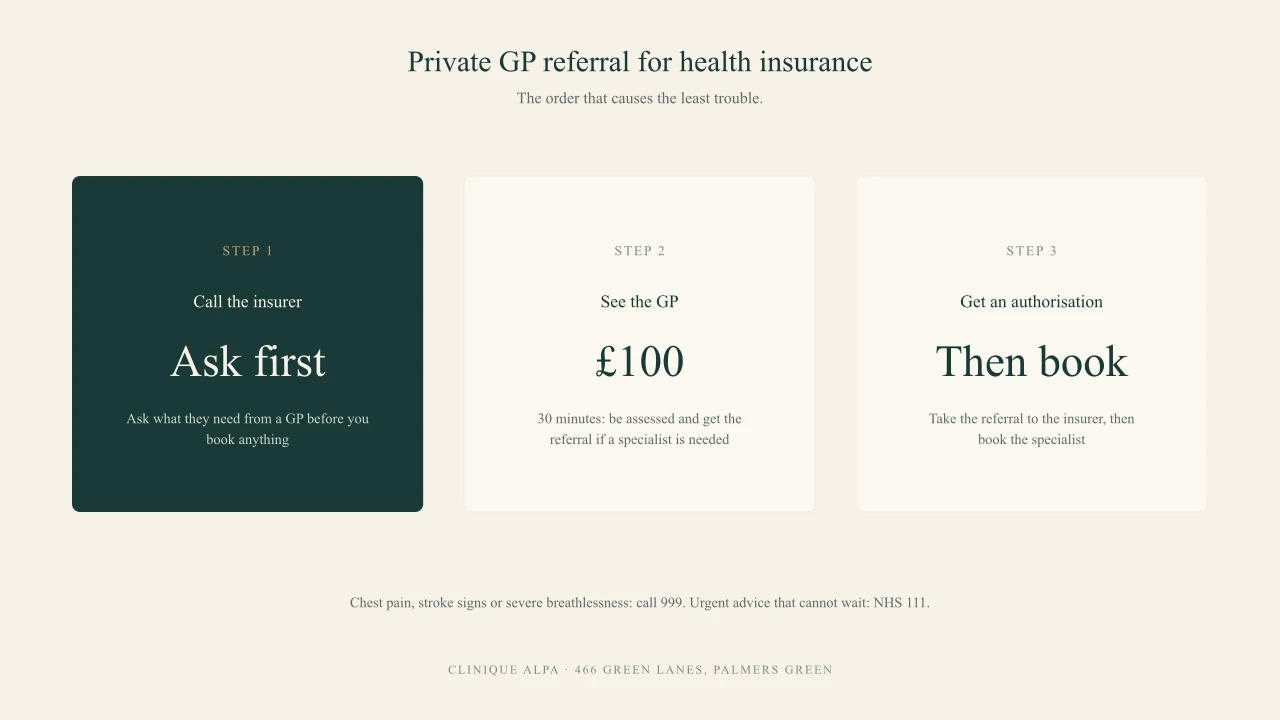
The order that causes the least trouble is this:
- Call the insurer and ask what they need from a GP.
- See the GP and be assessed.
- Take the referral back to the insurer and get an authorisation number.
- Only then book the specialist.
People who book the specialist first often find themselves trying to fit the paperwork around a date, and that is when claims become awkward.
What does the referral cover, and what do I look at before writing it?
What I look at in clinic is the problem, not the policy. A referral is a clinical document. It records what I have found and asks a colleague a specific question, and I can only write it honestly after I have taken the history and examined you. So the appointment looks like any other: when it started, how it has changed, what you have tried, what makes it better or worse and what you are worried it might be. Then the examination that the story calls for.
The piece most people miss is that I am also deciding whether a specialist is needed at all, and which kind. Shoulder pain that is really coming from the neck goes to a different clinic. Tiredness may need blood tests before it needs anyone. Sometimes the honest outcome is a plan and a review in 3 weeks, with no referral, and I would rather say so than send you to an appointment that leads nowhere.
Where a referral is the right step, it is written where clinically appropriate after assessment, and it sets out:
- The symptoms, and when they began.
- What the examination showed.
- Relevant medical history, current medicines and allergies.
- Tests already done and their results.
- What has been tried so far.
- The specialty needed, or a named consultant if you have chosen one.
- The question I would like the specialist to answer.
Insurers often ask whether they need a named consultant or an open referral to a specialty. An open referral gives them room to offer someone from their own list, which is why many prefer it. Ask them which they want and tell me at the start.
One thing needs saying plainly. Insurers pay close attention to dates, because many policies treat symptoms that began before the policy started differently. The dates in my referral are the dates you give me and the dates the records show. I cannot write a history to fit a policy, and you would not want a referral from a doctor who would. An accurate account is also the one least likely to cause trouble later, when the specialist takes the same history and writes it down again.
With your consent, a summary of the consultation also goes to your NHS GP, so the record that follows you through life shows what was found and where you were sent. Using insurance or paying privately does not change your place with your NHS practice. This is private care alongside the NHS, not instead of it.
From Dr Mitesh Parmar
Insurers usually want the referral to name the symptom, how long it has been present and what I found on examination. I will not guess a diagnosis to fit a form. Check whether your policy needs a named specialist or pre-authorisation, and bring the policy number and the insurer's contact details.
What do insurers usually not pay for?
I am a doctor, not an insurance adviser, and policies differ. These are the gaps people most often tell me they found afterwards, and each is worth one question to the insurer before you start:
- The GP appointment itself. Many policies begin at the specialist, so the consultation with a GP is yours to pay. Some include GP cover. Ask.
- The excess. If your policy has one, the first part of the claim is yours.
- Conditions that began before the policy. These are commonly excluded or treated differently.
- Long term conditions. Many policies cover finding out what is wrong and a period of treatment, then stop at ongoing monitoring.
- Anything not authorised first. A scan or a second appointment booked without a new authorisation may not be paid.
- Fees above the insurer's own limits. If a specialist charges more than the insurer allows, the difference can fall to you.
Here the consultation is paid for when you book, and whether any of it can be reclaimed is a question for your insurer. If they want one of their own forms completed as well as a referral, tell the clinic before you book, so that we can tell you whether that is something we can do and what it involves.
When should you not wait for an authorisation?
Paperwork is never a reason to sit on a symptom. Be seen sooner, by whoever can see you soonest, if:
- The problem is getting worse week by week.
- You have lost weight without trying.
- You have found a new lump, or bleeding that is new for you.
- Pain is waking you at night.
- There is new weakness or numbness, or a change in your bladder or bowels.
The emergency signs at the top of this page need 999, and NHS 111 can advise when you are unsure. Emergency care in this country is NHS care, whatever policy you hold.
How does this work at Clinique Alpa?
A clinic appointment is 30 minutes with a named doctor at 466 Green Lanes for £100 and the fee is shown before you pay. A referral written after that consultation is included in the fee. The fees of the specialist, the hospital and any tests they order are set by them, not by us, so ask for those figures before you commit.
Bring the insurer's answers with you: named or open referral, whether they authorise in advance, and any reference number you have been given. Bring your medicines and any results too. I have written separately about what goes into a private referral after a proper assessment, and about what a private referral actually costs once the specialist's fees are counted. If the specialist appointment is already booked, tell us the date when you call.
Drafted with AI assistance, clinically reviewed by Dr Mitesh Parmar, MBBS MRCGP, Principal GP and Clinical Director at Clinique Alpa, 466 Green Lanes, Palmers Green, London N13 5PA. This article is general information, not personal medical advice. In an emergency call 999. For NHS advice call 111 or visit nhs.uk.