
The medicines are on the kitchen table, the alarm on the phone is set, and the rhythm of the day is built around the next dose. Then a mealtime goes wrong, or food seems to stick, or someone stumbles on the way to the bathroom. At that point many families start searching for a parkinsons care plan, because they sense that the plan they have is a list of medicines and not a plan for a life.
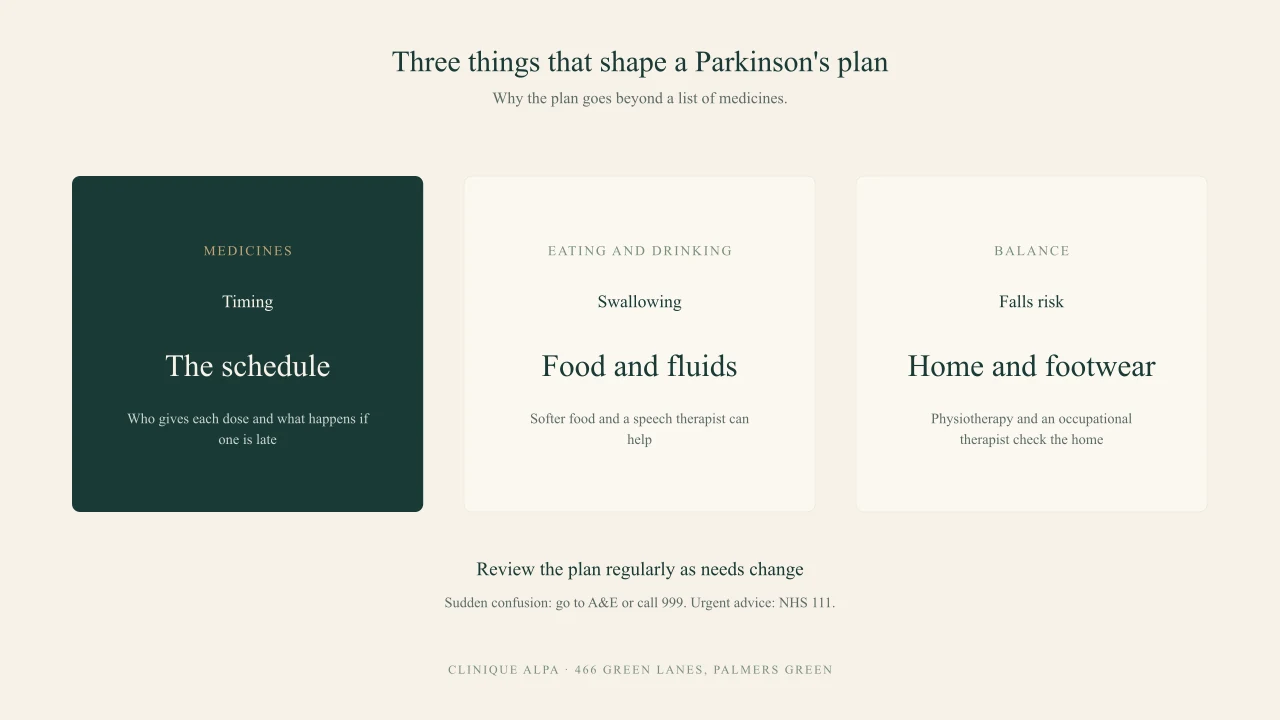
A good Parkinson's care plan is written around the things that make the condition hard to live with in practice: when medicines are taken, how safely someone can swallow, and how likely a fall is. This page explains why those three shape the plan, and what a review with a doctor covers.
Chest pain, signs of a stroke, severe breathlessness, heavy bleeding, a severe allergic reaction or symptoms of sepsis need 999 or A&E immediately. For urgent advice that cannot wait, call NHS 111.
What is a Parkinson's care plan?
The NHS says treatments are available to help reduce the main symptoms and support quality of life. It also says a care plan should be agreed with the healthcare team and family and reviewed regularly, because needs change as the condition progresses. In practice a plan is a shared document that says what matters to the person, what the main risks are, who does what, and when it will be looked at again.
It does not replace the specialist team who manage the condition. The plan sits around that care and makes sure the day to day details, the ones that rarely get discussed in a short review, are not left to chance.
Why does medicine timing matter in a Parkinson's care plan?
The NHS notes that medicines are usually started at a low dose and raised gradually, and that doses may need adjusting over the years. Because the dose and the schedule change, a care plan needs to say what the current schedule is, in plain terms, in one place that everyone who helps can read.
Several practical questions belong in the plan. Who gives or prompts each dose, and what happens when someone is away? What is done if a dose is late or missed? How does the schedule fit around meals, and does the person feel better or worse at particular times of the day? Do the other medicines they take, for the heart, the bladder, the stomach or the bowels, fit the same schedule without clashing? If a family member or carer is the alarm clock for every dose, the plan should say what happens when that person is ill.
This is also where I look for the second layer. A medicine list that has grown over the years sometimes contains items that nobody has reviewed. Constipation, low mood, poor sleep and memory change are all common alongside Parkinson's, and each can be made better or worse by what is on the list. Changes to Parkinson's medicines themselves should be made with the specialist team.
How does swallowing affect a Parkinson's care plan?
The NHS lists swallowing difficulties, called dysphagia, as a symptom, and says they can lead to malnutrition and dehydration. They can also make tablets, capsules and some foods hard to take. People often describe it as food catching, a need to wash things down, coughing at mealtimes, or meals that take much longer than they did.
The NHS says swallowing problems can improve with softened food, and that speech and language therapists can teach speaking and swallowing exercises or suggest assistive technology. A plan should therefore record any difficulty, who has been asked to assess it, and what changes at mealtimes in the meantime. It should also say how the person takes their medicines, because a medicine that cannot be swallowed safely is as good as a medicine missed. I would ask a pharmacist or the specialist team before crushing or changing the form of any medicine.
What about falls in a Parkinson's care plan?
The NHS says balance problems can make someone with the condition more likely to have a fall and injure themselves. The plan should therefore include a falls risk assessment. It looks at the home, including the route to the bathroom at night, rugs, steps and lighting. It looks at footwear, at dizziness on standing, and at whether any medicine could be contributing. And it records what has already been tried. The NHS describes physiotherapists helping with walking, flexibility and fitness, and occupational therapists checking that the home is safe so that someone can stay independent for as long as possible.
What does a doctor look at when reviewing a Parkinson's care plan?
What I look at in clinic is what has changed since the plan was written. I ask the person first, and the people who help them second, because the two answers are often different. What is a good day like, and a bad one? Which part of the day is hardest? What worries you most?
Then the practical checks. I go through the medicines and when each is taken. I ask about swallowing, weight and appetite, and look for signs of dehydration. I ask about falls and near misses, and check blood pressure lying and standing where that is relevant. I ask about bowels, bladder, sleep, mood and memory, since they are common and treatable. I look at how the person walks and gets up from a chair, and listen to how they speak and cough. Where the home is part of the problem, the review is easier at home, which is the reason I offer home visits for this.
The output is a short written plan. Who is responsible for each thing, what will be referred (to the specialist team, speech and language therapy, physiotherapy, occupational therapy or a dietitian), and a date to review. With consent a copy goes to the NHS GP so that nothing is held in only one place.
From Dr Mitesh Parmar
I compare what time doses are taken with when meals and symptoms occur, because small delays make a visible difference. I also ask about coughing at meals, drooling and falls. A swallowing assessment through the NHS or a speech therapist may be needed. Choking that does not clear, or a fall with a head injury, means 999.
When should you ask for help sooner?
- Coughing or choking at most meals, or losing weight.
- A fall that caused an injury, or repeated falls.
- Missed or late doses becoming common.
- Sudden confusion or hallucinations. The NHS advises A&E or 999 for sudden confusion.
- A family member who is the only carer and is struggling.
If you are looking for a plan or goals as a template, bring what you already have and we will build on it. For tremor itself, see the tremor guide. Parkinson's UK offers a free helpline on 0808 800 0303.
Common questions
What goes in a Parkinson's care plan example?
The person's priorities, the medicine schedule, swallowing and eating, falls risk, mood and memory, who helps and when it is next reviewed.
What are good Parkinson's care plan goals?
Goals should be the person's own, such as getting to the bathroom safely at night, eating without fear of choking, or keeping a regular activity. They need a date and an owner.
Is a care plan the same as a treatment plan?
No. The treatment plan is mainly the medicine and specialist care. The care plan covers daily life around it.
How do we help at Clinique Alpa?
A home visit lasts 60 minutes and is from £250 on a weekday, from £325 at weekends and bank holidays and from £450 for an evening start, with travel priced by postcode. A clinic consultation at 466 Green Lanes is 30 minutes and £100. Book online or call, and see appointments and fees for the rest. We work alongside the specialist team and the NHS GP, not instead of them.
Drafted with AI assistance, clinically reviewed by Dr Mitesh Parmar, MBBS MRCGP, Principal GP and Clinical Director at Clinique Alpa, 466 Green Lanes, Palmers Green, London N13 5PA. This article is general information, not personal medical advice. In an emergency call 999. For NHS advice call 111 or visit nhs.uk.