
The ache started in the neck and has been creeping. First it was only stiffness. Then it began travelling over the shoulder and down the arm, and now two or three fingers tingle when you hold a phone or a steering wheel. Sleep has gone, and sitting at a desk has become something you do in short bursts.
When someone searches for neck pain radiating to arm, the real question is usually narrower: is this a nerve being squeezed in the neck, does it need an MRI scan, and is there any chance it is something else? Here is how I think about each.
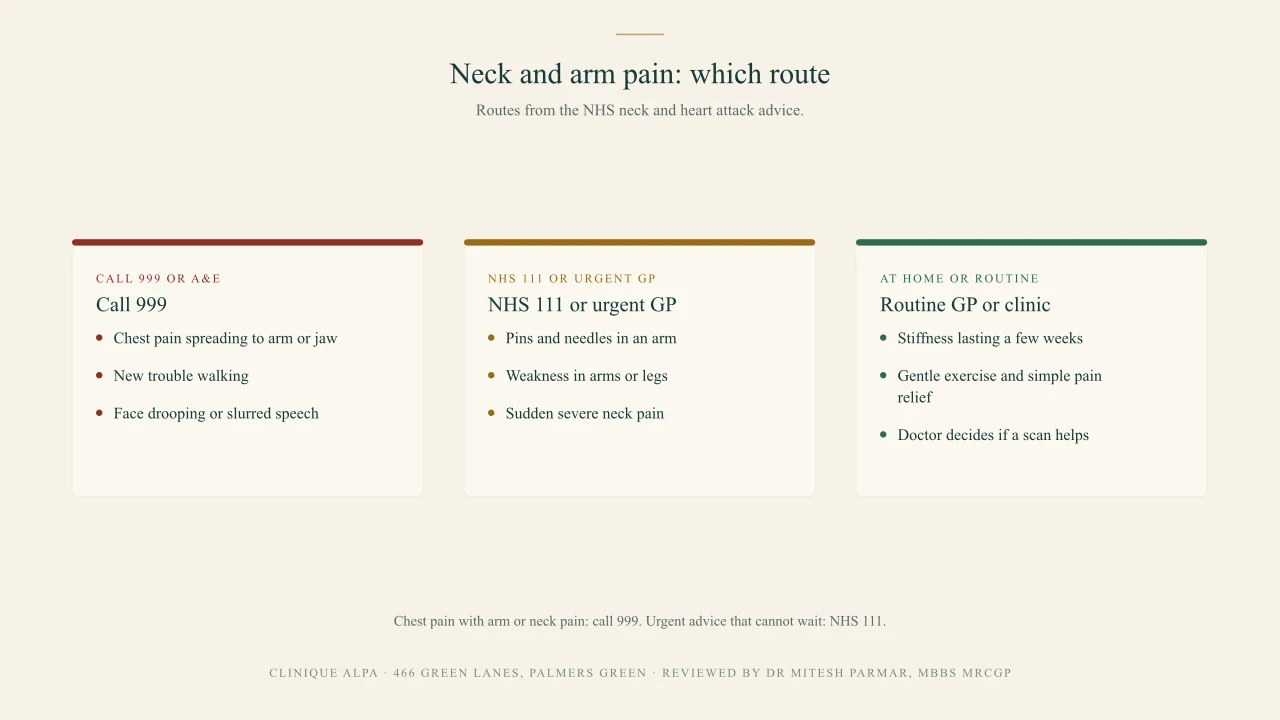
Chest pain, signs of a stroke, severe breathlessness, heavy bleeding, a severe allergic reaction or symptoms of sepsis need 999 or A&E immediately. For urgent advice that cannot wait, call NHS 111.
Could neck pain radiating to the arm be something urgent?
Start with the chest, because arm pain has more than one source. The NHS says to call 999 if you have chest pain that spreads to your arms, neck or jaw. Neck pain that comes with chest pain, breathlessness or sweating is not a neck problem until proven otherwise, and it does not wait for a booking.
The NHS also lists neck and arm features that need urgent help. Call 999 for new difficulty walking, loss of bladder or bowel control, sudden loss of coordination such as trouble with buttons, facial drooping, being unable to keep both arms raised, or slurred speech. Get an urgent GP appointment or call NHS 111 for sudden severe neck pain, pain getting worse quickly, heaviness or weakness in the arms or legs, pins and needles in an arm along with the neck or arm pain, or pain between the shoulder blades.
It is worth saying plainly that pins and needles in the arm is on the urgent list. That does not mean an emergency in every case. It means the symptom should be assessed by someone who can examine you, soon, and not left for weeks.
What is a trapped nerve in the neck?
The nerves to the arm leave the spine in the neck. The NHS calls nerve involvement in the arm cervical radiculopathy, and describes it as happening when a nerve is pinched, for example by a slipped disc or by bone. The result is pain that follows a line down the arm, often with tingling or altered sensation in particular fingers, and sometimes weakness in the grip.
The pattern is what makes it recognisable. Pain that spreads across the whole shoulder and upper back is more often muscle. Pain and tingling that follow a narrow strip into the thumb side or the little finger side of the hand point towards a particular nerve root. Many people notice it is worse at night, or when they look up or turn the head to one side.
What does a doctor look at with neck pain spreading down the arm?
What I look at in clinic starts with where the pain goes and what it feels like. Burning, tingling, an electric quality, a sense of heaviness: each tells me something. I ask which fingers are affected, whether the hand feels weaker, whether things slip from your grip, and whether the pain is worse with certain head positions. I ask about sleep, because pain that wakes you is a different conversation from pain that is only there at the end of a long day.
Then I ask about the rest of you. Any pain in the chest, any breathlessness, sweating or sickness with the arm pain. Whether there has been a fall, a knock, a whiplash type strain or a change in how you work. Weight loss, fever, a past history of cancer. Whether you have noticed any clumsiness in the hands, any trouble walking, anything with your bladder or bowels. Those are the questions that decide how fast the next step should be.
The examination is practical. I look at how the neck moves and where it hurts to move it. I test strength in the shoulder, elbow, wrist and grip, check sensation along the fingers, and test the reflexes in the arms. The NHS describes the same approach: examining the neck and shoulders, testing reflexes and watching how you walk. Small differences between the two sides are often more telling than any single result.
That examination is why I prefer to see people face to face for this. A video call can start the conversation, but strength and reflexes cannot be tested properly through a screen.
The scan question comes after that. The NHS says that, depending on symptoms, you may be referred for scans. I would think about neck imaging with MRI when there are definite nerve signs that are not settling, a weak arm or hand, or a picture that does not add up. If the findings are mild and improving, the plan is usually exercise, staying as active as you can, simple pain relief and a date to look again, because the NHS notes treatment takes a few weeks to work and symptoms can return.
When this comes up in consultation, people are often relieved by one thing: that a scan is a tool to answer a particular question, and not something to book just to see what shows up. Some change in the neck bones is a normal part of ageing, and many people have it with no symptoms at all.
From Dr Mitesh Parmar
I test arm strength, reflexes and feeling, and see which neck movements bring the pain on. That shows which nerve is trapped. Most settle with time and sensible movement. Weakness in the hand, trouble with balance or bladder, or pain with fever needs urgent help. Chest pain with arm pain needs 999.
What can you do while waiting to be seen?
- Keep moving the neck gently within comfort, and avoid staying in one position for long stretches.
- Take simple pain relief following the leaflet, and ask a pharmacist if you are unsure.
- Note which fingers tingle and whether it changes through the day.
- Write down anything in your chest, legs, bladder or bowels, even if it seems unrelated.
- Do not wait for a routine slot if the arm is getting weaker.
If it is mostly neck pain without the arm symptoms, see neck pain with a private GP in London.
Common questions
Is neck pain radiating to the arm and chest serious?
Chest pain that spreads to the arms, neck or jaw needs 999, according to the NHS. Do not try to work out the cause yourself.
Can neck pain radiating to the arm go away on its own?
Often it settles over a few weeks with exercise, staying active and simple pain relief, though the NHS notes symptoms can return. Pins and needles or weakness in the arm should be assessed soon.
Does it need an MRI?
Not always. It depends on the nerve signs found on examination and on whether they are improving.
How do we help at Clinique Alpa?
You can book online or call us. A clinic consultation at 466 Green Lanes is 30 minutes with a doctor and costs £100. Every fee is listed on appointments and fees. If the findings call for a scan or a specialist, we explain why and arrange the referral where clinically appropriate after assessment, and with your consent a summary goes to your NHS GP.
Drafted with AI assistance, clinically reviewed by Dr Mitesh Parmar, MBBS MRCGP, Principal GP and Clinical Director at Clinique Alpa, 466 Green Lanes, Palmers Green, London N13 5PA. This article is general information, not personal medical advice. In an emergency call 999. For NHS advice call 111 or visit nhs.uk.