
The tablets from the chemist took the edge off, then stopped doing so. By the time someone books with me, the discomfort high in the middle of the tummy has been coming and going for weeks or months, often with a tight, bloated feeling that arrives with it. Meals have become something to plan around.
Persistent indigestion is a reasonable thing to want looked at, and the question behind it is practical. What is causing it, does it need a camera test, and what happens if that test is clear?
Chest pain, signs of a stroke, severe breathlessness, heavy bleeding, a severe allergic reaction or symptoms of sepsis need 999 or A&E immediately. For urgent advice that cannot wait, call NHS 111.
When does persistent indigestion need more than home care?
NHS advice is to see a GP when indigestion keeps coming back. That is a lower bar than many people expect. It does not have to be severe or constant. Recurring is enough, particularly if it has changed in character or is happening on an empty stomach as well as after food.
Most of the time the cause is ordinary: acid irritating the lining of the stomach or gullet, a hiatus hernia, a stomach ulcer, or the effect of certain foods, alcohol, smoking, stress or anti inflammatory painkillers. Less often it is something that needs a scope to find. The skill is in sorting the first group from the second without sending everyone for a test they do not need, and without reassuring someone who should have been tested.
What I look at in clinic
I start with the pattern. Where exactly is the discomfort, and does it move? Does it come on after eating, on an empty stomach, or when lying flat? Is there bloating, belching, a sour taste, or a feeling of food sitting too long? People describe it differently, and the description often points to the cause before anything else is done.
Then the questions that decide how seriously to take it. Has your weight changed without trying? Has your appetite fallen, or do you feel full after very little? Is there any difficulty swallowing, or food that sticks? Have you been sick repeatedly, noticed blood in vomit, or passed black or tarry stools? Have you felt unusually tired or breathless, which can be a sign of low iron? These are the features NHS advice picks out as needing prompt attention, and I go through them one at a time.
The background matters as much as the symptom. A family history of stomach or gullet cancer, a past ulcer, a stomach infection that was treated, regular use of painkillers that irritate the stomach, smoking and alcohol, and a long list of other medicines all change what I think is likely. If you have had a scope before, I ask what it found and whether things have changed since.
The examination is short but not a formality. I feel the tummy for tenderness, for an enlarged organ and for any lump, check for pallor, and look at the weight against what you tell me. Blood tests are often the next step, usually to look for anaemia and to check the liver and other results. I also look for the stomach infection that can drive indigestion, and treating it is simple once it is found.
So when is a scope the right answer? A gastroscopy passes a thin camera through the mouth into the gullet, stomach and the first part of the bowel. NHS guidance lists indigestion, trouble swallowing, stomach pain, vomiting blood and dark sticky stools among the reasons for one, and it can take small samples at the same time. I think about it when symptoms keep returning despite sensible treatment, when any of the warning features above are present, or when the story is simply not settling into a pattern I can explain. It is a test with a purpose, not a reflex.
A scope is also not the end of the road if it is clear. Many people with a normal result still have symptoms. Indigestion without an ulcer or other finding is common, and it can still be treated: by changing the timing and size of meals, reducing the triggers, looking again at medicines, and agreeing a plan for what would make us look again. If bloating is the main complaint, a conversation about bowel habit follows, and the bloating and IBS guide covers that ground.
From Dr Mitesh Parmar
Swallowing, weight loss, vomiting, black stools and tiredness are what I ask about. Those alarm features decide how soon a scope is arranged. Without them we often try a sensible plan first. Antacids that have stopped working are a reason to be seen, not to keep adding more. Vomiting blood needs 999.
What should I do while waiting to be seen?
NHS self help advice is sensible and worth following. Cut back on coffee, tea, cola and alcohol, avoid rich, spicy or fatty food, stop eating 3 to 4 hours before bed, raise the head of the bed, and stop smoking if you smoke. If you take anti inflammatory painkillers such as ibuprofen or aspirin, do not carry on without asking a pharmacist or doctor, because they can irritate the stomach. A pharmacist can also advise on over the counter options for reducing acid.
Keep a short note for a week or two: what you ate, when the discomfort came, how long it lasted and what eased it. It takes five minutes a day and makes the consultation far more useful.
When should you come in sooner?
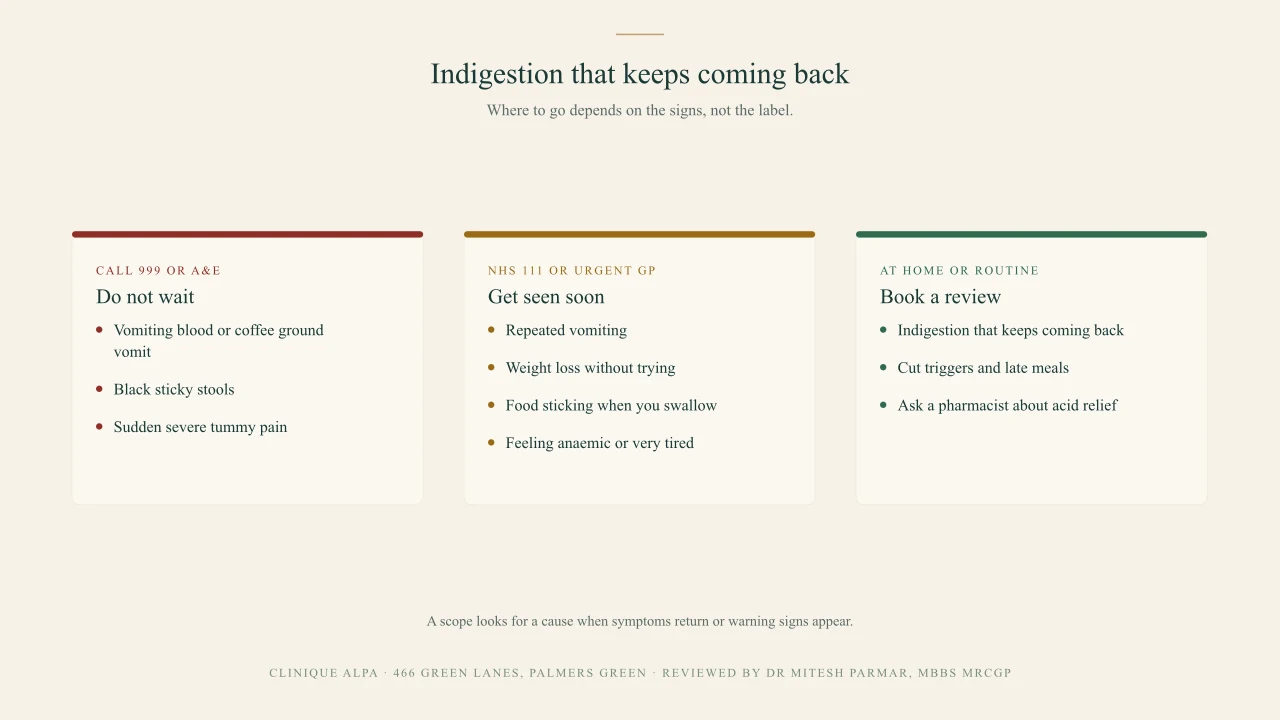
Call 999 or go to A&E for vomiting blood, vomit that looks like ground coffee, black sticky stools, or sudden severe tummy pain. Ask for an urgent GP appointment or call NHS 111 if you are being sick repeatedly, cannot keep fluids down, or your symptoms are getting worse. Do not wait for the next routine slot if:
- You are losing weight without trying.
- Food is sticking in your throat or swallowing has become difficult.
- You have been told you are anaemic, or you feel unusually pale, tired or breathless.
- You can feel a lump in the upper tummy.
- Indigestion is new and persistent, and you have not had it before.
How do we approach this at Clinique Alpa?
A clinic consultation with me is £100 for 30 minutes at 466 Green Lanes. I take the history, examine you, and explain which tests would change the plan and which would not. If a scope or a scan is the sensible next step, I explain what it involves and write the referral letter, which is included in the consultation fee, where clinically appropriate after assessment. Imaging such as ultrasound can be arranged through partner clinics, as described on the investigations page. With your consent a summary goes to your NHS GP. Our indigestion guide covers the basics if you want them first.
Common questions
What are the causes of persistent indigestion?
Acid irritation of the gullet or stomach lining is the most common, along with a hiatus hernia, an ulcer, a stomach infection, certain medicines, smoking and alcohol. Less often it needs a scope to find the cause.
What are the symptoms of persistent indigestion?
Discomfort or burning in the upper tummy, bloating, feeling full quickly, belching, feeling sick or a sour taste. Weight loss, swallowing trouble and repeated vomiting are the signs that should not wait.
Is it persistent indigestion or heartburn?
They overlap. Heartburn is a burning feeling rising behind the breastbone, while indigestion is usually discomfort in the upper tummy, and many people have both. The warning signs matter more than the label.
Sources: NHS: indigestion and NHS: gastroscopy and NHS: heartburn and acid reflux.
Drafted with AI assistance, clinically reviewed by Dr Mitesh Parmar, MBBS MRCGP, Principal GP and Clinical Director at Clinique Alpa, 466 Green Lanes, Palmers Green, London N13 5PA. This article is general information, not personal medical advice. In an emergency call 999. For NHS advice call 111 or visit nhs.uk.