
The home monitor has sat in a drawer for months, and then, a few days after a heavy cold, it throws up a number that makes you sit very still. You take it again and it is still high. By the time you pick up the phone you are not sure whether you should feel reassured or frightened.
High blood pressure home readings that appear after an illness are common, and one reading rarely tells the whole story. What matters is whether this is a passing effect of being unwell, or the first sign that your pressure has settled at a higher level than before.
Chest pain, signs of a stroke, severe breathlessness, heavy bleeding, a severe allergic reaction or symptoms of sepsis need 999 or A&E immediately. For urgent advice that cannot wait, call NHS 111.
What counts as a high blood pressure home reading?
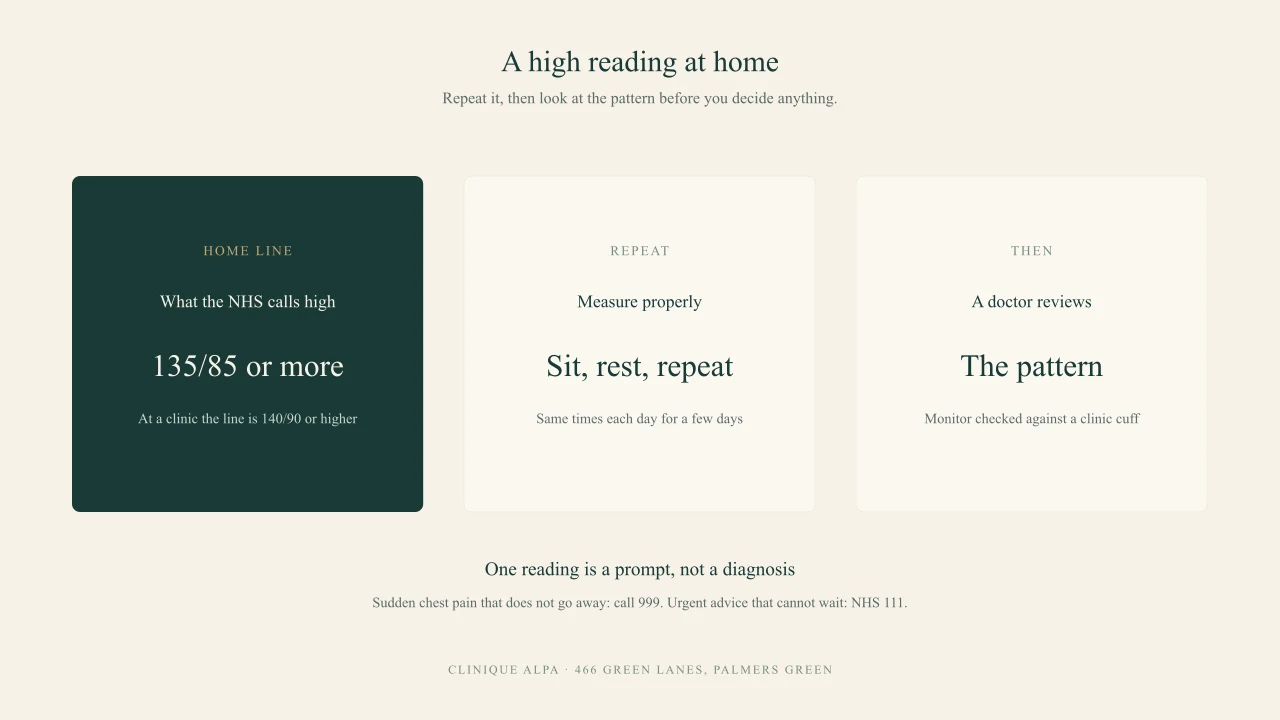
Blood pressure is written as two numbers, such as 130/80. For high blood pressure the NHS uses 140/90 or higher at a clinic and 135/85 or higher at home. Compare a home reading with the home figure.
Most people with raised pressure feel nothing at all. The NHS lists headaches, blurred vision and chest pain as rare symptoms, which is why a number on a screen is often the first and only clue. It also means a normal feeling does not prove a normal reading, and an alarming feeling does not prove a high one.
Why do home monitor high readings appear after an illness?
A body that is fighting an infection is under strain. Pain, a poor night, a dry mouth, a few too many coffees, an anxious afternoon spent checking the cuff and the odd over the counter cold remedy can all push the numbers up for a short time. Pharmacists can tell you which remedies are worth avoiding if you already know your pressure runs high.
When this comes up in consultation, a common pattern is someone whose readings are usually low or ordinary, who then records a run of much higher numbers during or just after a viral illness. The jump from their own baseline is what stands out, and it is usually the first thing I ask about. A reading that is high for you may not look dramatic on paper, and a reading that looks dramatic on paper may be an outlier within an otherwise settled pattern.
Technique matters. A cuff that is too small reads high, and so does talking, crossing the legs or measuring straight after climbing the stairs. None of this makes the monitor useless, it just means a first high reading should be repeated calmly before it is believed.
What is a good reading, and what is a bad one?
There is no single good or bad number, because the question is what your readings do over several days. A bad reading is one that stays above the home line when you are well, rested and measuring properly, or one that comes with symptoms. A good result is a run of readings that settle back towards your usual level once you have recovered.
The NHS advice, if a first reading is raised, is to monitor at home for a few days, to see a doctor again later, or to wear a portable monitor that records over 24 hours. That fits what I do in practice: gather a pattern before reaching a conclusion.
What I look at in clinic
I start with the illness itself: when it began, whether the fever has gone, how you are sleeping and eating, what you have taken for it and whether you were drinking enough. Then I ask about your own baseline. Do you usually run low, average or high? Has anyone ever told you your pressure was raised? Does high blood pressure, heart disease or stroke run in your close relatives?
Next, the monitor. I would rather you brought it than described it. I check the cuff size against your arm, watch how you sit and measure with it, and compare it against a reading taken on the clinic machine. If the two agree, your home numbers can be trusted. If they differ, we know by how much, and that is worth knowing before anyone makes a decision from your diary.
I take your pulse and check the rhythm, listen to the heart and lungs, and look for ankle swelling. Headaches, vision changes, chest discomfort and breathlessness change how urgently I act. Where it fits, I discuss blood tests that look at kidney function, blood sugar, cholesterol and thyroid function, plus a urine test, since these tell me whether anything is behind a rise and what your wider heart risk looks like.
The most useful part of the visit is often the plan for the next few days: when to measure, what to write down, and which reading would make you call sooner. If your readings stay high after you have recovered, a 24 hour monitor is the usual next step. If they settle, we have our answer, and it is the kind that does not need any treatment at all.
From Dr Mitesh Parmar
Rest for five minutes, sit with your back supported and the arm at heart level, and take two readings a minute apart. Illness, pain, caffeine and anxiety can all push a number up. I would rather see a week of readings than one worrying figure. A severe headache with chest pain needs 999.
What should you do with a high reading at home?
- Sit down with your back supported and your arm resting at heart level, and stay quiet for a few minutes before you measure.
- Repeat the reading once, and note the time, the numbers and how you felt.
- Check at the same times each day for a few days, rather than every hour.
- Keep taking any medicine you already take unless a doctor tells you otherwise.
- Bring the diary and the monitor to your appointment.
Checking again and again in a worried state tends to push the numbers up and rarely adds information.
When to come in sooner
Call 999 or go to A&E if you have sudden chest pain that does not go away, pain spreading to the arm, neck, jaw, stomach or back, or chest pain with sweating, feeling sick, light headedness or breathlessness. The NHS asks you not to drive yourself.
Call NHS 111, or get an urgent appointment, if you often have headaches or blurred vision, or chest pain that comes and goes. See a doctor routinely, rather than waiting for a routine check, if your home readings stay above the home line for several days once you are well. If you are 40 or over and have not had your pressure checked in the last 5 years, book a check anyway.
How do we approach this at Clinique Alpa?
A face to face consultation at 466 Green Lanes is 30 minutes with a named doctor and costs £100. That is long enough to check your monitor against ours, examine you, discuss the right blood tests and agree a plan for the days ahead. The clinic arranges bloods through its testing service, and ECGs and urine tests are done on site at the clinic, as described on the investigations page. With your consent, a summary goes to your NHS GP.
If you want to understand why a clinic reading and a home reading can differ, I have written about white coat readings and home monitoring, and the clinic keeps a general guide to blood pressure.
Common questions
Can an illness raise my blood pressure for a few days?
Yes. Fever, pain, poor sleep and dehydration can all push readings up temporarily. The reason to repeat measurements after you recover is to see where your pressure settles.
Is a home blood pressure monitor accurate?
Many are, if the cuff fits and you measure sitting quietly. A doctor can compare your monitor with a clinic reading to check it.
Do I need medicine after one high reading?
No. One reading is not a diagnosis. A decision about treatment is made after a pattern has been recorded, and treatment options are discussed with you.
Drafted with AI assistance, clinically reviewed by Dr Mitesh Parmar, MBBS MRCGP, Principal GP and Clinical Director at Clinique Alpa, 466 Green Lanes, Palmers Green, London N13 5PA. This article is general information, not personal medical advice. In an emergency call 999. For NHS advice call 111 or visit nhs.uk.