
The symptoms start part way through a shift, and they follow the temperature. Dizziness first, then nausea, a heavy sweat and an ache in the muscles, and all of it eases once the person is somewhere cooler. By the time they see a doctor they feel fine, which makes the whole thing difficult to describe and easy for a manager to doubt.
Heat intolerance at work raises two questions at once. What is causing it, and is there something a doctor can write that lets the workplace change? This is how I approach both.
Chest pain, signs of a stroke, severe breathlessness, heavy bleeding, a severe allergic reaction or symptoms of sepsis need 999 or A&E immediately. For urgent advice that cannot wait, call NHS 111.
What is heat intolerance at work?
Heat intolerance is a symptom, not a diagnosis. It means you cope badly with heat, or with a workplace that is too hot, in a way that other people around you do not. The NHS lists sensitivity to heat among the symptoms of an overactive thyroid, but that is only one of many possible causes, and often it is not the cause at all.
The NHS describes heat exhaustion as tiredness, dizziness, headache, nausea or vomiting, heavy sweating with pale clammy skin, muscle cramps, a high temperature and intense thirst. Anyone can get it in a hot enough place. What I am interested in is when it happens to you in conditions that others tolerate, or when it happens again and again.
What is causing my heat intolerance? What I look at in clinic
I start with the pattern. When do the symptoms begin, and how long into the exposure? What are the conditions at work: ventilation, how physical the task is, the clothing or protective equipment you wear, how often you can take a break and whether cold drinks are close by? Do you get the same symptoms in a hot room at home or on a warm day outside, or only at work? Do they ease when you cool down, and how quickly? Do you have any episodes with no heat at all?
When this comes up in consultation, the story often has a second layer. Poor sleep, a missed meal, drinking less than usual because of the job, a recent illness or a change in medicines each lowers the tolerance for heat. So I ask about all of them, including medicines bought over the counter and anything new, because some change sweating, blood pressure or fluid balance.
Then I ask about other symptoms that point somewhere specific. A racing or pounding heart, tremor, weight change, loose bowels, anxiety, poor sleep and persistent tiredness may suggest an overactive thyroid. Flushing and sweats at night, changes to periods or other hormonal changes can be part of the picture too. Feeling shaky, sweaty and hungry may relate to blood sugar. An infection can cause a fever that feels like heat intolerance.
The examination follows. Temperature, pulse and blood pressure, including sitting and standing to look for a fall in pressure. Skin, hydration, the neck for the thyroid, hands for tremor, a listen to the heart. If there is a rash, I look at it and ask when it appeared.
The NHS says a GP who suspects a thyroid problem can arrange a blood test to check how well the thyroid is working. A heat intolerance workup usually begins there, with other blood tests added if the history points that way, such as a blood count, kidney function and blood sugar. I explain what each test is for and what the result would change before anything is taken. Blood tests are priced separately, and the prices are on the site.
I also ask about stress, because long hours in uncomfortable conditions are a source of it and because anxiety can bring on sweating, a racing heart and a feeling of being too hot. Stress can make heat tolerance worse. It does not make the symptoms imaginary, and I do not treat it that way.
From Dr Mitesh Parmar
I ask whether symptoms follow heat, effort or dehydration, and I check blood pressure lying and standing, thyroid and blood count. The letter I can write describes the pattern and suggests sensible adjustments, such as breaks, water and cooler spaces. Your employer decides what is practicable. Collapse or confusion in heat needs 999.
Is heat intolerance a disability?
Heat intolerance on its own is a symptom, so the question is whether the cause and its effects meet the legal test. That depends on the underlying condition and how much it affects your day to day activities. I describe the effects honestly, and the decision belongs to your employer and, if it comes to that, a tribunal. I cannot declare it in a letter, and no doctor can promise how a workplace will respond.
Can stress cause heat intolerance?
It can make symptoms feel worse, and it is one of the things I ask about. It is not a reason to stop looking for a physical cause. Often both are present.
When does a letter for adjustments make sense?
When the symptoms are real, reproducible in particular conditions and fixable by changing those conditions. The strongest letters say what you can do and what you cannot do at present, and what would help: access to a cooler area, regular breaks, access to cold drinking water, lighter clothing where safety allows, and a review date. GOV.UK says employers must make reasonable adjustments so that workers with a physical or mental health condition are not substantially disadvantaged, and it lists changing working methods, moving work to a different space and phased returns among its examples.
Sometimes the right outcome is a fit note that says you may be fit for work with adjustments. Sometimes it is a letter saying you can work, but not in particular conditions. Both are provided where clinically appropriate after assessment. For the broader picture, see doctor letter for work adjustments, and for a longer report on fitness for work, see fitness to work report.
Do I have heat intolerance, and when should I seek help?
If you are not sure, a note of when it happens, what you were doing and how long recovery took is the most useful thing to bring. Come in sooner if the symptoms are happening repeatedly, are getting worse, or come with weight loss, a persistent racing heart or night sweats.
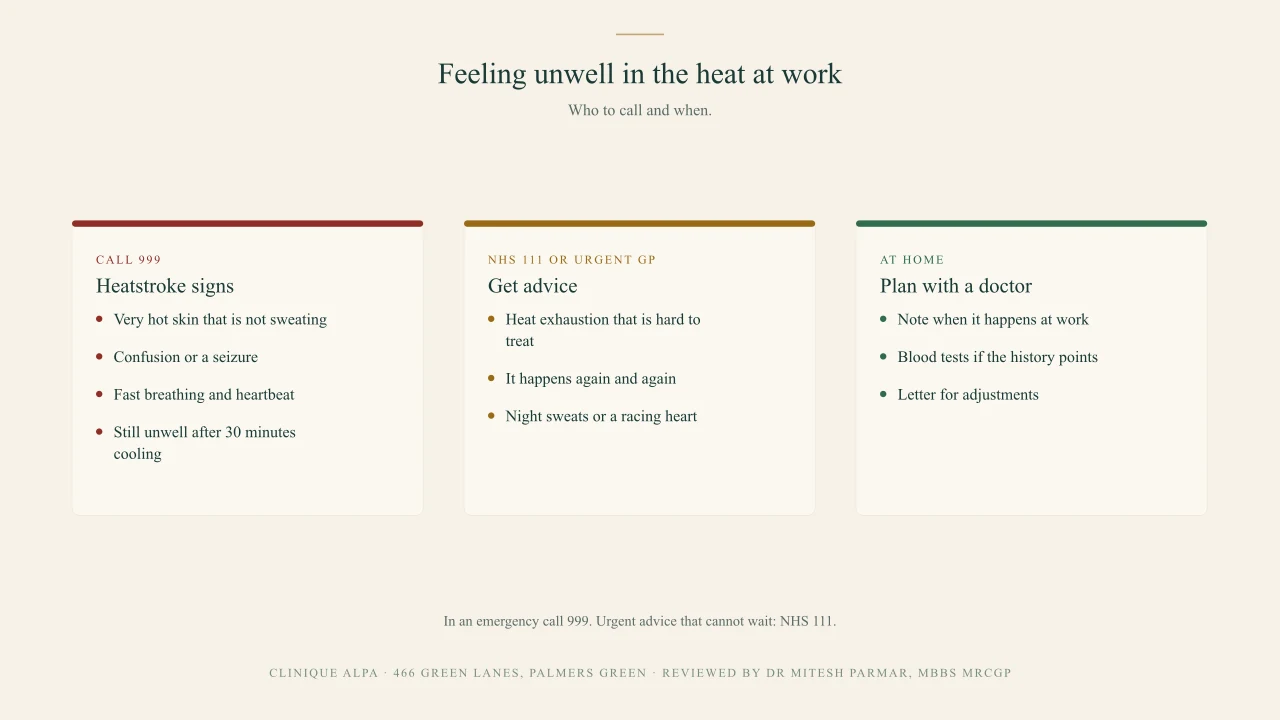
The NHS says heatstroke is a medical emergency. A very high temperature, hot skin that is not sweating, fast breathing and heartbeat, confusion, restlessness, a seizure or loss of consciousness needs 999. Call 999 as well if a person is still unwell after 30 minutes of rest, cooling and fluids. Call NHS 111 if heat exhaustion symptoms are hard to treat or you need advice.
Common questions
What is a heat intolerance workup?
A history and examination, usually a thyroid blood test and other tests if the history points to them.
Is heat intolerance at work covered by a letter?
A letter can set out what the symptoms stop you doing and what would help, where clinically appropriate after assessment. Your employer decides what to change.
Do I have heat intolerance if I only feel unwell at work?
That pattern is worth describing, because it suggests the conditions at work are part of the cause. It still needs a doctor to look for other causes.
How do we approach this at Clinique Alpa?
You see Dr Parmar at 466 Green Lanes for 30 minutes, for £100. A letter of one to two pages about fitness to work or capability is £250. An employment or reasonable adjustments report is £495. See the appointments and fees page for everything else. We provide letters where clinically appropriate after assessment.
This is an independent clinical opinion. It cannot be written to a required conclusion and does not guarantee the outcome of any claim, application, exemption or hearing.
Drafted with AI assistance, clinically reviewed by Dr Mitesh Parmar, MBBS MRCGP, Principal GP and Clinical Director at Clinique Alpa, 466 Green Lanes, Palmers Green, London N13 5PA. This article is general information, not personal medical advice. In an emergency call 999. For NHS advice call 111 or visit nhs.uk.