
The cardiologist has said the word procedure, and the family has gone quiet. There is a scan still to come, a decision to make, and an older relative who is more breathless than last month and tired in a way that has changed the whole shape of the day. Nobody doubts that something could be done. What they ask is whether it will give back the life that matters.
Heart valve disease is often discussed as a technical question, which valve and which procedure. For the family sitting in my room it is usually a different one: what would this mean for how my mother or my father lives? This is the last of three articles on heart failure at home, and it is about that question.
Chest pain, signs of a stroke, severe breathlessness, heavy bleeding, a severe allergic reaction or symptoms of sepsis need 999 or A&E immediately. For urgent advice that cannot wait, call NHS 111.
What is heart valve disease?
The NHS explains that heart valve disease means one or more heart valves do not work as they should. A valve can be narrowed, so it does not open fully, which is stenosis, or it can leak, so it does not close fully. Some people never need treatment. The NHS lists age related changes, damage from a heart attack, rheumatic fever and being born with a heart condition among the causes, and says high blood pressure, high cholesterol and smoking add to the risk of age related change.
Symptoms include shortness of breath, tiredness or weakness, dizziness, palpitations, chest pain and swollen ankles or feet. Some people have no symptoms at all and the problem is found when a doctor hears a murmur. For heart failure at home it matters because a valve problem can be one of the reasons the heart struggles, and treating the valve may change the picture.
What does a doctor look at with heart valve disease?
When this comes up in consultation, the person is often an older adult already living with heart failure and perhaps diabetes or high blood pressure, under a cardiology team, with a long list of medicines. The symptoms rarely belong to the valve alone. Breathlessness, tiredness, dizziness, poor sleep and general aches can all come from the valve, the heart failure, the medicines, the blood pressure or something else, such as anaemia, an infection or a problem with the ears or balance.
What I look at in clinic is whether the symptoms add up to one story. I ask exactly what has changed, and when, what the person can no longer do, and what they most miss. I check pulse, blood pressure sitting and standing, oxygen level, the chest and the ankles, and review every medicine. I ask about falls and about the ears, because a dizzy, unsteady person may have more than one reason. Where things do not fit, I arrange simple tests, such as blood tests and an ECG, so that what the cardiology team decides is based on the whole person.
This is not a substitute for the specialist assessment. Whether a valve is narrowed or leaking, and how severe it is, is for the cardiology team and the scans they arrange. My part is to make sure the rest of the picture is in order, and to help the family understand what they are being asked to decide.
How do families weigh quality of life with heart valve disease?
The NHS says severe valve disease may be treated with surgery to repair the valve if it is not badly damaged, or to replace it with an artificial valve or one made from human or animal tissue. It does not say that any one option suits everybody, and it should not. The decision rests on the person, the heart, the other conditions and what the person wants.
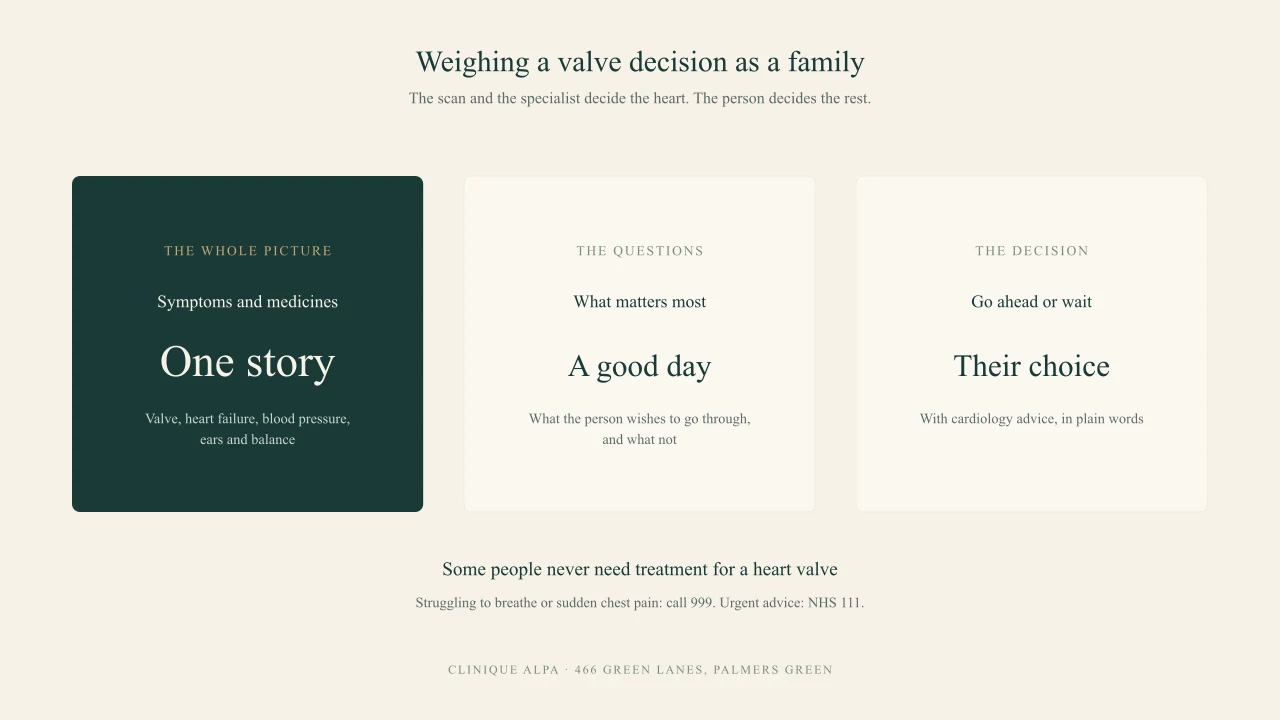
These are the questions I find most useful to talk through with a family.
- What does a good day look like for this person, and what is getting in the way of it now?
- What would they be willing to go through for a chance of that day coming back, and what would they not?
- What other conditions will remain after the valve is treated, and how much of the tiredness might they explain?
- What support does the person have at home, and what would be needed during recovery?
- What does the cardiology team say about the benefits and risks for this person, in plain words, and has the family had a chance to ask?
Families often arrive with a worry they are afraid to say aloud, that the procedure will take away whatever independence is left, or that saying no means giving up. Neither is true by default. A person may choose to go ahead, may choose to wait, or may decide to concentrate on symptoms and comfort, and each is a legitimate decision when it is made with good information. The NHS also notes that people with heart failure can ask about referral to a palliative care team, which focuses on managing symptoms and comfort at any stage, and that is not the same as stopping treatment.
Throughout, the person at the centre should be the one who decides, with the family supporting. Where there are concerns about the person’s ability to decide, that is assessed separately and with care.
From Dr Mitesh Parmar
I help the family separate what the cardiologist said from what remains unclear. I ask what a good day looks like and what has been given up. That, alongside breathlessness, dizziness and swelling, shapes the decision. Fainting, chest pain or sudden breathlessness needs 999.
When should I get help with heart valve disease?
- Struggling to breathe, choking, gasping or unable to speak: call 999 and do not drive yourself.
- Sudden chest pain that spreads to the arms, back, neck or jaw, or lasts more than 15 minutes: call 999.
- Chest pain with breathlessness or palpitations: call 999.
- Ongoing breathlessness, tiredness or dizziness during normal activities, recurring palpitations, swollen ankles or feet, or chest pain that comes and goes: see a GP.
Bring your medicines when you go for help. The NHS page on heart valve disease has the full list. The first article in this series covers worsening breathlessness at home and the second covers leg swelling and skin care. For wider reading, the breathlessness guide and the cholesterol and heart health guide may help.
How do we approach this at Clinique Alpa?
A clinic consultation is 30 minutes with a doctor at 466 Green Lanes for £100. Relatives are welcome to join. If getting here is difficult, a home visit lasts 60 minutes and is from £250 on a weekday, from £325 at weekends and bank holidays and from £450 for an evening start; see home visits. We work alongside the cardiology team and the NHS GP, and with consent a summary goes to the NHS GP.
Common questions
What are the symptoms of heart valve disease?
Shortness of breath, tiredness, dizziness, palpitations, chest pain and swollen ankles. Some people have no symptoms at all.
What is the treatment for heart valve disease?
It depends on severity. The NHS describes regular check ups for mild disease, medicines for symptoms, and surgery to repair or replace a valve in severe disease.
What causes heart valve disease?
The NHS lists age related changes, damage from a heart attack, rheumatic fever and being born with a heart condition, among others.
More in this series: heart failure at home
Drafted with AI assistance, clinically reviewed by Dr Mitesh Parmar, MBBS MRCGP, Principal GP and Clinical Director at Clinique Alpa, 466 Green Lanes, Palmers Green, London N13 5PA. This article is general information, not personal medical advice. In an emergency call 999. For NHS advice call 111 or visit nhs.uk.