
It often begins with a tooth, or with something that felt like one. The dentist treats what can be seen, the pain stays, and a few months later there is a second round of appointments, a different explanation and still no relief. People tell me they have stopped knowing who to see next.
Chronic facial pain is a problem where the first sensible answer does not always turn out to be the right one. The question is how to work through it in a structured way, so that each possibility is either found or put aside.
Chest pain, signs of a stroke, severe breathlessness, heavy bleeding, a severe allergic reaction or symptoms of sepsis need 999 or A&E immediately. For urgent advice that cannot wait, call NHS 111.
What are the common causes of chronic facial pain?
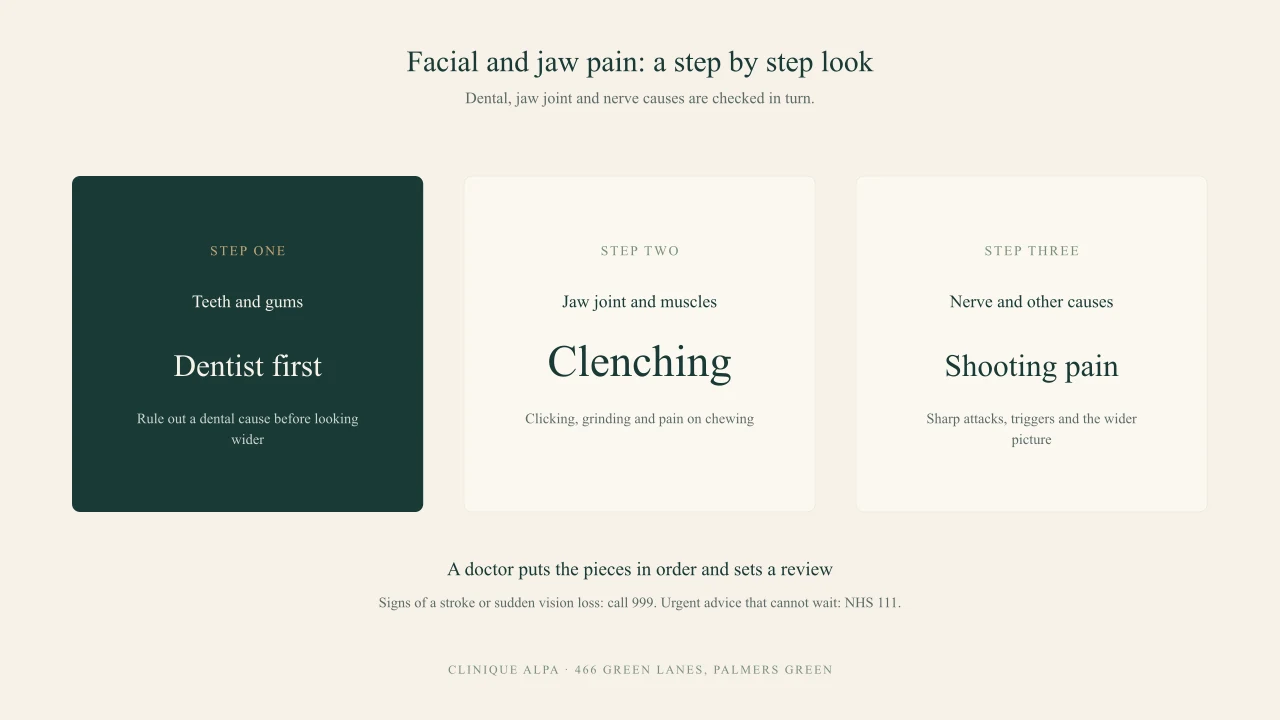
There are three broad groups, and they overlap. Dental causes come first, which is why the NHS advises ruling those out with a dentist. Then problems of the jaw joint and the muscles around it. The NHS describes temporomandibular disorder as pain around the jaw, ear and temple, with clicking, popping or grinding when the jaw moves, sometimes with headaches. Teeth grinding, stress, wear and tear of the joint and an uneven bite are the causes it lists.
The third group is nerve pain. The NHS describes trigeminal neuralgia as sudden, severe, sharp or electric shock pain, usually on one side of the face, lasting seconds to a couple of minutes, often set off by light touch, eating, brushing teeth or a breeze. It says that diagnosis can be difficult and may take a few years to confirm. Other causes are less common, and that is where a doctor who has time to read the whole history is useful.
Why does facial pain sometimes persist after dental treatment?
Because pain can come from more than one place at once, and treating one source does not stop the others. A tooth problem can sit on top of clenching. Clenching can strain the jaw muscles and joint, and long term strain can sensitise the area. Pain also gets worse with poor sleep, anxiety and tension, so a stressful stretch of life can keep it going after the original trigger has gone. None of this means the pain is imagined. It means the explanation is usually layered.
What I look at in clinic
The first thing I want is the pain described in detail. The exact place and whether it stays on one side. Its quality: dull and aching, tight, burning, or sharp and sudden. How long each episode lasts. What brings it on, such as chewing, yawning, touch, cold air or stress. What it does to eating, speech and sleep. Whether it is constant or comes in attacks, because the answer points to different groups of causes.
Then I go through what has been tried, and what each treatment did. This is easy to overlook and it is among the most useful parts of the consultation. A response, or a worsening, after a particular treatment is a clue, and so is the absence of any response. I also ask about the dentist's findings, any scans and any previous specialist opinions, and I would rather read the reports than rely on memory.
I ask about the person around the pain: sleep, mood, stress and how long this has gone on. Long standing pain wears people down, and I ask directly how things are. I also ask about other symptoms, such as eye or vision changes, a rash, ear symptoms, headaches, weakness or numbness in the face, fever, and anything that has changed in general health.
The examination covers the face, jaw, mouth and neck. I check how far the jaw opens and whether it moves smoothly, feel the muscles of the face and jaw for tenderness, look at the teeth and gums, check the skin and test feeling across the face. Blood pressure and a quick look at the eyes and ears are part of it. Depending on what I find, there may be blood tests or a request for a scan, and I explain what each is for and what the result would change.
The plan sets out which possibility is most likely, what is being ruled out and in which order. It may include a dental or jaw specialist opinion, a physiotherapist for jaw exercises, advice on reducing clenching, support for sleep and stress, and treatment options for nerve pain if the picture fits. I give a date to look again, usually a few weeks away, because a pattern is clearer with time.
From Dr Mitesh Parmar
I ask whether the pain is sharp and electric, or dull and aching, and what sets it off, such as chewing, cold air or touch. That separates nerve pain from joint and dental pain. I press on the jaw muscles and check the bite. Sudden facial weakness or severe headache needs 999.
When should you come in sooner?
Call 999 for signs of a stroke, such as a drooping face, weak arm or slurred speech, and for breathing difficulty or swelling that affects the airway. The NHS advises an urgent GP appointment or NHS 111 if you are unable to eat or drink, have vision problems such as double vision or vision loss, or have pain or tenderness at the side of the head or scalp. Also come in sooner if:
- the pain is frequent, severe or getting worse
- your jaw locks or will not open fully
- you have lost weight without trying
- common painkillers no longer help
How do we approach this at Clinique Alpa?
A face to face consultation at 466 Green Lanes is 30 minutes with a named doctor and costs £100. Facial pain needs an examination, so a first visit is better in person than by video. A referral letter is written where clinically appropriate after assessment and is included in the consultation fee. With your consent, a summary goes to your NHS GP and your dentist can be kept informed. If headaches are also part of the picture, I have written a guide to headaches, and a guide to persistent pain.
Common questions
What causes chronic facial pain?
Dental problems, jaw joint and muscle problems and nerve pain are the main groups. A doctor works through them in turn.
Is there treatment for chronic facial pain?
Yes, and it depends on the cause. The NHS lists stronger pain relief, relaxation, sleep advice, a dentist, a physiotherapist and a specialist opinion among the options for jaw pain.
Should I see a dentist or a doctor first?
The NHS advises a dentist to rule out dental causes. If dental causes have been ruled out and the pain continues, the next step is a GP.
Drafted with AI assistance, clinically reviewed by Dr Mitesh Parmar, MBBS MRCGP, Principal GP and Clinical Director at Clinique Alpa, 466 Green Lanes, Palmers Green, London N13 5PA. This article is general information, not personal medical advice. In an emergency call 999. For NHS advice call 111 or visit nhs.uk.