
It starts as a feeling more than a pain. One ear seems stuffed, as if after a flight, and the room tilts a little when you turn over in bed. A hum in the same ear is louder at night, when everything else goes quiet. You have been told it is probably a blocked ear or a lingering virus, and you would like someone to be sure.
The question underneath ear fullness and dizziness is whether this is the ear itself, the nerve behind it, or something else that has settled nearby. For a small number of people a scan is part of the answer, and that is what this page is about.
Chest pain, signs of a stroke, severe breathlessness, heavy bleeding, a severe allergic reaction or symptoms of sepsis need 999 or A&E immediately. For urgent advice that cannot wait, call NHS 111.
What causes ear fullness and dizziness together?
Most of the time, the ear and the balance system share a cause. The NHS lists an ear infection, an infection of the inner ear after a cold or flu, migraine, dehydration, low blood sugar in people with diabetes, iron deficiency anaemia, and stress or anxiety among the usual reasons for dizziness. It also notes that feeling off balance together with hearing loss or ringing can point to the inner ear.
When this comes up in consultation, people often have a mix. A cold that went on too long, an ear that has felt different for months, a few days of feeling drained, and a worry that something has been missed. Each part is common. Together they are worth sorting into order, because the order tells me which part is driving the rest.
What do I check in clinic?
I start by asking what the person means by dizzy. Spinning, faint, unsteady and light headed are different complaints with different causes, and people use the same word for all of them. Then I ask about the ear: which side, how long, whether hearing has changed, whether the fullness comes and goes, and whether the ringing is steady or beats with the pulse.
I ask about the rest of the body too. Recent infections, headaches, tiredness, food and fluids, sleep, mood, and every medicine, including the ones bought over the counter. Some medicines cause dizziness, and a new one is worth knowing about.
Then the examination. I look into both ear canals and at both eardrums, because an infection or fluid behind the drum explains a lot. I check hearing at the bedside, compare the two sides, and watch the eyes move, since the eyes give away problems with the balance system. I watch you stand and walk. Blood pressure and pulse are taken lying and standing, because a drop on standing is a common reason for feeling dizzy and tired.
Blood tests are chosen from what I find, usually for anaemia, blood sugar and thyroid. The NHS ties thyroid problems and diabetes to ringing in the ears, so they are worth ruling out. If wax is in the way I explain that we do not remove it here, and I arrange removal with an external provider.
Quite often the end of that first visit is a plan to treat what I can see and look again in a few days. That is a reasonable answer, as long as there is a date to look again and a clear idea of what would change my mind.
From Dr Mitesh Parmar
Hearing in each ear is worth checking early, and I test balance in the room before suggesting a scan. A scan helps when only one ear is affected, hearing is lower on that side, or symptoms are not settling. Sudden hearing loss in one ear needs urgent assessment, so call NHS 111 or go to A&E.
When does ear pressure or one sided ringing need a scan?
A scan is not the first step for every dizzy ear. Most ear pressure settles once the infection, fluid or blocked passage behind it is treated. I think about a scan when one sided symptoms persist after the ear has been treated and looked at again, or when they start to point to the nerve that carries hearing and balance.
The NHS describes that nerve problem, an acoustic neuroma, as a non cancerous growth that usually develops slowly. Its common symptoms are hearing loss in one ear, ringing and vertigo. The NHS says that when one is suspected, you are usually referred for hearing tests and an MRI scan. Larger growths can cause headaches, blurred or double vision, and numbness or weakness of the face on one side.
The pattern matters more than any single symptom. A fullness that comes with a cold and goes with it is different from hearing that is steadily worse on one side. If I think a scan is reasonable, I arrange a specialist referral where clinically appropriate. A normal scan is useful too. It lets us stop worrying about the nerve and get back to the ordinary causes.
When should I come in sooner?
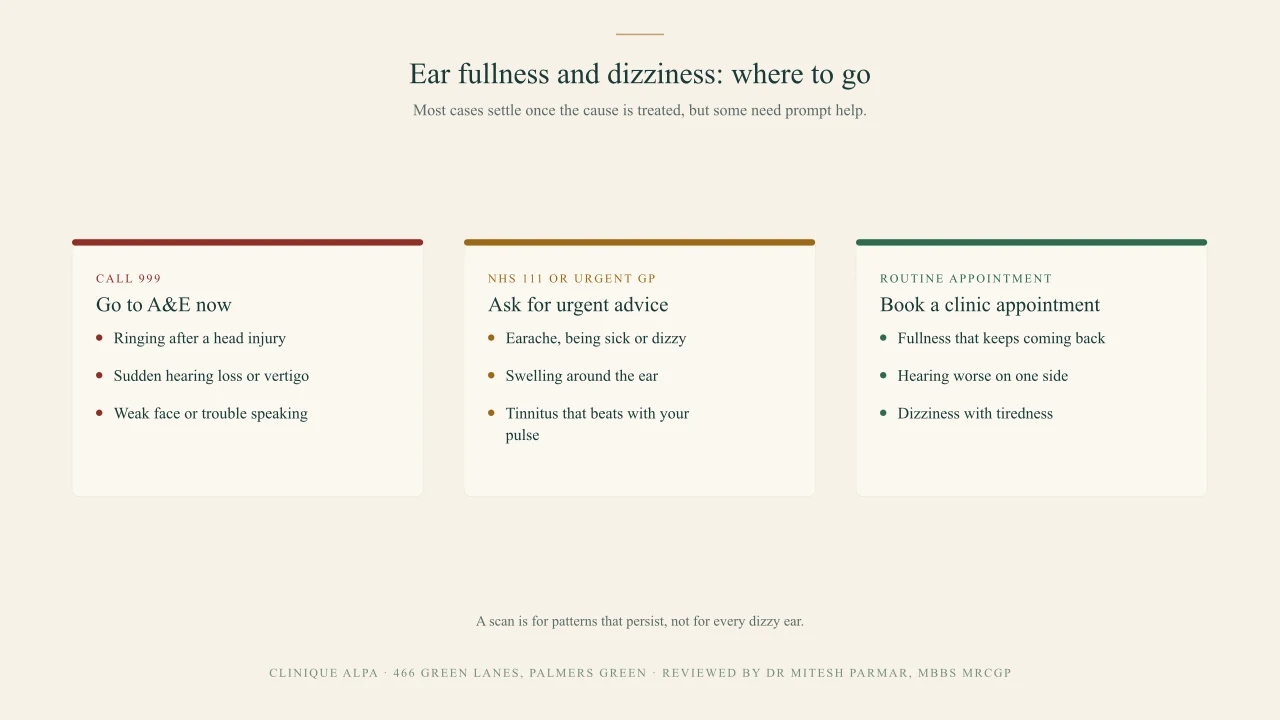
- Ringing after a head injury, or ringing with sudden hearing loss, weakness of the face or spinning vertigo: call 999 or go to A&E, and do not drive yourself.
- Dizziness with trouble speaking, numbness or weakness in the face, arms or legs: call 999.
- Earache with a high temperature, swelling around the ear, discharge, being sick or feeling dizzy: ask for an urgent appointment or call NHS 111.
- Tinnitus that beats in time with your pulse: ask for an urgent appointment.
- Hearing that is steadily worse on one side, or double vision: see a doctor promptly.
The NHS page on dizziness lists when to see a GP. If the ringing is the main problem, I have written about ringing in one ear and when to see a doctor, and the dizziness and vertigo guide covers the wider picture.
How do we approach this at Clinique Alpa?
A clinic consultation is 30 minutes with a doctor at 466 Green Lanes for £100. We look in both ears, check balance and blood pressure, and decide together whether treatment, tests or a referral comes next. With your consent a summary goes to your NHS GP.
Common questions
Can ear pressure and dizziness be caused by anxiety?
Stress and anxiety are on the NHS list of causes of dizziness. I would not settle on that until the ears, hearing and blood pressure have been checked.
What is the treatment for ear fullness and dizziness?
It depends on the cause. It may mean treating an infection, reviewing medicines, correcting a blood result, or arranging specialist tests.
Is ear fullness, dizziness and nausea serious?
Being sick or dizzy with an ear infection is a reason for the NHS to advise an urgent appointment or NHS 111. Do not wait it out.
Drafted with AI assistance, clinically reviewed by Dr Mitesh Parmar, MBBS MRCGP, Principal GP and Clinical Director at Clinique Alpa, 466 Green Lanes, Palmers Green, London N13 5PA. This article is general information, not personal medical advice. In an emergency call 999. For NHS advice call 111 or visit nhs.uk.