
The licensing form has arrived with a section marked for a doctor, and a date by which it has to be returned. Nobody has explained what the doctor is supposed to do with it, or whether an ordinary GP appointment will count. The reader is usually less worried about the examination than about whether they have booked the right thing.
A driver medical assessment is a narrow question with a precise form behind it. Here is what is examined, who arranges it, and how to find out before you book whether we can complete yours.
Chest pain, signs of a stroke, severe breathlessness, heavy bleeding, a severe allergic reaction or symptoms of sepsis need 999 or A&E immediately. For urgent advice that cannot wait, call NHS 111.
What does a driver medical assessment involve?
It is a doctor's assessment of whether you meet the medical standards for the kind of driving you do, recorded on a form that someone else has set. That someone is normally a licensing authority or an employer, and the form decides what is asked. It is not a general health check, and it is not the doctor's own view of whether you are a good driver.
The standards themselves come from the DVLA. Its guidance for doctors is published on GOV.UK as assessing fitness to drive, prepared on the advice of the Secretary of State for Transport's medical advisory panels, and it is usually updated every 12 months. The standards are stricter for lorry and bus drivers than for car drivers, which is why the form you hold matters so much.
What is examined in a driver medical assessment?
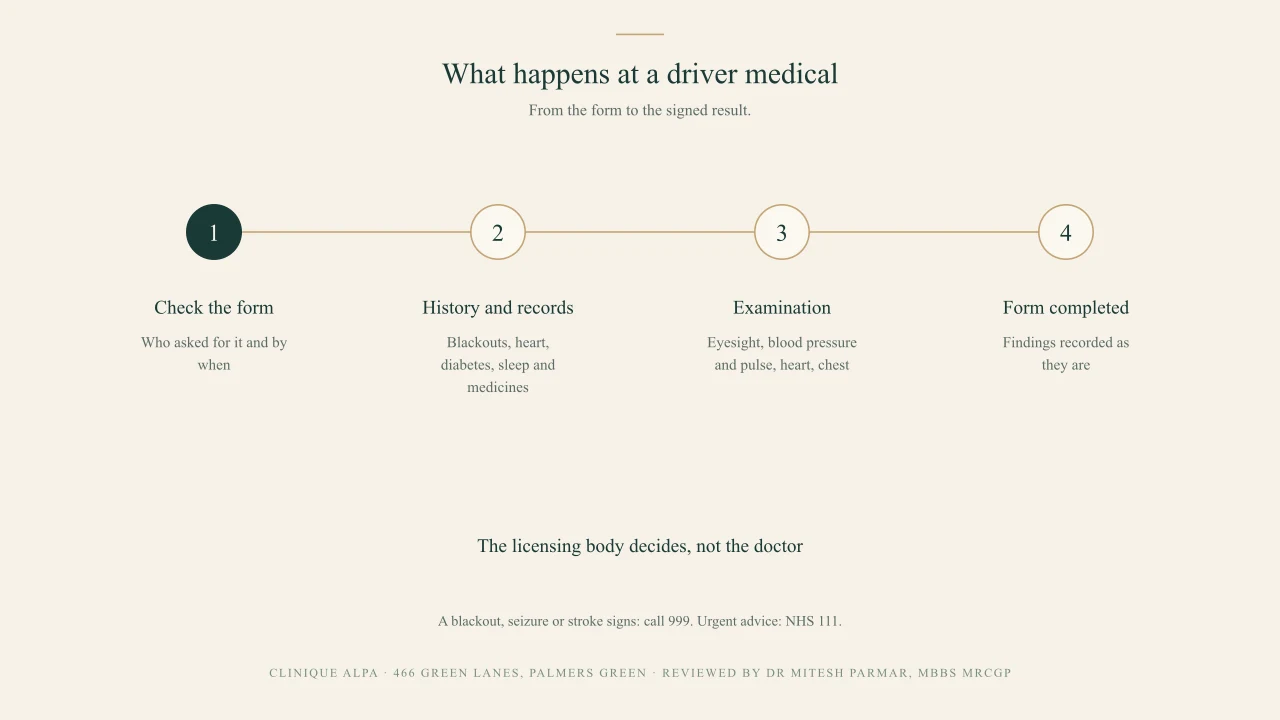
I begin with the form, line by line, because it tells me exactly what the reader needs to know. Then I take a history that fits it. When this comes up in consultation, the form and the person usually line up: the questions are about conditions that could suddenly affect control of a vehicle, and most people have nothing to declare. I still ask each one directly.
That means asking about blackouts, faints and dizziness; seizures; heart conditions and chest pain; diabetes and how it is treated; sleep disorders and daytime sleepiness; strokes; problems with eyesight; and conditions affecting the nerves, muscles and joints. GOV.UK lists several of these, including diabetes or insulin use, fainting, heart conditions, sleep apnoea, epilepsy, strokes and glaucoma, as conditions a driver must tell the DVLA about. I ask about all medicines, since some cause drowsiness, and about alcohol.
Where the doctor is allowed to see your GP records, they are read, because they often answer a question more reliably than memory does. Where records are not available, the history rests on what you tell me and I say so on the form.
Then the examination. Eyesight is nearly always part of it. I check what the form asks for, which commonly means how well each eye sees with glasses or contact lenses if you wear them. I measure blood pressure and pulse. I listen to the heart and chest. Depending on the form and your history, I look at how you walk, the strength and movement of your limbs, your reflexes, and your balance. I check what I have been asked to check and I am wary of adding what the form does not need.
At the end I complete the form accurately. If something does not meet the standard, I say so, and I explain what happens next, which may be a report to the DVLA or a further test. I will not write what the form wants to hear. I tell you this at the start because it is better to hear it before than after.
From Dr Mitesh Parmar
Check which form the DVLA or licensing body has sent before you book, because some conditions need a specific form and some need a report from a specialist. I examine vision, blood pressure, pulse, nerves and what treatment you take. Bring your glasses and a list of your conditions.
What are the eyesight standards?
GOV.UK sets them out. For ordinary car drivers, you must be able to read a number plate from 20 metres, and have a minimum visual acuity of 0.5 on the Snellen scale (6/12) using both eyes together, with glasses or contact lenses if you need them. You also need an adequate field of vision, which an optician can test. For lorry and bus drivers the standards are higher: at least 0.8 (6/7.5) in the better eye, at least 0.1 (6/60) in the other eye, and a horizontal field of vision of at least 160 degrees. Short sight, long sight and colour blindness do not need to be reported. The detail is on the GOV.UK page for driving eyesight rules.
Who arranges a driver medical assessment, and is there a form?
Usually not you. The licensing authority, employer or agency sets the requirement and gives you the form. If you were asked to book a medical yourself, ask them three things. Which form must be completed. Whether it must be done by a particular kind of examiner or an accredited occupational health provider. And by what date.
Separately, GOV.UK says anyone who develops a notifiable condition, or whose condition has got worse, must tell the DVLA. People applying for a first licence and people renewing from 70 give health information on their application. Bus, coach and lorry licence holders send a form or questionnaire. You must surrender your licence if your doctor tells you to stop driving for 3 months or more. See GOV.UK on driving and medical conditions for how to report.
Can Clinique Alpa complete my driver medical?
Often yes, but not always, and it is better to know in advance. Some forms must be completed by a specific approved examiner or an accredited provider, and a general practice cannot do those however carefully the examination is done. When that is the case, I say so and point you to the right route, even if it costs us the appointment. If your form says nothing about the examiner, tell us the form and the deadline when you ring. Our diary may not match a short deadline, and I will not invent a slot. For employer requests and wider fitness questions, see occupational health medicals, and for other documents see medical letters.
When should you not wait for an appointment?
A blackout, a seizure, sudden loss of vision or any sign of a stroke is not something to book a medical about. Call 999 or get urgent care, do not drive yourself, and tell the DVLA if it is a condition the GOV.UK list covers. NHS 111 can advise if you are unsure how urgent something is.
Common questions
Is there a driver medical assessment form I can download?
Not a single one. The authority or employer that requires the medical gives you its own form, and that is the one to bring.
Where can I find a driver medical assessment near me?
We are at 466 Green Lanes, Palmers Green. Ring first with the name of the form so that we can tell you whether we can complete it.
Does the assessment decide whether I can drive?
No. It records the findings against the standards. The licensing body decides.
How do we approach this at Clinique Alpa?
You see Dr Parmar for a clinic consultation of 30 minutes, which is £100. Fees for driver medicals and other certificates are listed on the appointments and fees page and confirmed before we start. Bring photo identification if your form asks for it. A summary can go to your NHS GP if you consent. Certificates and forms are completed where clinically appropriate after assessment.
This is an independent clinical opinion. It cannot be written to a required conclusion and does not guarantee the outcome of any claim, application, exemption or hearing.
Drafted with AI assistance, clinically reviewed by Dr Mitesh Parmar, MBBS MRCGP, Principal GP and Clinical Director at Clinique Alpa, 466 Green Lanes, Palmers Green, London N13 5PA. This article is general information, not personal medical advice. In an emergency call 999. For NHS advice call 111 or visit nhs.uk.