
The packing list is nearly done: passport, chargers, adaptors. Then there is the pharmacy bag on the kitchen table with 6 weeks of medicine in it, and a half remembered story about someone being held at an airport over the contents of a washbag.
Most people who ask me for a doctor's letter for travelling with medication are not sure whether they need one, what it has to say, or who is supposed to write it. All three have answers, and the first one starts with a question for your pharmacist, not for me.
Chest pain, signs of a stroke, severe breathlessness, heavy bleeding, a severe allergic reaction or symptoms of sepsis need 999 or A&E immediately. For urgent advice that cannot wait, call NHS 111.
When do you need a doctor's letter for travelling with medication?
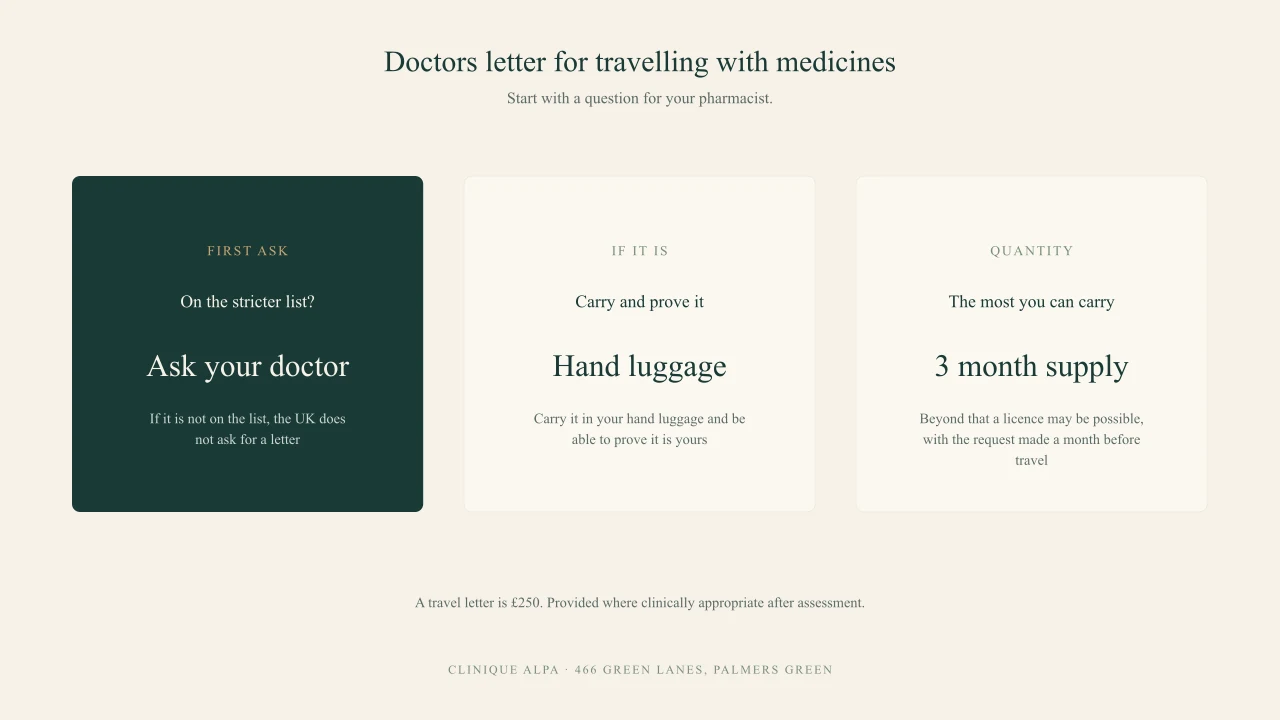
The UK rules turn on one thing: whether your medicine is one that the law controls more strictly than most. GOV.UK guidance on taking medicine in or out of the UK has a name and a published list for these medicines, and tells travellers to ask their doctor or pharmacist. If the answer is yes, three things follow. You must carry the medicine in your hand luggage when you enter or leave the UK. You need to be able to prove it is yours, with the form it was issued on or a letter from your doctor. And you should check the rules of the country you are going to with its embassy before you travel.
That last step is the one people skip. GOV.UK guidance on personal licences points out that other countries have their own import laws for medicines, and that a traveller can be fined or imprisoned for carrying a medicine that is illegal there. A medicine that is routine in London can be restricted somewhere else, including where you change planes. Only the embassy can tell you, and no letter from a doctor overrides its answer.
Quantity matters as well. GOV.UK sets a 3 month supply as the most you can carry across the UK border without a personal licence. For anything beyond that, it says a licence may be possible in exceptional circumstances, with the request made a month before travel.
If your medicine is not on that stricter list, the UK does not ask for a letter. Some countries still expect one, which is one more reason to ask the embassy.
What does the letter need to say, and who should write it?
For someone carrying less than 3 months of a medicine on the stricter list, GOV.UK recommends a letter that gives your name, a list of the medicine with the doses, strength and frequency, enough detail on quantities and travel dates to show that you are carrying no more than a 3 month supply, the signature of the clinician who issued the medicine and that clinician's professional registration details.
Notice whose signature that is. The guidance expects the letter to come from the person who issues the medicine. If your NHS GP or your hospital specialist provides your regular treatment, they are the natural author, and it is worth asking them first and asking how much notice they need.
A letter from me is the right document in a narrower set of situations: where I have assessed you, seen the evidence of what you take and can confirm it. The letter then says exactly that. It names the medicines, states what I have verified and how, and says who issues them. Where a country insists on the signature of the issuing clinician, or on its own permit or form, my letter does not replace that, and I will tell you before you pay.
What do I look at before I write it?
What I look at in clinic starts with identity and evidence. Photo identification, because the letter confirms who you are. Then the medicines themselves, in their original boxes with the pharmacy labels on, alongside your repeat list from the NHS App or your surgery and any clinic letters that explain why you take them. I am matching three things: the name on the label, the dose you tell me you take and the record.
Then the condition. A short history of what each medicine is for, how long you have taken it and how stable things are. I examine where it is relevant, and blood pressure and pulse are checked for most people. The purpose is to be able to write, truthfully, that the treatment is medically necessary for you.
Next the trip. Dates out and back, every country including transit stops, and what the embassy has told you. I count the quantity against the number of days away, because a letter that says 4 weeks of treatment beside a bag holding 4 months of it invites the conversation you are trying to avoid.
I also ask how you will keep to your timings across time zones, and what you would do if a bag went missing, which is one reason the medicine belongs in the cabin with you.
The piece most people miss is the second layer. The medicines question is frequently the visible part of a wider one about travelling with a long term condition. Insurance is the obvious example: GOV.UK advises declaring existing conditions to your travel insurer, because failing to declare something may invalidate the policy. Vaccines are another, and our travel vaccinations page covers those.
There are things the letter cannot do. It cannot promise that an airline or a border officer will accept it. It cannot confirm a medicine I have been unable to verify. It cannot state that another country permits what you are carrying. And it is a record of treatment you already have, so it is not a route to a new supply for the trip.
Many countries require a doctor's letter when you're traveling with certain medications abroad. This involves a consultation with a doctor and the doctor will produce a letter stating your treatments and the duration of medications needed and the indications why it's needed. The letter is stamped and signed and you'll be rest assured that Clinique Alpa is a CQC registered clinic and all the doctors are registered with the GMC and are in good standing. So rest assured you're in safe hands when requesting a letter for traveling with medication abroad.
When should you sort this out, and what should you bring?
Earlier than feels necessary. The GOV.UK foreign travel checklist suggests looking at health precautions at least 8 weeks before a trip, and embassies do not always answer quickly. Bring:
- Every medicine you will carry, in its original labelled box.
- Your repeat list, and any letters from the clinic or specialist who started the treatment.
- Your travel dates and every country on the route, including transit stops.
- Whatever the embassy or the airline has told you, in writing if you have it.
- Photo identification, ideally the passport you will travel on.
If you have been unwell recently and the real worry is whether you should be flying at all, that is a separate assessment, and I have written about it in fit to fly letters. If you become unwell before you leave and cannot wait for an appointment, call NHS 111.
How does it work at Clinique Alpa, and what does it cost?
A travel letter for the treatment you carry is £250. It runs to 1 or 2 pages, and the fee includes a 30 minute assessment and up to 15 minutes of records review. The assessment is face to face at 466 Green Lanes, Palmers Green, and you can book online or call.
Letters and certificates are provided where clinically appropriate after assessment. The fee pays for the assessment and the letter, not for a decision at any border, which belongs to the country you are entering. It includes one consolidated review of the draft, and we correct our own errors free of charge, as our report review and amendment policy explains. With your consent a summary goes to your NHS GP.
Drafted with AI assistance, clinically reviewed by Dr Mitesh Parmar, MBBS MRCGP, Principal GP and Clinical Director at Clinique Alpa, 466 Green Lanes, Palmers Green, London N13 5PA. This article is general information, not personal medical advice. In an emergency call 999. For NHS advice call 111 or visit nhs.uk.