
It rarely looks like much at first. A cut from a tool, a blade or a broken plate goes in quietly, bleeds more than expected, and then settles under a tissue held tight. The edges are close together, there is no pain to speak of, and the person says they will see how it looks in the morning.
The question is whether this is a cut needing stitches, and how soon someone has to look. Cuts from tools and sharp objects are the ones that fool people, because the opening on the skin is small and the damage under it is not.
Chest pain, signs of a stroke, severe breathlessness, heavy bleeding, a severe allergic reaction or symptoms of sepsis need 999 or A&E immediately. For urgent advice that cannot wait, call NHS 111.
How can you tell if you have a cut needing stitches?
You cannot always tell from the outside, and the NHS does not give a single rule for when a cut needs stitches. It says that cuts may be closed with stitches, staples, strips or special glue, or left open if they are infected or at risk of infection. What it does give is a clear list of when not to manage a cut at home.
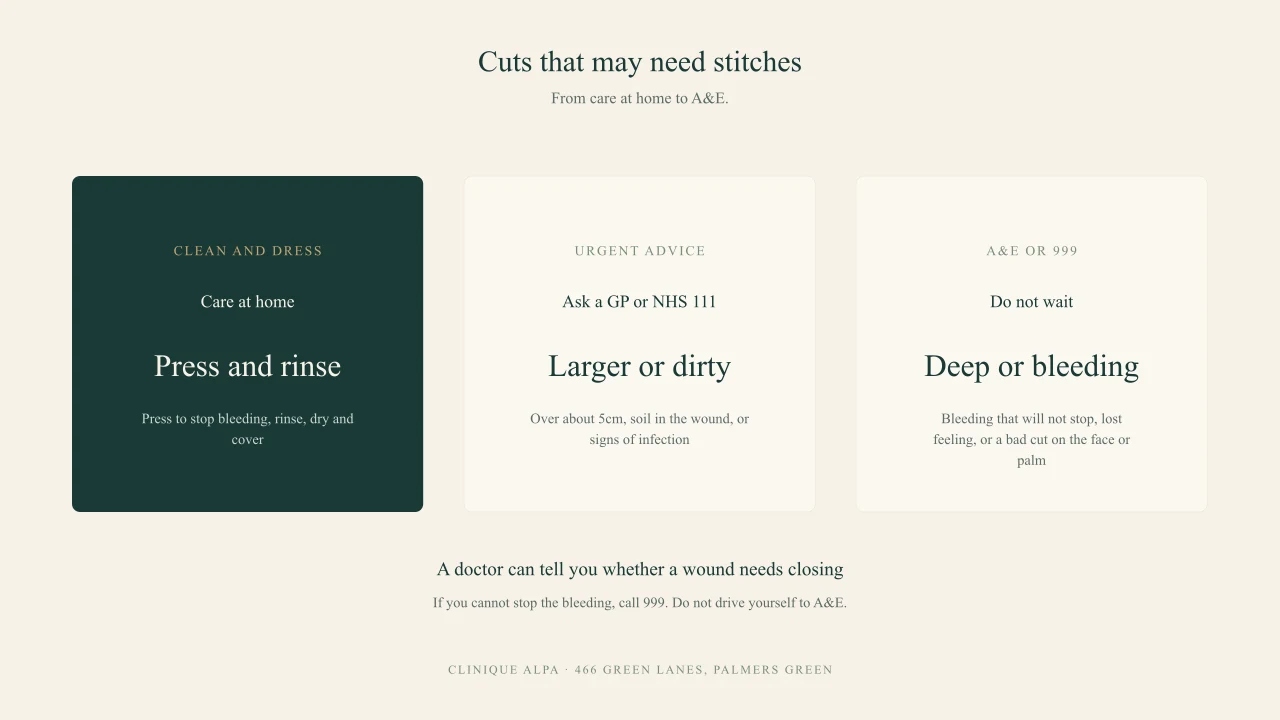
Go to A&E, or call 999, if:
- You cannot stop the bleeding, or blood is spurting or bright red and hard to control.
- You have lost feeling near the wound or have trouble moving the part.
- It is a bad cut on the face or the palm of the hand.
- The wound is very large or deep.
- Something is stuck in the cut, such as glass. Do not pull it out yourself.
Do not drive yourself. Ask someone to drive you or call 999, and bring your medicines.
Ask a GP or call NHS 111 for urgent advice if:
- There is soil, pus or body fluid in the wound, or it is still dirty after cleaning.
- The cut is larger than about 5cm.
- It is swollen, red and getting more painful, or pus is coming out.
- You also feel generally unwell or have a high temperature.
- You were bitten by a person or a wild or stray animal.
Those lists are from the NHS page on cuts and grazes, and they are worth saving on your phone.
How should you clean and dress a cut first?
Stop the bleeding before anything else. Press on the wound with a clean cloth or bandage. If it is on a hand or arm, raise it. If it is on a leg, lie down and raise it above the level of your heart. Check every 10 minutes that the bandage is not too tight.
Once the bleeding has stopped, wash and dry your hands, rinse the wound with tap or bottled water, pat it dry, and cover it with a sterile dressing or a clean cloth. Clean the skin around it with soap and water, wiping away from the wound. Keep the dressing clean and dry and change it as often as needed.
What do I look at in clinic when someone brings a deep or tool related cut?
When this comes up in consultation, a common pattern is a cut that looked trivial and was dressed at home, and the person comes in a day or two later because it is still sore or the edges have opened. The first thing I do is look at it properly, in good light, with the dressing off.
I ask how it happened: a clean blade, a dirty tool, something that had been outdoors or in soil. Then I check movement and strength against the other side, test sensation beyond the wound, and check the circulation. A cut near a joint, over a tendon or on the palm needs particular care, and a change in feeling or movement tells me more than the length of the cut.
I look at how deep it goes, whether the edges meet, whether anything is in it and whether the tissue underneath looks injured. I clean it. I decide whether it needs closing, and if so whether it needs closing in a setting equipped for it. If that is a hospital, I say so straight away and tell you what to take with you. I do not keep a wound that needs more than I can safely offer.
I check tetanus. The NHS advises getting urgent GP advice or calling NHS 111 if a wound may be contaminated and you are not fully vaccinated or are not sure, and says a booster may be needed if you have had fewer than five doses in total or your history is uncertain. I ask what you know, and I record it. Tetanus symptoms usually start 4 to 21 days after infection. Call 999 or go to A&E if you have a large or deep wound with a stiff jaw, painful muscle spasms, or trouble breathing or swallowing.
I look for infection, and for the risk of it. A wound that is deep, dirty or in a person with diabetes or poor circulation is more likely to get infected, and the NHS says antibiotics may be given if the cut could be infected. I decide whether treatment is needed now or watching is safe.
Finally I say when to have it looked at again. A concrete day, not a vague instruction to return if it gets worse.
From Dr Mitesh Parmar
The depth and the position matter as much as the length. I check whether a tendon, nerve or joint could be involved, by asking you to move the finger and test the feeling beyond the cut. Bleeding that will not stop after firm pressure, or a cut with something stuck inside, needs A&E.
Which signs after a cut mean infection?
Increasing pain, redness spreading, swelling, warmth and pus are the usual ones. The NHS advises calling NHS 111 or asking for an urgent GP appointment if skin is painful, hot and swollen, because early treatment can stop cellulitis becoming more serious. Call 999 or go to A&E if that comes with a very high temperature, feeling hot, cold or shivery, a fast heartbeat or fast breathing, dizziness, confusion or purple patches on the skin.
Redness is harder to see on brown and black skin, so watch for pain, warmth and swelling too.
Cut that needs stitches or not, on a finger or hand?
Fingers and hands are where I would be quickest to have a cut seen, because a small opening can hide a damaged tendon or nerve, and the hand is built from small, close parts. A cut on the palm of the hand is on the NHS list for A&E. If you cannot bend or straighten the finger fully, or it feels numb or tingly at the tip, do not wait.
Common questions
Is it a cut needing stitches if the edges gape open?
Often, yes, but not always, and a wound that is dirty or already infected may be left open on purpose. A doctor can tell you which applies.
Can I close a deep cut at home with strips or glue?
Not if it is deep, bleeding, dirty or on the face or palm. Those need a professional look first.
How do we approach this at Clinique Alpa?
I see you at Palmers Green for 30 minutes for £100. I will not hurry the examination. If a wound needs more than can safely be done here, I tell you immediately and where to go. With your consent, a summary goes to your NHS GP, because private care here sits alongside the NHS and does not replace it. If you cannot travel, a home visit is possible and is subject to availability.
For infected wounds and post surgical wounds, I have written about wound care at a private doctor, and the health library has a guide to wounds and skin infections. For what we offer, see clinic appointments.
Drafted with AI assistance, clinically reviewed by Dr Mitesh Parmar, MBBS MRCGP, Principal GP and Clinical Director at Clinique Alpa, 466 Green Lanes, Palmers Green, London N13 5PA. This article is general information, not personal medical advice. In an emergency call 999. For NHS advice call 111 or visit nhs.uk.