
Constipation that has gone on for days is miserable on its own. When it arrives with blood on the paper or in the pan, or with mucus, cramps that move around, and a belly that swells after every meal, people stop treating it as a nuisance. Constipation with blood is the combination that sends most of them to a doctor.
Most of the time the cause is simple, and the blood comes from straining. But it is one of the symptom pairings where I do not assume that, and this article explains why.
Chest pain, signs of a stroke, severe breathlessness, heavy bleeding, a severe allergic reaction or symptoms of sepsis need 999 or A&E immediately. For urgent advice that cannot wait, call NHS 111.
Is constipation with blood serious?
Often it is not. NHS advice lists constipation as a common cause of piles, because straining makes them more likely, and of small tears in the skin of the back passage, which cause sharp pain and bright red blood on the toilet paper. Both are common and treatable.
But the NHS also lists blood in the stool, constipation that is unusual for you, bloating, tummy pain and unintentional weight loss among symptoms to have checked, and says the symptoms do not definitely mean bowel cancer. The point is that I cannot tell from a description alone, so I look.
What I look at in clinic
I start with the blood. What colour, how much, and where? Bright red on the paper after a hard stool is a different story from dark red mixed through the stool, and both differ from black and sticky stool. Is it with every bowel movement or once only? Is there pain on opening the bowels, and does it burn afterwards? Is there mucus? A tear usually hurts, whereas bleeding without any pain is one the NHS flags for an urgent appointment in the context of piles, and I take it seriously.
Then the constipation. How many bowel movements in a week, compared with what is normal for you? A useful marker from the NHS is fewer than 3 in the last week. Is the stool hard, thin, or pellet like? Do you feel you have emptied? Is it new, or have you had it since childhood? A change in a habit that was regular is more significant than a lifelong tendency. I ask about laxatives you have tried, since overuse of stimulant laxatives and herbal products sold as colon cleansers can both irritate the bowel, and whether the problem began after a change in diet, travel, medicine or mood.
I ask about the rest of the picture. Is the tummy bloated after meals, or swollen and tight? Is there nausea, vomiting, fever, or a sense of being unwell? Can you pass wind? Not passing wind or stool at all, with vomiting and a swollen tummy, can mean a blockage and is an emergency. Have you lost weight, felt tired, or noticed breathlessness? Does anyone in the family have bowel problems or bowel cancer? Do you take opioid painkillers, iron or other medicines that bind the bowel? Is there a history of IBS, which can explain bloating and cramps, but which should not be assumed to explain new blood?
The examination includes the tummy: tenderness, swelling, a mass, and the sound of the bowel. Where it is appropriate and you agree, I examine the back passage to look for piles, a tear or a lump, with a chaperone available. A urine test is sometimes useful when the pain is low in the tummy. Blood tests look for anaemia, which can come from slow bleeding, and for the thyroid and other causes of a sluggish bowel. A stool test for inflammation can help when the story points that way.
If anything on the history or examination is not what I expect, I do not wait. A scan or an examination of the bowel with a camera, arranged through a specialist, can be the right next step, and I explain which and why. If everything points to a simple cause, the plan is practical: more fibre introduced gradually, plenty of fluids, a regular toilet routine without straining, a short course of a laxative from a pharmacist if needed, and a date to review. If the blood has not stopped or the bowel habit has not recovered by then, we look again.
From Dr Mitesh Parmar
Fresh blood on the paper often comes from piles or a small tear, and I check for that. What changes my plan is a lasting change in bowel habit, weight loss, tiredness or blood mixed in with the stool. I would examine you and probably arrange blood tests. Heavy bleeding or severe pain means A&E.
What can you do at home in the meantime?
NHS advice is to eat more fibre, introduced slowly, drink plenty of fluids, cut back on alcohol, stay active and go when you feel the urge. Resting your feet on a low stool so your knees are above your hips can make passing a stool easier. Do not strain. Ask a pharmacist about a short course of a laxative if lifestyle changes are not enough, and ask whether any painkiller you take is adding to the constipation. Do not keep using a laxative for weeks without review. Avoid ibuprofen if piles are bleeding.
When should you come in sooner?
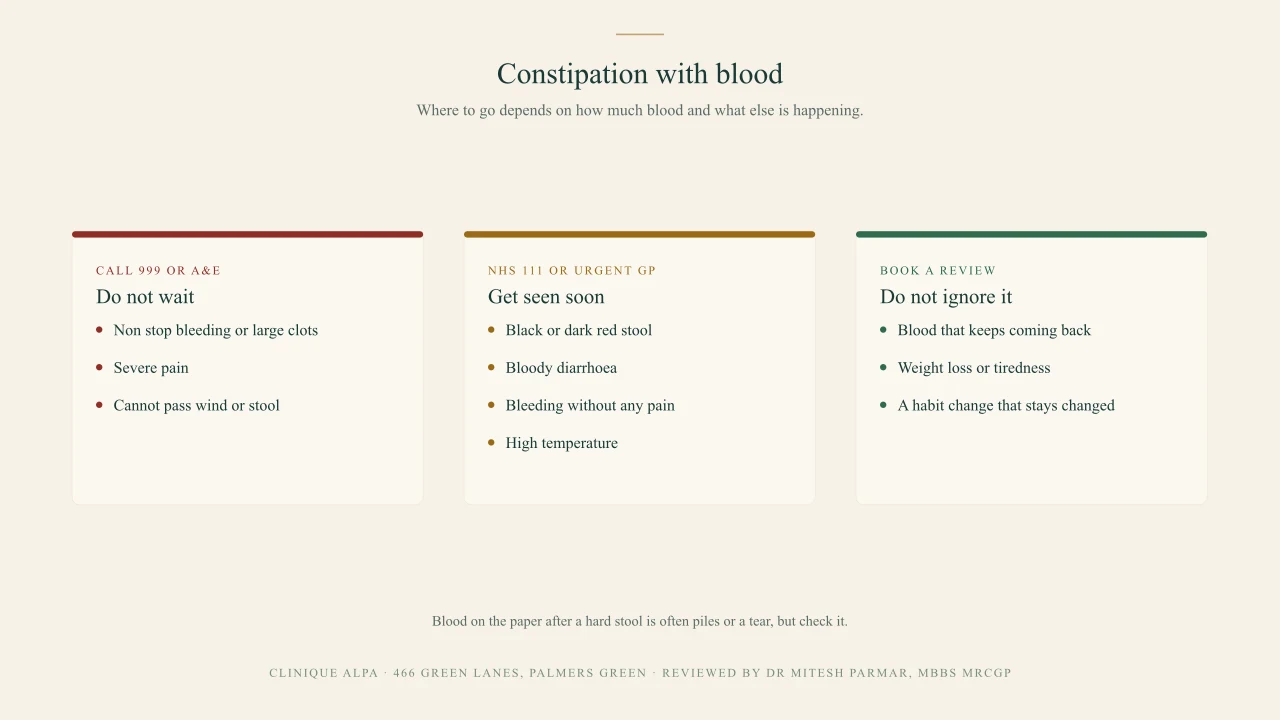
Call 999 or go to A&E if you are bleeding non stop from the bottom, there is a lot of blood or large clots when you open your bowels, you have severe pain, you are vomiting blood, or you cannot pass wind or stool at all. Do not drive yourself. Ask for an urgent GP appointment or call NHS 111 if your stool is black or dark red, you have bloody diarrhoea, you have a high temperature, or the bleeding comes without any pain. See a doctor promptly if:
- The blood keeps coming back.
- Constipation is new and not improving with treatment.
- You have lost weight without trying.
- You feel tired all the time.
- Your bowel habit has changed and stayed changed.
How do we approach this at Clinique Alpa?
A clinic consultation is £100 for 30 minutes at 466 Green Lanes. If piles are the cause, assessment comes first, then medical treatment or in clinic banding with Dr Alpa J. Morawala where clinically suitable; the procedure prices page shows the starting fee. Referral letters are included in the consultation fee where clinically appropriate after assessment, and with your consent a summary goes to your NHS GP. For constipation without blood, there is a constipation guide, and one on rectal bleeding.
Common questions
Why is there constipation with blood in stool?
Straining can cause piles or a small tear that bleeds. Because blood in the stool can also come from higher in the bowel, it should be checked.
What does constipation with blood when wiping mean?
Bright red blood on the paper often comes from piles or a tear near the opening. If it keeps happening or comes without pain, see a doctor.
Is constipation with blood clots an emergency?
Large clots, or a lot of blood, need 999 or A&E. Smaller amounts that do not stop should be seen urgently.
Sources: NHS: constipation and NHS: bowel cancer symptoms and NHS: piles and NHS: anal fissure.
Drafted with AI assistance, clinically reviewed by Dr Mitesh Parmar, MBBS MRCGP, Principal GP and Clinical Director at Clinique Alpa, 466 Green Lanes, Palmers Green, London N13 5PA. This article is general information, not personal medical advice. In an emergency call 999. For NHS advice call 111 or visit nhs.uk.