
Abdominal pain for weeks has a way of becoming part of the day. It comes soon after a meal, or on and off through the evening, and it is rarely dramatic enough to send anyone to A&E. People adapt their eating, put up with it, and then one evening they decide that a few weeks is long enough.
The usual next step is a scan, most often an ultrasound. People often ask why that one, and what it means if it comes back normal.
Chest pain, signs of a stroke, severe breathlessness, heavy bleeding, a severe allergic reaction or symptoms of sepsis need 999 or A&E immediately. For urgent advice that cannot wait, call NHS 111.
Is abdominal pain for weeks something to get checked?
Yes. NHS advice is that many stomach aches go within a few days, and that pain, bloating or indigestion that does not go away or keeps coming back is a reason to see a GP. A lump in the tummy, or being worried, is reason enough too. Pain that has gone on for months deserves the same attention, and the answers differ little between weeks and months. What changes is how complete the picture should be.
What I look at in clinic
The location of the pain gives the first clue, so I ask you to point to it. Pain under the right ribs suggests the gallbladder or liver. Pain in the centre of the upper tummy points to the stomach or the pancreas. Pain in the side and back may be the kidney. Lower pain may come from the bowel or, in women, the pelvis. Then I ask about timing. Does it start soon after eating, particularly fatty food? Does it ease after passing wind or opening your bowels? Does it come at night, or when the stomach is empty? Each answer shifts the likely cause.
The NHS describes gallstone pain as a severe, steady ache in the middle of the tummy or under the right ribs, lasting from 30 minutes to several hours, sometimes with sickness. It also describes how kidney stones tend to cause pain in the side that may spread to the groin. I use these patterns, but I do not rely on them. Plenty of people have a classic story and a normal scan, and plenty have an odd story and a stone.
I ask what else is going on. Have you been sick, lost weight, noticed blood or black stool, had a fever, or a change in your bowels? Is there any difficulty swallowing, or does food stick? Have you had a stomach infection tested for and treated, and was the repeat test clear? Which painkillers do you take, and how much alcohol? Have you already been to an emergency department, or had a scan booked and missed? I need to know what has already been done so that we do not repeat it.
The examination is hands on. I check your colour and eyes, feel the tummy for tenderness and for any enlargement of the liver or spleen, and press under the right ribs while you breathe in, because pain on that breath can point to the gallbladder. I check your pulse, blood pressure and temperature, and I note your weight. Blood tests for liver, kidney, pancreas and inflammation are common.
Why is an ultrasound the usual first scan for abdominal pain for weeks?
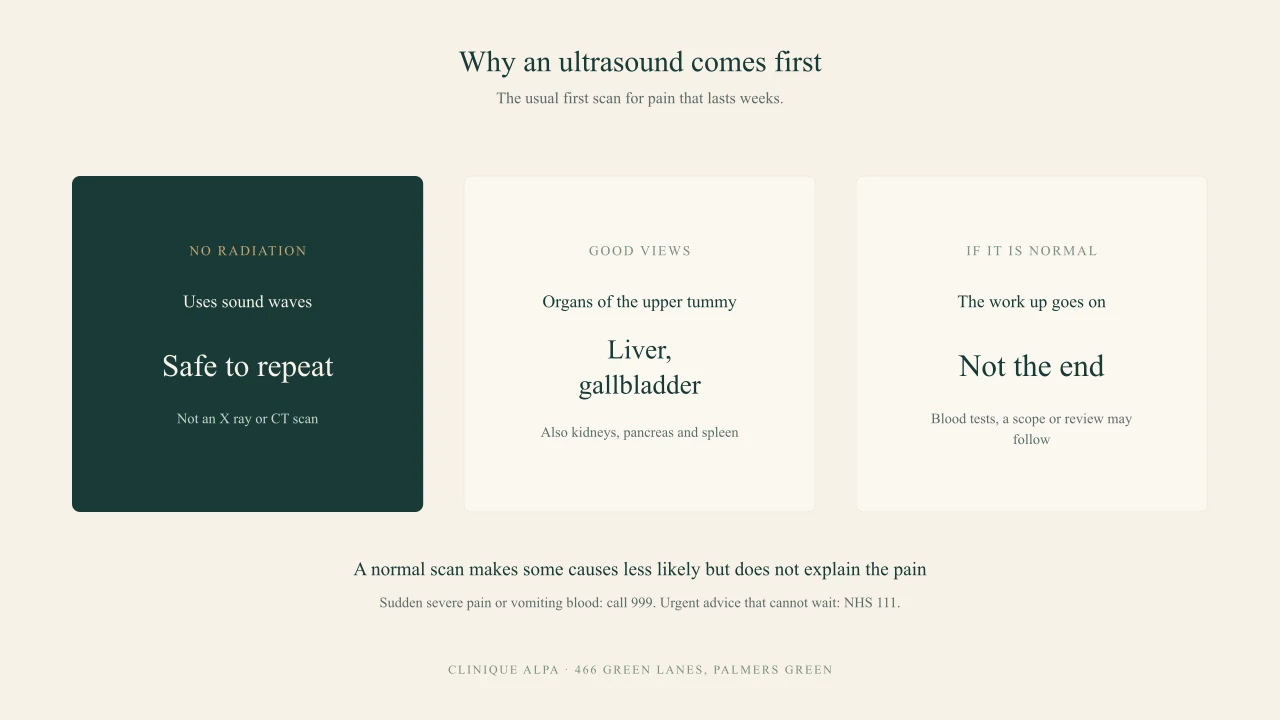
An ultrasound uses sound waves, not radiation, so there is nothing to build up with repeat scans. The NHS describes it as a way to investigate symptoms such as pain or a lump and to look at organs. It is good for the liver, gallbladder, kidneys, pancreas and spleen, and for the bladder and pelvic organs. It shows stones in the gallbladder, and the NHS notes that gallstones are often found this way. It is also widely available. For most people with pain in the upper or right side of the tummy, it answers more questions per minute than any other test.
It has limits. Gas in the bowel gets in the way, so the pancreas and the bowel itself can be hard to see. It does not show the inside of the stomach. Preparation matters, and clinics often ask you to avoid food beforehand or to come with a full bladder, so follow the instructions you are given. A missed appointment is common and easy to fix, so if one was missed, rebook it.
Does a normal scan end the work up?
No. A normal scan is useful news, because it makes some causes much less likely. It does not explain the pain. Pain that is real but with a normal scan is still common, and the next step depends on the story. I may suggest blood tests, a stool test, a look at medicines, a scope of the stomach, or a trial of changes to meals with a date to review. I would rather say plainly that I do not yet know, and agree how we will find out, than tell you everything is fine when the pain is still there.
From Dr Mitesh Parmar
I start with when the pain comes, what eases it and whether weight, appetite or bowel habit have changed, because those answers choose the test. I examine the abdomen before any scan is ordered. Blood in the stool, black stools, persistent vomiting or severe worsening pain needs NHS 111 or A&E.
When should you come in sooner?
Call 999 or go to A&E for pain that starts suddenly and is severe, pain spreading to the back with vomiting, yellow skin or eyes with a high temperature, vomiting blood or ground coffee vomit, or if you cannot pass wind or stool at all. Do not drive yourself. See a GP or call NHS 111 promptly if:
- Pain in the tummy lasts longer than 30 minutes and is not easing.
- You are being sick, or food is getting stuck.
- You are losing weight without trying.
- There is blood in the stool.
- The pain is getting worse over days.
How do we approach this at Clinique Alpa?
A clinic consultation is £100 for 30 minutes at 466 Green Lanes. If the story fits and the pain is not severe, a video consultation is another way to begin, but examination matters in abdominal pain, so I usually ask to see people in person. Ultrasound, CT and MRI can be arranged through partner clinics; see the investigations page. The referral letter is included in the consultation fee where clinically appropriate after assessment. With your consent a summary goes to your NHS GP. If gallbladder pain is the main worry, read about gallbladder pain and the private doctor route.
Common questions
What can cause stomach pain for weeks?
Gallstones, indigestion or an ulcer, bowel problems such as IBS, kidney stones and constipation are among the possibilities. An examination and sometimes a scan tell them apart.
Is stomach pain for months more serious than pain for weeks?
Not necessarily, but it deserves a complete assessment. See a GP sooner if there is weight loss, blood in the stool or vomiting.
Why has my stomach been hurting for weeks after meals?
Pain soon after eating often comes from the gallbladder, stomach or bowel. A doctor will ask about the timing and the type of food and may arrange an ultrasound.
Sources: NHS: stomach ache and NHS: gallstones and NHS: ultrasound scan.
Drafted with AI assistance, clinically reviewed by Dr Mitesh Parmar, MBBS MRCGP, Principal GP and Clinical Director at Clinique Alpa, 466 Green Lanes, Palmers Green, London N13 5PA. This article is general information, not personal medical advice. In an emergency call 999. For NHS advice call 111 or visit nhs.uk.