
A decision letter has arrived saying work is possible, and the person reading it knows that standing for an hour, sitting through a drive or lifting anything off the floor brings the pain straight back down the leg. The letter does not say what anyone examined or measured. It reads as a conclusion with no working shown.
Sciatica and work is where that gap tends to open. The question is what a doctor records about nerve pain when someone's ability to work is being weighed, and what a good record looks like.
Chest pain, signs of a stroke, severe breathlessness, heavy bleeding, a severe allergic reaction or symptoms of sepsis need 999 or A&E immediately. For urgent advice that cannot wait, call NHS 111.
How do sciatica and work fit together?
Sciatica is pain from irritation of the sciatic nerve, usually felt in the buttock and the back of one leg, sometimes reaching the foot and toes. The NHS describes it as sharp or burning pain, with tingling, numbness or weakness, which can come on suddenly or gradually and can be worse with movement, coughing or sneezing. Recovery usually takes a few weeks to a few months, and it can come back.
Whether that stops someone working depends on the job. A desk job and a physically heavy job make very different demands on the same nerve. Long periods of sitting, standing, driving, lifting from the floor, bending and twisting each provoke it differently. That is why the label sciatica tells an employer or an assessor very little, and why the record has to be about tasks.
What do I record when I assess nerve pain?
I begin with the pain itself, because the pattern points to the cause. Where does it start, and where does it travel? Is it one leg or both? Is the leg pain worse than the back pain, as it often is? Is there numbness or pins and needles, and in which part of the foot? Is there weakness, such as a foot that catches on the ground or a leg that gives way?
Then I ask what brings it on and what eases it. How long can you sit before it builds? How far can you walk before you have to stop? What happens when you stand from a chair, climb steps, bend to put on shoes or lift a light weight? Does it change over the day, and what is it like at night? When this comes up in consultation, people describe a very consistent pattern: it is manageable until a particular posture or effort is held for too long, and then it stops them. I write down the numbers they give, such as minutes sitting or distance walked, and I mark them clearly as the person's own account.
Next the examination, and I keep what I see separate from what I am told. I watch how you stand, walk and turn, and whether you favour one leg. I look at how your back moves. I test the strength of the muscles of the legs and feet, the sensation across the leg and foot, and the reflexes. I lift the straight leg while you lie down, which stretches the nerve and shows whether it reproduces the pain, and I record the angle and what you feel. Any weakness, any change in sensation and any reduced reflex I note by side and by level.
I record the treatment so far and its effect: what has helped, what has not, and what is planned, such as physiotherapy or an opinion from a back specialist. I note the effects on sleep, mood and confidence, because long term pain changes all three, and I note stress about money or work when it is part of the picture.
What I do not do is announce whether someone can work. The assessor or employer who must decide needs a clear clinical description to weigh alongside their own information. My task is to give the description honestly, including where the examination was normal and where it was not, because a record that only reports the abnormal findings will not be trusted.
From Dr Mitesh Parmar
I record what I find: how far you can bend, how long you can sit, and whether lifting the straight leg reproduces the pain. A report is only as good as the examination behind it. I write facts, not a verdict. Weakness in the foot, numbness between the legs or bladder trouble needs 999.
Is it safe to carry on working or working out with sciatica?
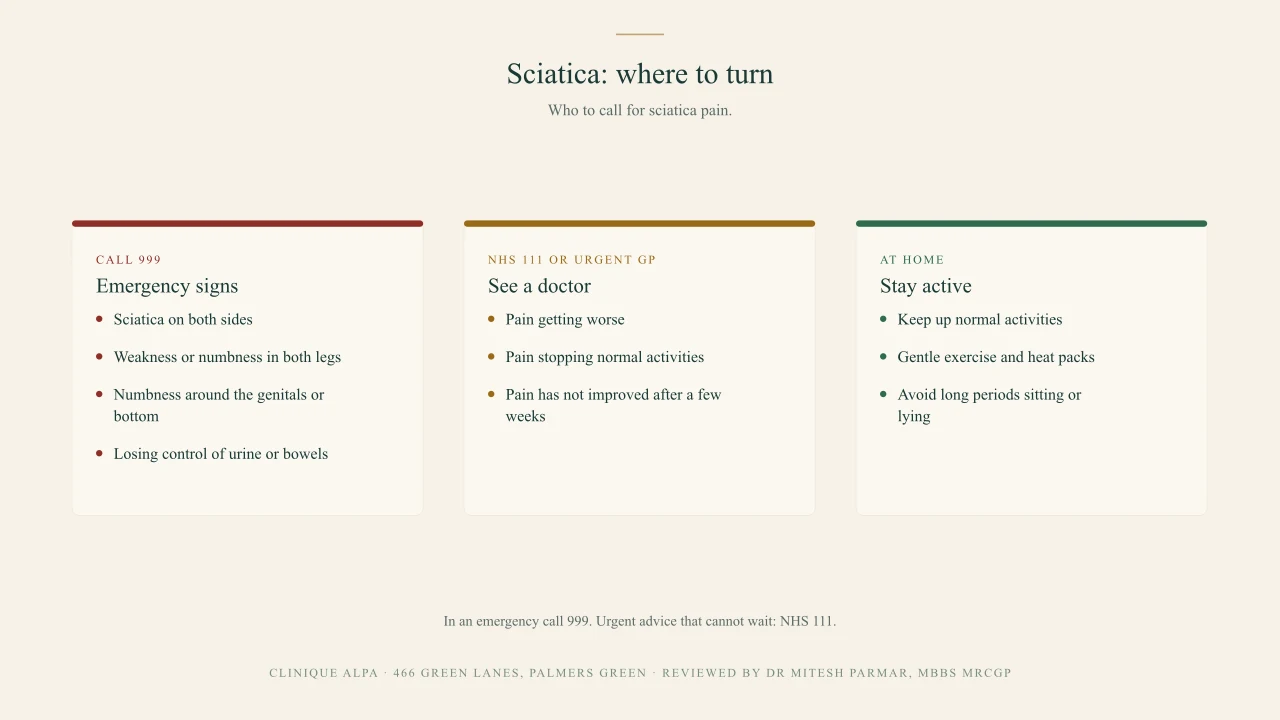
The NHS advice is to keep up normal activities as much as you can, to do gentle exercise, to avoid sitting or lying down for long periods, and to use heat packs on the painful area. It says movement may hurt but is not harmful and can speed recovery. If you are asking about the gym, that is the reference point: stay active and keep to what you can do without making the leg symptoms worse for long afterwards.
That advice is general. It is not a judgement on your particular job, and some roles cannot be adjusted by the person doing them. That is where a letter to an employer can help.
Can a letter help with adjustments at work?
GOV.UK says employers must make reasonable adjustments so that workers with disabilities or physical or mental health conditions are not substantially disadvantaged. Its examples include phased returns with flexible or part time hours, changing equipment and moving work to a different space. A letter is useful when it says which tasks to avoid, which to keep and for how long, in words a manager can act on. Letters are provided where clinically appropriate after assessment.
When should you not wait?
Call 999 or go to A&E if sciatica affects both sides, if you have severe or worsening weakness or numbness in both legs, numbness around the genitals or bottom, difficulty starting to pass urine, being unable to pass urine or losing control of it when that is not normal for you, or losing control of your bowels or not noticing the need to go. The NHS says not to drive yourself. For the full list, see sciatica red flags and the NHS page on sciatica. If the pain has not improved after a few weeks of home treatment, is getting worse or is stopping normal activities, see a doctor.
Common questions
Can sciatica stop you working?
It can limit particular tasks for a time, depending on the job and the severity. A record of what you cannot do, and for how long, is what employers and assessors need.
What does a doctor write about sciatica for work?
The pattern of pain, what provokes it, the examination findings, the treatment so far and the effect on daily tasks. A conclusion belongs to whoever decides.
Is a private medical report the same as an NHS assessment?
No. It is independent and separate from any decision body.
How do we approach this at Clinique Alpa?
You see Dr Parmar at 466 Green Lanes. A consultation is £100 for 30 minutes. If you are challenging a decision about disability benefits, see PIP mandatory reconsideration. A PIP functional and medical assessment and report is £550 and a mandatory reconsideration and tribunal report is £900. An employment or reasonable adjustments report is £495.
This is a private independent medical report. It is not a DWP assessment and it is not a guarantee of an award.
DWP does not require you to obtain new medical evidence. You can send evidence you already hold, including copies of your records. Our fee pays for an assessment and an independent opinion, not for a result.
This is an independent clinical opinion. It cannot be written to a required conclusion and does not guarantee the outcome of any claim, application, exemption or hearing.
Drafted with AI assistance, clinically reviewed by Dr Mitesh Parmar, MBBS MRCGP, Principal GP and Clinical Director at Clinique Alpa, 466 Green Lanes, Palmers Green, London N13 5PA. This article is general information, not personal medical advice. In an emergency call 999. For NHS advice call 111 or visit nhs.uk.