
People often begin with an apology. The back has been difficult for years, or the neck has been stiff on and off, and after the collision it feels as if the old history will cancel out the new pain. It does not. What it does is make the question harder, and the answer more careful.
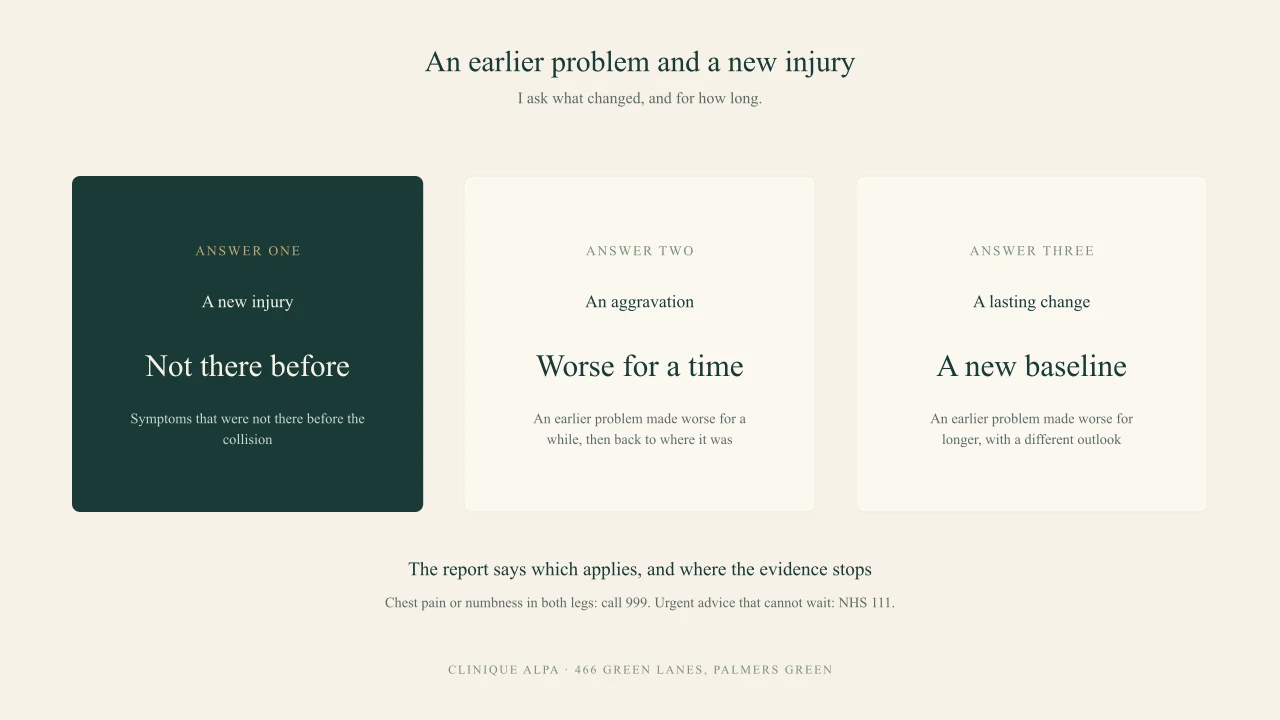
The question under every pre existing condition car accident report is the same: what changed? Did the collision cause something new, make an earlier problem worse for a while, make it worse for good, or did it simply happen at the same time as something that was already moving on its own?
Chest pain, signs of a stroke, severe breathlessness, heavy bleeding, a severe allergic reaction or symptoms of sepsis need 999 or A&E immediately. For urgent advice that cannot wait, call NHS 111.
How is a pre existing condition car accident question worked out?
I work through three questions in order. What was life like before? What happened to it afterwards? What does the evidence say about the gap?
The first question is the one people expect least. I am not looking for a medical history in the abstract. I want the baseline: how often the problem bothered you, what you could do on a good day and on a bad day, what treatment you were having, whether you were off work with it. A person with a quiet back who now cannot sit through a meal has a different story from a person whose back flared every month and has flared a little more since.
The second question is about the pattern after the collision. When did the symptoms start, and where? The NHS notes that whiplash symptoms can take several hours to appear, so a delay does not count against you. Has the pain moved, spread or changed in character? Is there anything entirely new, such as pain into an arm, a different kind of headache, or sleep that has fallen apart? New features matter more than a louder version of the old complaint.
What do I look at in clinic when the problem was there before?
The records come first. GP notes, physiotherapy entries, any earlier scans, hospital records, and the entries from the months before the collision as much as the months after. If a problem was in the notes beforehand, I say so in the report, and I say what the notes show about how bad it was. Pretending not to have seen the earlier entries is how reports come apart later, and it does the person in front of me no favours.
Then the examination. I look at how you stand, sit and move. I measure range of movement in the neck or back and watch where it stops and why: pain, stiffness or guarding. I test strength, sensation and reflexes in the arms and legs, because that tells me whether a nerve is involved, and I check the pattern of tenderness. Findings from an old problem and findings from a new injury can look alike, so I record what I find rather than what I expect to find.
Imaging is where people hope for a clear answer and rarely get one. A scan describes the structure on the day it was taken. It does not carry a date stamp for when a change happened. Wear and tear can appear on a scan in people who have never had pain, and an old scan compared with a new one is the most useful thing there is. If no earlier scan exists, I say what that means for how firmly the report can speak.
From Dr Mitesh Parmar
Earlier back or neck trouble does not cancel a new injury. I ask what you could do before the accident and what you cannot now. Old scans and GP records help me separate the two. I write it as I find it, and I cannot predict what anyone else will conclude.
Can a car accident aggravate a pre existing condition?
Yes, and the report has to say how. An aggravation can be temporary, so the problem was worse for a period and then returned to where it was. It can be longer lasting, so it took longer to settle. Or it can leave a different baseline, with a worse outlook than before. These are three different opinions, and I try to state which one the evidence supports.
For a soft tissue neck injury, the NHS says whiplash usually gets better within 2 to 3 months, though some people have symptoms for longer. With an earlier problem in the same area, recovery may take longer or may be less complete. I give a range, say what would move it either way, and say plainly when I cannot be more precise.
What does prognosis look like when there was a problem before?
Honest, and sometimes cautious. When the history is complicated, I will often say that a firm prognosis needs a specialist's input, usually from a spinal or orthopaedic doctor who can read the imaging and examine for things a GP cannot judge. A report that names the limits of what a GP can say is more useful than one that stretches.
I would rather say that I do not know yet, and name what would tell us, than give a confident figure that cannot be supported.
When should you not wait for a report?
A report is never a substitute for care. Get help first if any of these apply, and let the paperwork follow.
- Pain, tingling, weakness or numbness in both legs, loss of feeling around the genitals or anus, or new difficulty controlling your bladder or bowels: call 999 or go to A&E. The NHS lists these among the signs that need emergency help for back pain, including pain that started after a serious accident.
- Tingling or pins and needles on one or both sides of the body, weakness in the hands, arms or legs, or severe pain despite painkillers: ask for an urgent GP appointment or call NHS 111.
- Fever, feeling shivery or generally unwell with back pain: ask for an urgent GP appointment or call NHS 111.
- Pain that is steadily worsening, or has not improved after a few weeks: a routine GP or clinic appointment, so the problem is treated and not only documented.
Common questions
Does a pre existing condition before a car accident mean there is no new injury?
No. An earlier condition tells me where you started, not where you ended up. The report compares the two.
Can a pre existing condition made worse by a car accident still be reported on?
Yes. The report describes the earlier state, the change, and how long the change is likely to last, with the reasons.
How do we approach this at Clinique Alpa?
I read the records before I see you, so the appointment is spent on you and not on summarising paperwork. I examine you at Palmers Green, and where travel is the difficulty, a home visit assessment can be arranged. The scope and a written fee estimate are agreed before any work begins. Reports are usually ready 48 to 72 hours after the assessment and after all records and instructions are in, and complex ones may need longer, which I state at the outset.
For the wider process, see what a medico legal report is and what it owes to the court, and the fees are on medical report fees. If you simply want a doctor to look at the pain, a clinic appointment is the quicker route.
This is an independent clinical opinion. It cannot be written to a required conclusion and does not guarantee the outcome of any claim, application, exemption or hearing.
All medico-legal assessments and expert reports are independent professional opinions. No particular diagnosis, conclusion, causation opinion, prognosis, consistency assessment, recommendation or outcome can be promised or guaranteed.
Drafted with AI assistance, clinically reviewed by Dr Mitesh Parmar, MBBS MRCGP, Principal GP and Clinical Director at Clinique Alpa, 466 Green Lanes, Palmers Green, London N13 5PA. This article is general information, not personal medical advice. In an emergency call 999. For NHS advice call 111 or visit nhs.uk.