
The stairs are the first problem. Then the lift that is out of order, the taxi that cannot park close enough, and the long wait in a waiting room with a leg that will not bend. By the time an appointment is made, the thought has usually been in someone's mind for weeks: could the doctor not come to us?
The answer is often yes. A medical examination at home can be arranged after an injury, and for some people it is the only realistic way to be properly assessed. What matters is knowing what it can do and what it cannot.
Chest pain, signs of a stroke, severe breathlessness, heavy bleeding, a severe allergic reaction or symptoms of sepsis need 999 or A&E immediately. For urgent advice that cannot wait, call NHS 111.
Can a medical examination at home replace a clinic assessment?
For many injuries, yes. The history is the same, whether you tell it at your own table or in a consulting room. Much of the examination is the same too: how you move, where it hurts, the strength in your limbs, the feeling in your skin, how you stand and how you manage a transfer from chair to bed.
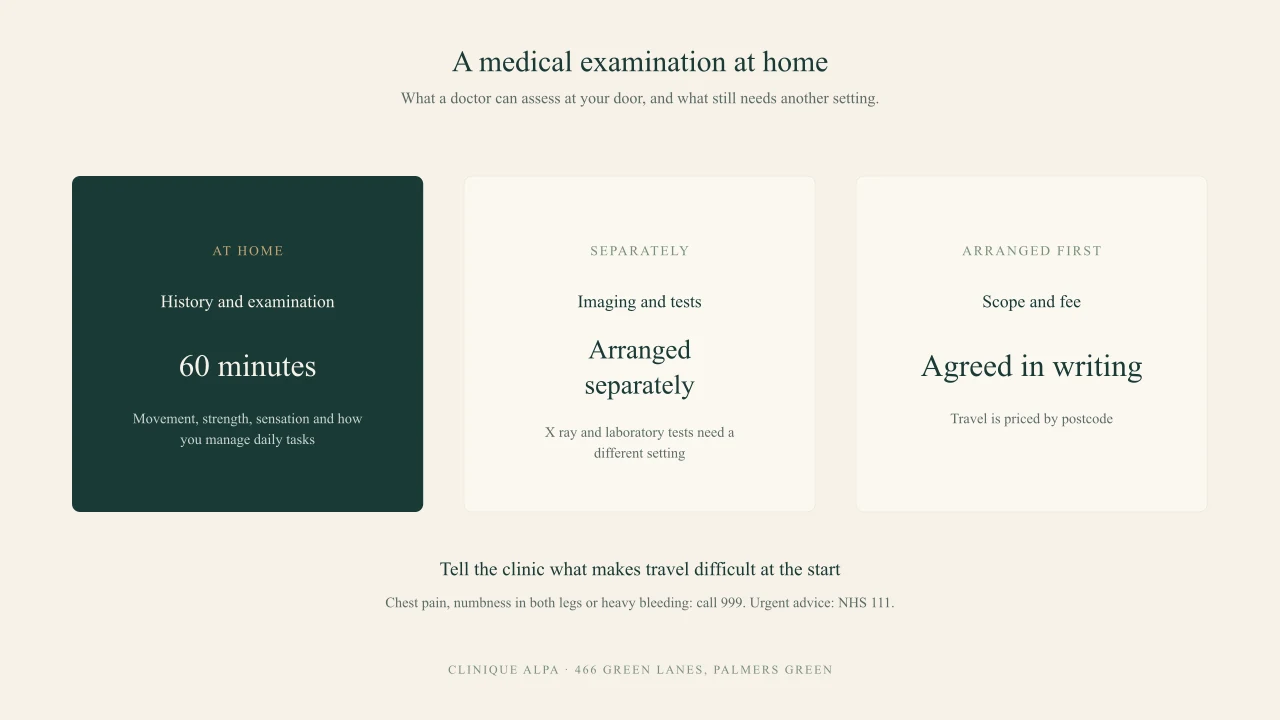
Where it is not the same is equipment. Imaging cannot be done at the door. Anything that needs a scanner, an X ray or a laboratory needs to be arranged separately, and I say so before I come. For a person who cannot travel, I explain what I am able to conclude from an examination at home and what a report would need to say about what I could not examine. That honesty is part of the report, not a weakness in it.
What do I look at when I assess someone at home?
I begin as I would at the clinic. The history, in your words, in the order you tell it, with your records beside us. What happened, what treatment you have had, what has changed since, and what each day looks like now.
Then the examination. I watch how you get up, how you walk or move with a frame, crutches or wheelchair, and what it costs you. I measure range of movement, test strength and sensation, and check circulation, and I compare the injured side with the uninjured side. If a limb is swollen or has lost muscle, I measure it.
What a home visit gives me that a clinic does not is the setting. I can see the stairs you cannot climb, the bed you cannot get out of easily, the bathroom you manage by holding on, and where you have moved the things you used to reach. That is real evidence about daily function, and it is more persuasive than a list of tasks you say are difficult. I take care to describe what I observe separately from what I am told.
I ask who helps you and how. I also ask how things have been in your spirits, in a quiet and ordinary way, because people who cannot leave the house often feel it. If low mood or worry is a problem, I note it and suggest the right route, which is not usually something to settle in the same visit.
Safety comes first. If the history suggests something that cannot wait, I will say so and arrange the right route, whether that is your GP, NHS 111 or an ambulance. The NHS lists, for example, pain, tingling, weakness or numbness in both legs, loss of feeling around the genitals or anus, and changes in bladder or bowel control as reasons to call 999, as well as back pain that started after a serious accident. A broken ankle with toes that look blue or white or feel numb is on the same urgent list. These are not things to wait for a visit about.
From Dr Mitesh Parmar
A home examination suits you when travel is hard, but it has limits. I can examine you, measure movement and take a full history, though an X-ray or scan still needs a department. For a report, I describe what I see in your own surroundings, such as stairs and bathroom. Severe pain, deformity or numbness needs A&E.
Who is a medical examination at home suited to?
People for whom getting to a clinic would be hard, painful or unsafe. That includes those recovering from surgery or a fracture, people who use a wheelchair or a frame, those with a long term condition that makes travel exhausting, and carers who cannot leave the person they look after. If you are unsure, tell us what makes travel difficult and we will say honestly whether a home visit is the right route.
It is not suited to everything. If I think you need an examination or test that cannot be done at your door, I will tell you, and we will plan it so that the trip is made once and is worthwhile.
How does a home visit assessment work for a report?
If you want a report for a personal injury case, the assessment follows the same steps as in the clinic: I read the records first, take a history, examine you and write an independent opinion. The medico legal service confirms that a home visit assessment can be arranged where attending the clinic is difficult. The scope and a written fee estimate are agreed before any work begins.
If you want a doctor to see you for the injury itself, not a report, a home visit is a 60 minute consultation: from £250 on a weekday, from £325 at weekends and bank holidays, and from £450 for an evening start, with travel priced by postcode. Home visits are subject to availability.
Common questions
Can a doctor do a medical checkup at home?
Yes, a doctor can see you at home for a 60 minute consultation. What can be examined depends on what you need, and some things, such as imaging, need another setting.
Is a medical test at home the same as a medical examination at home?
Not necessarily. An examination is the doctor assessing you. A test, such as imaging, is done separately and may need a different place.
Can the report be as thorough if I am assessed at home?
Yes, for what can be examined. The report states what was and was not examined, and why.
How do we approach this at Clinique Alpa?
I read the records before the visit, and I ask what you most want to be able to do again. I tell you in advance what I will examine and what I will not. The visit lasts as long as it needs to for the history and examination, and a home visit consultation is booked as 60 minutes. Afterwards, with your consent, a summary can go to your NHS GP.
For the home visit service itself, see home visits. For the report side, see what a medico legal report is and what it owes to the court, and the fees on medical report fees. If you can travel and want a doctor, a clinic appointment is simpler.
This is an independent clinical opinion. It cannot be written to a required conclusion and does not guarantee the outcome of any claim, application, exemption or hearing.
All medico-legal assessments and expert reports are independent professional opinions. No particular diagnosis, conclusion, causation opinion, prognosis, consistency assessment, recommendation or outcome can be promised or guaranteed.
Drafted with AI assistance, clinically reviewed by Dr Mitesh Parmar, MBBS MRCGP, Principal GP and Clinical Director at Clinique Alpa, 466 Green Lanes, Palmers Green, London N13 5PA. This article is general information, not personal medical advice. In an emergency call 999. For NHS advice call 111 or visit nhs.uk.