
Getting into the bath has become the part of the day everyone in the house plans around. A rail has been fixed in one place and a stool bought for another, each after a bad moment rather than before it. Nobody is sure whether any of it is the right equipment, or what to ask for next.
That is the question behind a home adaptations assessment: how do you move from an everyday struggle to a clear list of what would make the home safe and manageable? For people living with long term pain, I will explain how a clinical assessment feeds into that, and where it stops.
Chest pain, signs of a stroke, severe breathlessness, heavy bleeding, a severe allergic reaction or symptoms of sepsis need 999 or A&E immediately. For urgent advice that cannot wait, call NHS 111.
What is a home adaptations assessment?
It is an assessment of how a person manages in their own home, and of which changes would make daily tasks safer or easier. The NHS says a council care needs assessment can lead to a separate assessment for home adaptations, and that the council staff who carry out needs assessments include social workers and occupational therapists.
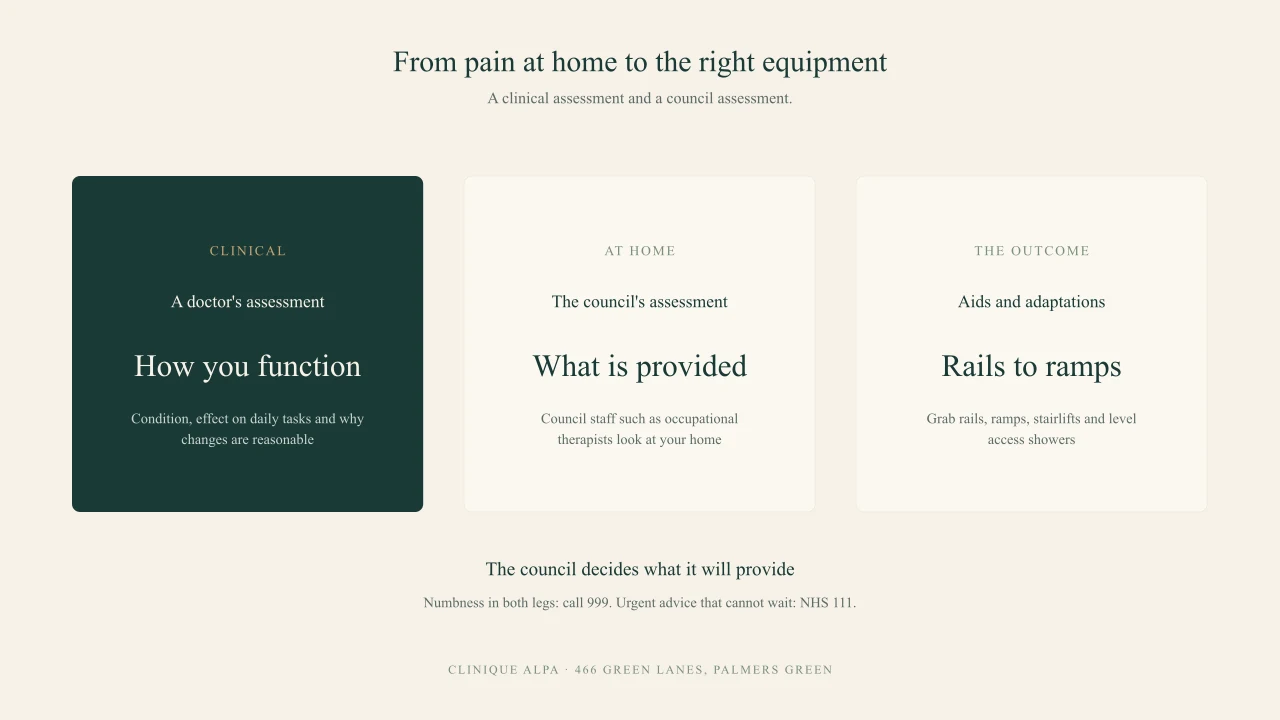
So there are two kinds of assessment, and it helps to keep them apart. The council's assessor looks at the home and decides what the council will provide. A doctor's assessment is clinical: it describes the condition, what it does to function, why particular aids are medically reasonable and what could go wrong without them. The first often rests on the second. If you want the longer clinical picture behind a request, see my piece on the functional assessment report. For a shorter statement, see disability supporting letters.
What do I look at when pain limits the home?
Chronic pain is rarely the same all day. It builds with effort, eases with rest and is often worst at the points where the body has to change position: getting out of bed, standing from the toilet, stepping over the side of a bath, climbing the stairs at night. So I ask about the day in order, room by room, and I ask what happens at each transition.
When this comes up in consultation, there is usually a pattern of wear in the joints, a spine that stiffens and hurts, or hands that have lost grip and feeling, and often more than one of these together. The home was arranged for a body that worked differently. I look for the mismatch.
I ask about the bathroom first, because it is where most of the risk sits. Can you get in and out of the bath or shower, and how? Is the toilet too low to rise from? What do you hold when you stand? Then the bedroom and the stairs. Then the kitchen, where the questions are about reaching, lifting a full kettle, turning taps and opening packets. Hands matter more than people expect. If a person cannot open the containers their medicines come in, that is a safety problem and an adaptation problem at once.
Then the examination. I watch how you rise from a chair without using your arms and then with them. I watch you walk, turn and step. I test grip and the movement of the affected joints, balance, and strength in the legs. I note the points where pain stops you. I review your medicines too, because some treatments for pain bring drowsiness or dizziness, and that changes how risky a step becomes. I ask about falls, near falls and whether you have started to avoid certain rooms.
I also ask who helps and with what. Equipment is meant to reduce the amount of help needed, or to make that help safer for the person giving it. That works in both directions, and the report should say so.
From Dr Mitesh Parmar
Show me, not just tell me, how you get in and out of the bath, up the stairs and out of a chair. Pain is often worst at certain points, and equipment should address those. Reports work best when they match each problem to the particular item needed.
What kinds of aids and adaptations are there?
The range is wide. GOV.UK lists changes funded through a Disabled Facilities Grant such as wider doors, ramps, grab rails, stairlifts, level access showers, a downstairs bedroom and easier to use heating or lighting controls. Smaller items sit beside those, such as a raised toilet seat or a perching stool. What suits you depends on what the assessment finds, and the right answer is sometimes a small change that costs very little.
GOV.UK describes the grant as coming from your local council, and says it does not affect any benefits you receive. Who decides, and on what test, is the council's matter. I cannot say whether you will qualify, and no doctor can promise it.
What is a home modifications assessment, and is it different?
The phrase is used interchangeably with home adaptations assessment in most places, and the idea is the same: someone qualified looks at what you do at home and recommends changes. If you are asked to arrange one, ask the person who requested it what they will accept as evidence and who normally carries it out. A letter from me does not replace the council's own visit.
When should you not wait?
Equipment solves a known, steady problem. A sudden change is different. The NHS lists numbness around the genitals or bottom, difficulty controlling the bladder or bowel, and weakness or numbness in both legs as reasons to call 999 or go to A&E, and says not to drive yourself. A fall with an injury, or a sharp change in what you can manage, needs a doctor promptly. NHS 111 can advise if you are not sure how urgent it is. Adaptations can wait a week. These cannot. The NHS has more on sciatica and when to seek help.
Common questions
Can a GP letter help with a home adaptations assessment?
Yes, where clinically appropriate after assessment. It describes the condition, the effect on daily tasks and why particular changes are reasonable. It supports the application. It does not decide it.
Does a home adaptations assessment cost anything?
The council's needs assessment is free, according to the NHS. A private clinical assessment and letter are separate and are quoted before any work begins.
Should the assessment be done at home?
A home visit lets me see the bathroom and stairs myself, which is valuable when the question is about the building. It is assessed for suitability first.
How do we approach this at Clinique Alpa?
You see Dr Parmar at 466 Green Lanes, or at home if getting here is part of the problem. A home visit lasts 60 minutes and is from £250 on a weekday, from £325 at weekends and bank holidays and from £450 for an evening start, with travel priced by postcode. A clinic consultation is £100 for 30 minutes. Any letter or report is provided where clinically appropriate after assessment, and I give the fee for written work before I start. See medical report fees for how it is priced.
This is an independent clinical opinion. It cannot be written to a required conclusion and does not guarantee the outcome of any claim, application, exemption or hearing.
Drafted with AI assistance, clinically reviewed by Dr Mitesh Parmar, MBBS MRCGP, Principal GP and Clinical Director at Clinique Alpa, 466 Green Lanes, Palmers Green, London N13 5PA. This article is general information, not personal medical advice. In an emergency call 999. For NHS advice call 111 or visit nhs.uk.