
The council has asked for something that describes how a person manages at home, and the family has nothing that does. There is a list of diagnoses and a list of medicines, but no page that says who helps with washing, whether the stairs are safe or what happens in the night. A functional assessment report is that page.
The plain question is what a functional assessment report for care needs contains, who reads it and how a doctor gets to it. This is how I approach it.
Chest pain, signs of a stroke, severe breathlessness, heavy bleeding, a severe allergic reaction or symptoms of sepsis need 999 or A&E immediately. For urgent advice that cannot wait, call NHS 111.
What is a functional assessment report?
It is a written account of what a person can do, what they can do only with help or prompting, and what they cannot do, across the tasks that make up an ordinary day. It is about function, not labels. A diagnosis explains why something is hard. The report says what happens as a result.
The people who read it are rarely doctors. A council assessor, a care provider planning visits, an insurer or a family trying to agree who does what all want the same thing: a clear, honest picture they can act on. A report that names a condition and stops gives them nothing to act on. If you only need a shorter statement of impact, see disability supporting letters. The report is the longer document, with the detail behind each task.
What does a functional assessment report cover?
The headings are usually the same, whatever the condition:
- Moving around indoors and outdoors, including stairs, steps and uneven ground.
- Getting up from a bed, a chair and a toilet.
- Washing, bathing and dressing.
- Using the toilet and managing continence.
- Preparing food, eating and drinking.
- Taking medicines correctly and on time.
- Understanding, remembering and making decisions.
- Mood, motivation and sleep.
- Safety at home, including falls and being alone.
- Who helps now, how often and how long it takes.
Not every heading matters for every person. The skill is in giving the weight to the ones that do, and saying plainly when something is fine.
What do I look at in the assessment?
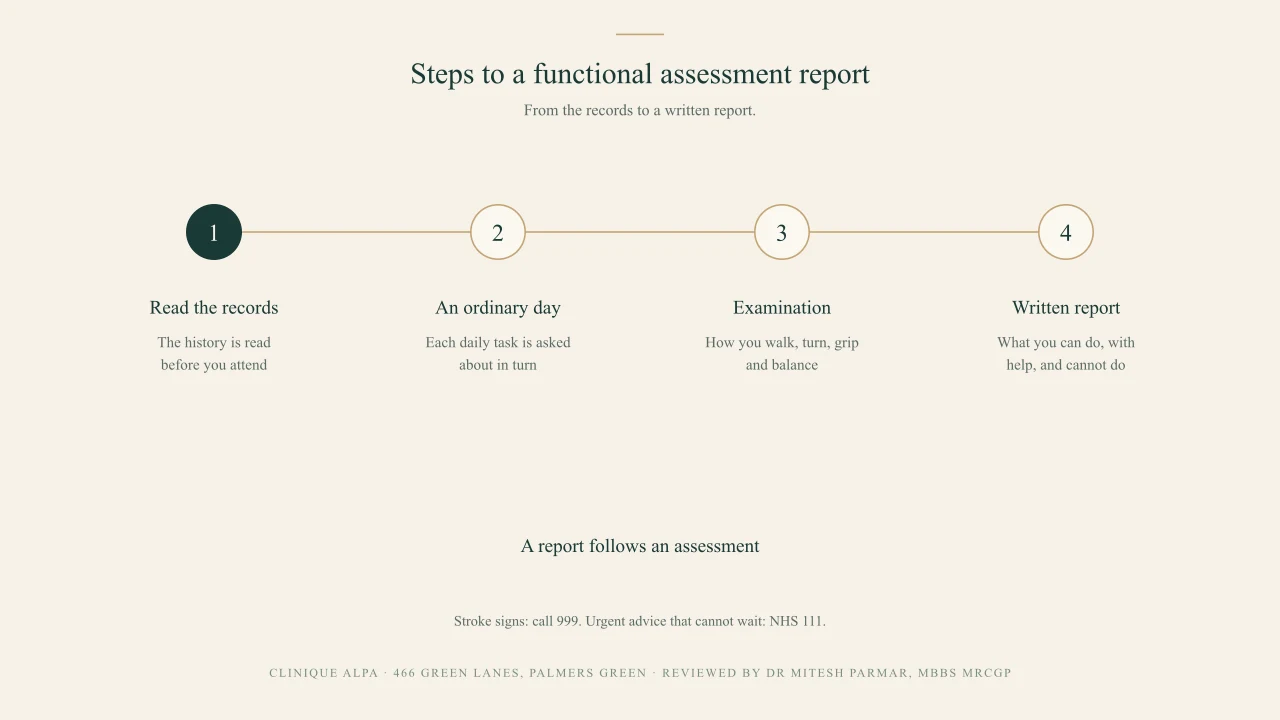
I read the records first, so the appointment is not spent on history that is already written down. Then I ask the person to describe an ordinary day from waking to bed, in their own words. A typical day, not a good one. When this comes up in consultation, the person living with the difficulty often understates it, and the person who helps most describes it more exactly. I ask both, separately where I can, and I record where the two accounts differ.
For each task I ask the same few questions. Can it be done at all? Can it be done safely? Can it be done in a reasonable time, and repeatedly, without becoming exhausting or painful? Needing a reminder, needing a second person, needing a rest halfway through: each of those is a different answer, and a report that turns them all into "needs help" loses the detail that matters.
Then I look. How someone stands up from a low chair. How they walk across the room, turn, and step up. Whether they can grip, twist a lid, button a cuff or hold a cup. Balance with the eyes open and with a small push of attention elsewhere. Joint movement and pain on movement. Breathlessness on a short walk. Where memory or thinking is part of the picture, a brief check of both, to put numbers beside my impression.
I review the medicines, including what is taken for pain and what causes drowsiness or dizziness, because the side effects of a treatment can limit function as much as the condition does. I ask about mood, because low mood changes what people attempt. And I ask about the home: bathroom, steps, lighting, who else is in the house during the day.
Throughout, a chaperone is available whenever an intimate or physical examination is needed.
From Dr Mitesh Parmar
The best report is built on what I see and what the person and carers tell me, not on a diagnosis list. I ask about a typical bad day and a typical good day. The more precise the detail on washing, dressing, eating and getting about, the more useful the report is to the reader.
Is there a functional assessment report form?
There is no single national form. A council, an insurer or a care provider will sometimes send its own questions. If one has been sent to you, bring it. I answer those questions in the order they are asked, and add anything the form leaves out but the reader would need. Where there is no form, I use the headings above.
How does it fit with a care needs assessment?
They are different documents. The NHS explains that a care needs assessment is a free assessment by your local council, done by staff such as a social worker or occupational therapist, to find out whether you need help with day to day tasks such as washing, dressing and cooking. The NHS also says anyone can ask for one, and that it can lead to a separate assessment for home adaptations.
My report does not replace that assessment and cannot decide what the council offers. What it can do is give the assessor a clinical description to read beside their own. People tell me it also helps them describe their difficulties more precisely at the council's visit, because the report has already put the tasks in order.
When should you not wait for a report?
A functional report describes a settled pattern. A sudden change is a medical problem first. Sudden weakness on one side, a drooping face or difficulty with speech needs 999, as the NHS describes in its stroke signs. A fall with injury, new confusion or a rapid drop in what someone can manage needs a doctor soon, and NHS 111 can advise if you are unsure how quickly. Book the report once the change has been looked at, because a description written during a crisis is not a description of the usual picture.
Common questions
Does a functional assessment report decide what care I get?
No. It describes what you can and cannot do. The decision about services belongs to whoever you are asking, and I cannot promise how they will use it.
Who can ask for a functional assessment report?
The person themselves, a family member helping them, or a professional. If someone else is arranging it, I still need to see the person, because the report rests on assessment.
Can the report be written without seeing me?
A description of function needs someone to have seen it, so the report follows an assessment, with the records read beforehand.
How do we approach this at Clinique Alpa?
You see Dr Parmar at Palmers Green. Where travelling is the difficulty, ask about a home visit, which is assessed for suitability first. The fee depends on the length and detail the reader needs, and I give it in writing before any work begins. The usual turnaround is 48 to 72 hours after the assessment and after all records and instructions are in, and a complex report may need longer. If a short letter will do, one to two pages is £250. Fees for longer work are on medical report fees. A letter or report is provided where clinically appropriate after assessment.
This is an independent clinical opinion. It cannot be written to a required conclusion and does not guarantee the outcome of any claim, application, exemption or hearing.
Drafted with AI assistance, clinically reviewed by Dr Mitesh Parmar, MBBS MRCGP, Principal GP and Clinical Director at Clinique Alpa, 466 Green Lanes, Palmers Green, London N13 5PA. This article is general information, not personal medical advice. In an emergency call 999. For NHS advice call 111 or visit nhs.uk.