
The course team has said the student would benefit from adjustments, and the disability service wants something from a doctor before it can arrange them. The student has no idea whether that means an extension letter, a diagnosis or a letter of a different kind altogether. They have an appointment with the support team coming up and a half formed idea that medical evidence is the key.
This is a different request from an extension. The question is what a medical letter for university learning support can include, and what it cannot, so that the right letter is written in the first place.
Chest pain, signs of a stroke, severe breathlessness, heavy bleeding, a severe allergic reaction or symptoms of sepsis need 999 or A&E immediately. For urgent advice that cannot wait, call NHS 111.
What is a medical letter for university learning support?
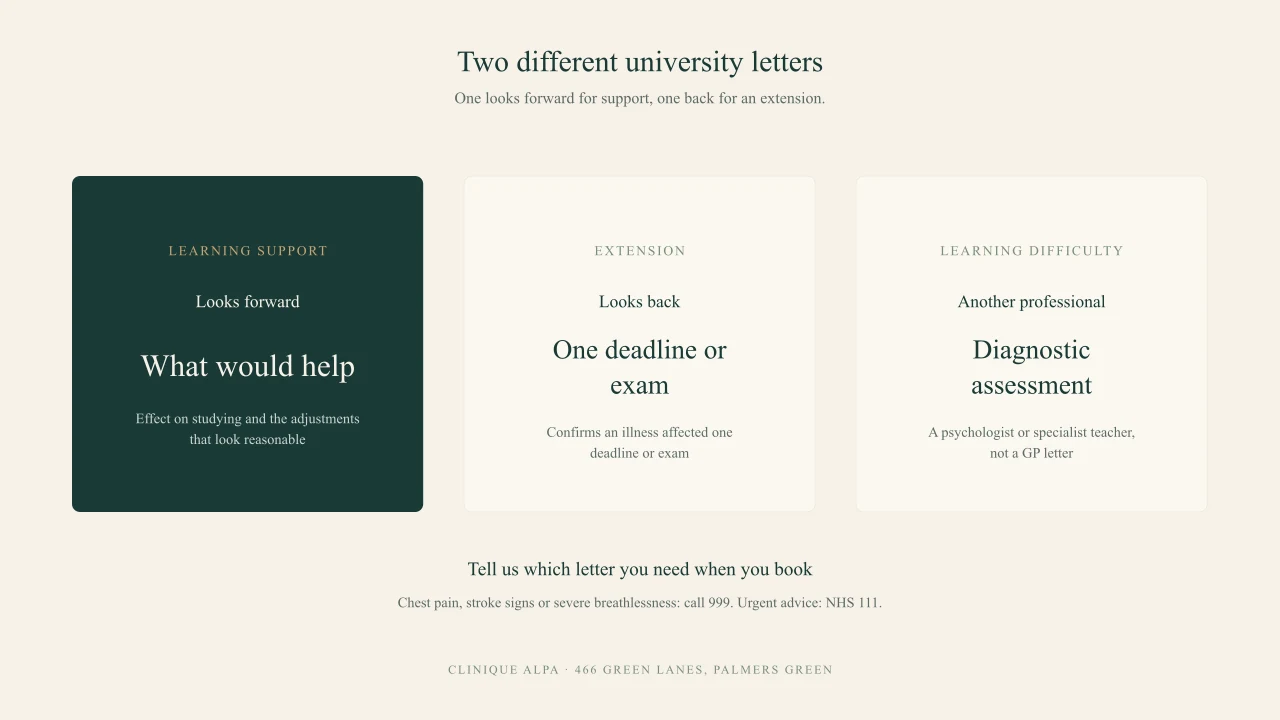
A medical letter for learning support describes a long term health condition or difficulty and its effect on studying, so that the university can put adjustments in place. It looks forward. It says what the condition does to attendance, concentration, reading, writing, working at a screen, sitting through exams or managing a workload, and what would help.
An extension or mitigating circumstances letter looks back. It confirms that an illness affected a particular deadline or exam, and it has to be written close to the time. If that is your need, my piece on a GP letter for university covers it. The two letters are not interchangeable, and sending the wrong one costs time.
What do I look at before writing the letter?
First, what the university has actually asked for. The disability service usually has a form or a list. I would rather work to it than to my own guess, and I would rather see it before the appointment than hear about it afterwards. If the request is for a diagnosis that belongs to another profession, I need to know that early.
Then your history. When this comes up in consultation, the difficulty is often not a single condition. It may be a medical problem that interrupted studies, a long term physical illness, a difficulty that has always made some kinds of work harder than they should be, or a combination. I ask when it began, how it has changed, and which parts of study it touches. I ask about concentration, distraction, memory, fatigue, pain, sleep, vision, hearing, hand function and anything that makes screens or long periods of sitting hard. I ask what you do already to cope, and where that stops working.
I ask how it showed up in the work itself: missed classes, incomplete assignments, taking longer to retain information, struggling in exam conditions, finding one format of teaching easier than another. A person may study better on paper than on a computer, or better with written instructions than spoken ones. That is useful, specific information, and it is the sort of detail a university can turn into an adjustment.
I read what you bring, such as letters from other specialists or hospital correspondence, because they are better evidence than recollection. If you have been seen by other teams, their findings belong in the picture, and I say whose findings they are.
I examine only where an examination bears on the question. A letter about fatigue or pain may need one. A letter about a long standing learning difficulty may need none. I do not guess at a diagnosis. If your difficulty needs a formal assessment I cannot give, I will say so and tell you who does it.
That last point matters. GOV.UK says that for Disabled Students' Allowance, a specific learning difficulty needs a diagnostic assessment from a practitioner psychologist or a suitably qualified specialist teacher. A GP letter cannot stand in for that.
From Dr Mitesh Parmar
Ask the disability service exactly what it wants before booking, because a short letter and a full assessment are different pieces of work. I describe the condition, how it affects study, and which adjustments seem reasonable. I do not decide the outcome, because the university does that on its own terms.
What can a GP letter include?
Where I have assessed you, and where clinically appropriate after assessment, a letter can include:
- The condition or difficulty, in the level of detail you agree to share.
- How long it has been present and whether it is expected to continue.
- The effect on attendance, reading, writing, concentration, stamina or sitting exams.
- Treatment so far, and any limits it places on study.
- The adjustments that look reasonable, such as extra time, breaks, an alternative format or allowances for attendance.
- A review date, because needs change.
It does not decide what the university provides. It gives the support team clinical grounds to act on.
What does the Disabled Students' Allowance need?
GOV.UK says Disabled Students' Allowance is for students in England with a disability that affects study, including long term health conditions and mental health conditions. For physical, sensory, long term health and mental health conditions it asks for a report or letter from a doctor or medical professional explaining how the condition has a substantial and long term effect on day to day activities. For a specific learning difficulty it asks for a diagnostic assessment from a practitioner psychologist or a qualified specialist teacher. The allowance can help with specialist equipment and non medical helpers, and the page says not to buy equipment until you have been assessed, because you will not be reimbursed. Check the current rules on GOV.UK before you rely on them, and I cannot say whether you will qualify.
Is it a medical letter for college or for leave?
The same principles apply at a college, though the forms differ. A letter for a period away from study, sometimes called a medical leave letter, has a different job again: it confirms the dates of an illness and that it prevented study. Tell us which you need when you book, because it changes what I write.
Common questions
Can I get a medical letter from a GP for university?
Yes, from a doctor who has assessed you, where clinically appropriate. Your university decides what it will accept, so check its requirements first.
How long does the letter take?
It depends on what is needed and when the records are in. Tell us your deadline when you book, and we will tell you honestly whether the diary can meet it.
Is this the same as a letter about a mental health condition?
It can cover one, if a doctor has assessed you for it. If you are in distress, call NHS 111 and choose the mental health option, or Samaritans free on 116 123, any hour.
How do we approach this at Clinique Alpa?
You see Dr Parmar at 466 Green Lanes for 30 minutes, for £100. A letter of one to two pages for university is £250. You can send the university's requirements first. Letters are provided where clinically appropriate after assessment, with a summary to your NHS GP if you consent. For other letters, see medical letters.
This is an independent clinical opinion. It cannot be written to a required conclusion and does not guarantee the outcome of any claim, application, exemption or hearing.
Drafted with AI assistance, clinically reviewed by Dr Mitesh Parmar, MBBS MRCGP, Principal GP and Clinical Director at Clinique Alpa, 466 Green Lanes, Palmers Green, London N13 5PA. This article is general information, not personal medical advice. In an emergency call 999. For NHS advice call 111 or visit nhs.uk.