
Reading and writing have always been the hard part. Forms are handed to someone else, instructions are learned by listening, and a test that most people prepare for with a booklet is simply out of reach. When a formal requirement asks for evidence of English or knowledge of life in the UK, that long history has to be put into words a decision maker can read.
That is the job of the medical evidence for a learning disability exemption. This article explains what a doctor documents, what the evidence is for, and what it cannot do.
Chest pain, signs of a stroke, severe breathlessness, heavy bleeding, a severe allergic reaction or symptoms of sepsis need 999 or A&E immediately. For urgent advice that cannot wait, call NHS 111.
What is medical evidence for a learning disability exemption?
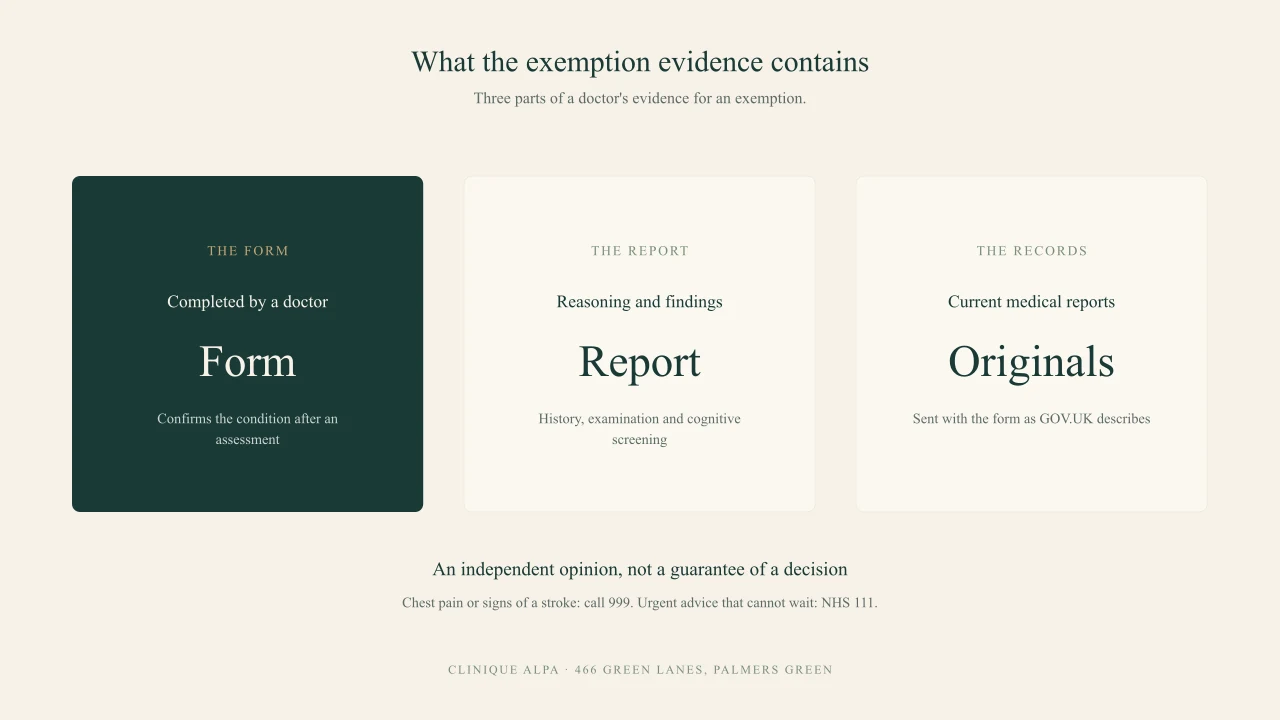
GOV.UK says that you do not need to prove your knowledge of English if you are unable to because of a long term physical or mental condition. To claim the exemption, you must send a completed exemption form from a doctor confirming the condition, with original copies of current relevant medical reports. The Life in the UK test and English language exemption applies at settlement and citizenship, and it must be sent again at the citizenship stage.
So the evidence is a pairing: the doctor's completed form, and a report that explains the condition and its effect. The form is short. The report is where the reasoning lives. It is independent, and it cannot be written to a required conclusion.
If you want the wider picture of the exemption itself, see the Life in the UK test medical exemption, and for other immigration documents immigration medical letters, which are provided where clinically appropriate after assessment.
What does a doctor document?
NHS information describes a learning disability as something that affects how a person learns new things throughout life, and says it is different for everyone. Some people find it hard to understand complex information or learn certain skills, while others work, form relationships and gain qualifications. That range is why one line on a form is never enough.
The report records four layers. The condition itself, and how and when it was identified. Where it was identified in childhood, what the records or other professionals say. The lifelong pattern: learning at school, reading and writing, understanding spoken and written instructions, and how the person manages everyday paperwork. And the present position: what can be done now, with what help, and what cannot be done at all.
What do I look at in clinic?
The assessment is face to face and includes structured cognitive screening. I do not rely on the screening alone, because it measures one moment. I use it with the history, the examination and any documents that exist.
I begin with the story of learning. When difficulty was first noticed, what school was like, what support was offered, whether anyone ever assessed it. Many adults have no paperwork from childhood, and that is not a reason to dismiss the account. It is a reason to look for other evidence: older records, anything an employer or a course provider wrote, or a statement from someone who has known the person for years and has seen how they manage.
Then I ask about everyday function, and I ask for examples rather than opinions. How a letter is dealt with when it arrives. What happens with a form at a bank or a doctor's surgery. How a bus route is learned, whether numbers and money are handled, who helps and in what way. I am looking for consistency between what is said and what I observe in the room: the way instructions are understood, how questions are answered, and what happens when I ask someone to read a short passage or write a sentence.
I check physical and mental health at the same time. Hearing, vision, mood, anxiety and memory can each make reading and understanding harder, and they can be treated or supported. A report that attributes everything to one cause when there are several is not helpful. It is also common for people to be unsure of the dates of their own history, so I write approximate dates and say they are approximate.
Sometimes the honest finding is that the evidence does not support an exemption. The person may manage reading and writing better than they expected, or there may be another route, such as extra preparation. I say so. A report that is written to fit a requirement is worthless, and it can cause serious trouble for the person who relies on it.
From Dr Mitesh Parmar
I rely on records as much as the consultation: school reports, statements, previous assessments and any support at work. A diagnosis alone is not usually enough. What the decision maker wants is how the condition affects the person's learning and daily life. Bring everything, even if it feels old.
Which learning disability conditions can a report cover?
The report covers whatever the assessment finds. The NHS lists causes that include problems with brain development before birth, during delivery or in early childhood, and it notes that causes are not always known. Down's syndrome is associated with a learning disability. A report does not need the cause to be known. It needs a clear description of what the person can and cannot do, and why the doctor thinks so.
What if support from family or others covers the gap?
It often does, and people can be reluctant to say how much they depend on others. I record who helps and with what. That is not a weakness in the evidence. It is the evidence.
When should you get help sooner?
An application deadline is never a reason to delay treatment for anything urgent. Call 999 for chest pain, signs of a stroke or severe breathlessness. Call NHS 111 for problems that cannot wait. If distress or low mood is overwhelming, Samaritans is free on 116 123 at any hour.
Common questions
Does a learning disability always qualify for an exemption?
No. It depends on what the evidence shows about the condition and its effect on reading, writing and understanding. The Home Office decides.
Can the doctor complete the exemption form without a report?
The form must be completed by a doctor who has assessed you, and GOV.UK says current relevant medical reports are sent with it.
Do I need a childhood diagnosis?
It helps, but many adults do not have one. A doctor can look at other records and the pattern of a lifetime.
How do we approach this at Clinique Alpa?
Assessments are in person at Palmers Green, and a home visit examination can be arranged. Dr Mitesh Parmar sees you for the assessment, reads the records you bring and explains plainly what he will write before he writes it. Form completion is £180 and a full report is £550. Reports are usually ready 48 to 72 hours after the assessment and after all records are in.
This is an independent clinical opinion. It cannot be written to a required conclusion and does not guarantee the outcome of any claim, application, exemption or hearing.
Drafted with AI assistance, clinically reviewed by Dr Mitesh Parmar, MBBS MRCGP, Principal GP and Clinical Director at Clinique Alpa, 466 Green Lanes, Palmers Green, London N13 5PA. This article is general information, not personal medical advice. In an emergency call 999. For NHS advice call 111 or visit nhs.uk.